


Helpful advice: Some drivers, trying to wear out the parking brake cables less, try to use them less often. Such "savings" lead to the opposite result: the cables, rarely moving in the casings, gradually lose mobility, eventually jam and break. Use the parking brake in all cases when it is necessary.
You will need: tools necessary for removing the brake disc
You will need: the tools needed to remove the brake disc (see "Replacing the brake disc of the rear wheel brake mechanism"), brake pads of the rear wheel (see "Replacing the brake pads of the rear wheel brake mechanism") and the lining of the body floor tunnel (see "Removal and installation the floor tunnel lining").
1. Disconnect the wire from the negative terminal of the battery.
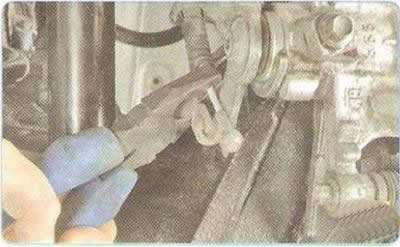
2. Remove the rear end of the parking brake cable from the rear brake lever.
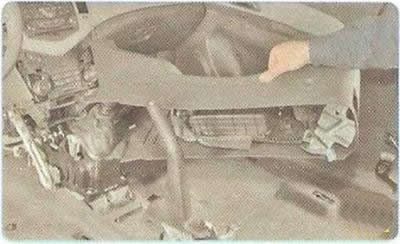
3. Remove the rear section of the floor tunnel trim (see "Removal and installation the floor tunnel lining").
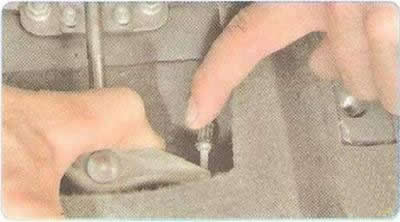
4. Disconnect the front end of the brake cable from the equalizer.
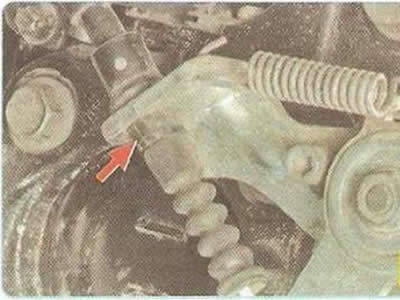
5. Press the parking brake cable housing clips and remove it from the bracket.
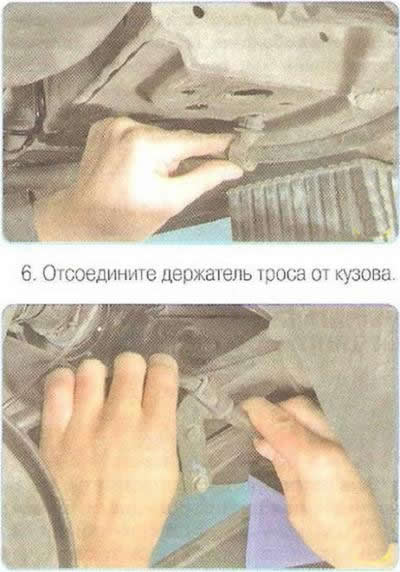
7. Remove the cable from the bracket on the rear suspension beam arm.
8. Using a screwdriver, pry...
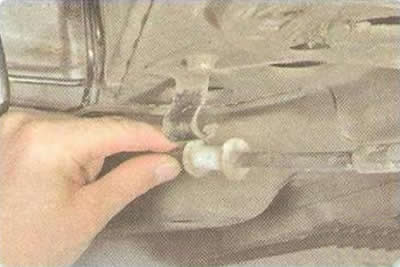
9. ... remove the cable sheath retainer from the bracket on the vehicle body.
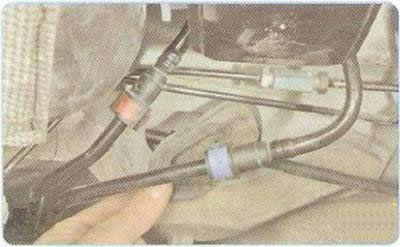
10. Pull the cable out of the hole in the base of the body from below and remove it from the car.
11. Remove the second cable in the same way.
Helpful Hint: If the cable is difficult to move in the sheath after being removed from the vehicle, lubricate it. Pour engine or transmission oil into the sheath until it starts to flow out of the opposite end of the sheath. While pouring, periodically move the cable in the sheath.
12. Install the rear parking brake cable and all removed parts in the reverse order of removal.