


If there are burrs, deep scratches and other defects on the working surface of the disc that increase pad wear and reduce braking efficiency, as well as in the case of increased lateral runout of the disc that causes vibrations during braking, replace the disc. In specialized workshops, such a disc can be turned and ground on both sides to the same depth, but after processing, the thickness of the disc must not be less than the minimum permissible.
The minimum permissible thickness of the brake disc of the front wheel brake mechanism is 24 mm. If the thickness of one of the discs is less than the specified value, replace both discs. When replacing the brake discs, be sure to replace the brake pads with a new set.
1. Remove the wheel from the side of the disc being replaced.
2. Remove the bolts securing the guide pads to the steering knuckle.
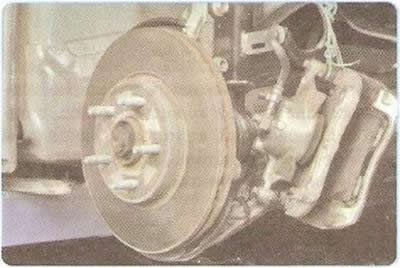
3. Remove the caliper assembly without disconnecting the brake hose and secure it with wire, preventing the hose from twisting or being pulled (see "Replacing the front wheel brake caliper assembly").
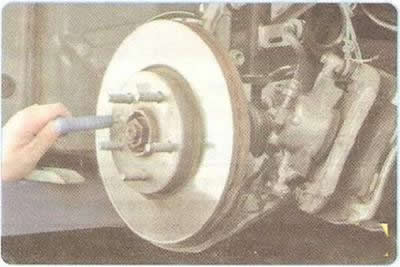
4. Remove the screw securing the disc to the hub...
Hold the hub from turning with a tire iron, resting it on the wheel nuts screwed onto the studs.
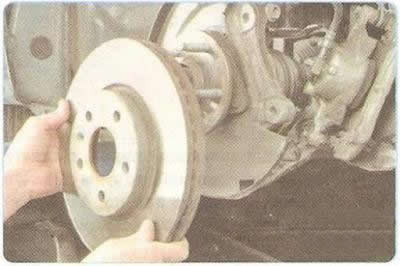
5. ...and remove the disk.
6. Install the parts in the reverse order of removal.
Note: Before installing the disc, thoroughly clean the mating surfaces of the hub and disc from rust and scale, since even the smallest particle clamped between the mating surfaces will cause disc beating and vibration during braking,
7. Press the brake pedal all the way down several times. This is necessary to eliminate the gaps in the brake mechanism that appeared after the pistons were pressed into the cylinders,
8. Install the wheel.
9. Remove the brake disc of the other wheel in the same way.
[The article was reprinted from the website: «CHEVYMAN.RU»]