


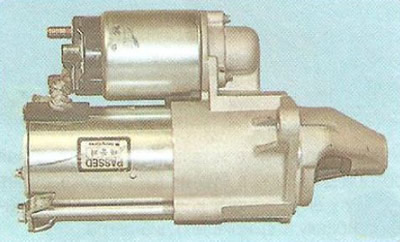
Covers 1 and 15 (Fig. 10.6), as well as the stator housing 17, are tightened with two bolts 14. Permanent magnets are fixed in the stator housing. Rotation from the rotor 18 of the electric motor is transmitted to the drive shaft 9 through a planetary gearbox consisting of a sun wheel 7, a carrier made in one piece with the drive shaft 9, and three satellites 11. A freewheel roller clutch 5 is installed on the drive shaft.
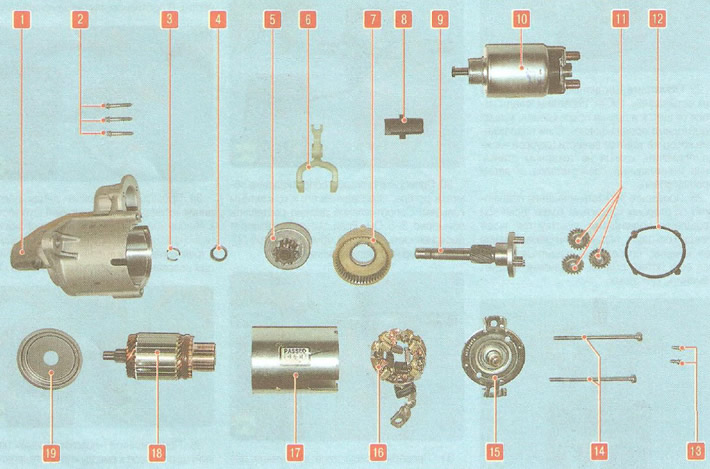
Fig. 10.6. Starter parts: 1 - front cover; 2 - screws for fastening the traction relay to the front cover; 3 - drive coupling retaining ring; 4 - thrust ring of the drive coupling; 5 - drive clutch; 6 - drive lever; 7 - solar wheel; 8 - drive lever support; 9 - drive shaft; 10 - traction relay; 11 - satellites; 12 - planetary gear sealing ring; 13 - rear cover mounting bolts; 14 - tie bolts; 15 - back cover; 16 - brush unit; 17 - stator; 18 - rotor; 19 - planetary gear cover
The drive shafts and rotor rotate in two metal-ceramic bearing bushings pressed into covers 1 and 15.
The traction relay 10 is fixed on the cover 1, the anchor of which moves the clutch 5 of the drive via the lever 6. When the key in the ignition switch (lock) is turned to the "START" position, the voltage from the storage battery is supplied to the pull-in and holding windings of the traction relay 10, the anchor of which moves the lever 6 of the drive, and the gear of the clutch 5 of the starter drive engages with the toothed ring of the engine flywheel. At the same time, the anchor of the traction relay closes the power contacts (at this moment the pull-in winding is switched off) and voltage from the battery is supplied to the starter motor. The rotor 18 of the starter rotates the engine crankshaft through the planetary gear. After starting the engine, when the speed of the gear exceeds the speed of the starter shaft, the freewheel clutch is unlocked and slips, thereby protecting the starter from high speed and damage.
The starter operating mode is short-term (its duration is up to 10 sec). At negative temperatures, the operating time is allowed to be up to 15 s. The starter is powered by a 55 Ah battery and is a regenerable, serviceable product.
Helpful tips: To avoid many starter malfunctions, follow a number of simple rules when using it:
- when starting the engine, turn on the starter for no more than 10-15 seconds and again after 20-30 seconds. Continuous long-term operation of the starter can lead to overheating. If after three attempts the engine does not start, then you should check and eliminate faults in the engine power supply system or in the ignition system;
- after starting the engine, immediately turn off the starter, as prolonged rotation of the flywheel of the drive gear can damage the starter overrunning clutch;
- do not move the vehicle using the starter, as this will cause significant overload and damage to it.
[The article is based on data from the website «CHEVYMAN.ru»]