


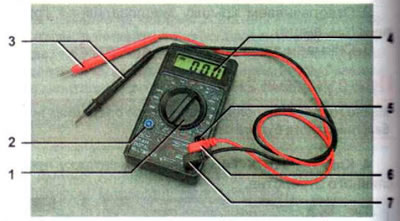
Multimeter: 1 - multimeter operating mode switch; 2 - sockets for connecting the terminals of semiconductor devices during their testing; 3 - feeler gauges,; 4 - liquid crystal display; 5 — socket for connecting a wire with a probe to a multimeter when measuring current; 6 - positive conclusion; 7 - negative output
Some models are equipped with additional functions that are useful when repairing electronic equipment, but they are generally not required for car repairs. Sometimes multimeters are equipped with a thermocouple and have a temperature measurement mode. This is a useful function, it expands the capabilities of the device for checking the engine cooling system.
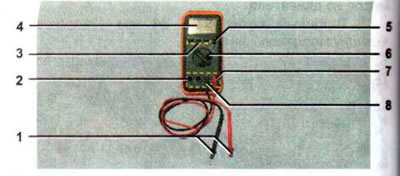
Multimeter: 1 - feeler gauges; 2 - sockets for connecting probes to a multimeter; 3 - buttons for turning on and switching various functions; 4 - liquid crystal display; 5 - sockets for connecting the terminals of semiconductor devices during their testing; 6 — multimeter operating mode switch; 7 - positive conclusion; 8 - negative output
All devices are equipped with red and black wires with probes at the ends. It is generally accepted to connect the red wire to the positive terminal of the device, marked with the symbol "+", and the black wire to the negative terminal, marked with the sign "-" or "
 ". The number of sockets for connecting wires with probes is usually more than two. The connection order depends on the measurement mode. Usually you have to switch the positive terminal to measure current. Some multimeter models have several sockets, depending on the maximum permissible current strength. To avoid damaging the multimeter, do not measure current greater than the values specified on the meter.
To check de-energized circuits, the multimeter is switched to ohmmeter mode. When measuring very low resistance (within a few ohms), it is necessary to introduce a correction - subtract the internal resistance of the multimeter, the electrical resistance of its wires and probes from the obtained value (usually within 0.06-0.08 Ohm). To accurately determine this correction, you should switch the device to the low resistance measurement mode (up to 200 Ohm) and short-circuit the ends of its probes.
To check the electrical circuits of a vehicle under voltage, the multimeter is switched to voltmeter mode with a measurement limit of up to 20 V DC. In the mode with a higher upper voltage range, the measurement accuracy will be lower. Some multimeters (more expensive models) automatically switch to the range with the optimal measurement range.
Warning! Do not use a multimeter to measure the voltage in the high-voltage circuit of the ignition system, as this may damage the device.
The multimeter allows you to measure the current consumed by the vehicle's electrical equipment (usually up to 10 A, less often up to 20 A). Typically, to perform a measurement, you will need to not only switch the multimeter to ammeter mode, but also reconnect one of the probes to the corresponding terminal of the device.
Warning! Do not measure the current in the starter circuit with a multimeter to avoid damage to the device. The current consumed by the starter is very high (300-400 A).
For a car enthusiast, a very useful function is the "circuit test mode". It allows you to identify closed circuits by a sound signal - a buzzer.
Many measurements that a car enthusiast may need to take when repairing a car can be performed using an analog instrument with a pointer indicator. It has several scales, each corresponding to a measured parameter. Sometimes, to measure one parameter, several scales with different ranges of values are made.
Pointer instruments have a special regulator for setting the pointer to "zero" in ohmmeter mode. To adjust the device, the device probes are short-circuited. By rotating the regulator disk, ensure that the arrow is positioned exactly on the "0" mark of the scale
 . Once the device has been calibrated, measurements can be taken. In this case, no other corrections need to be made to the obtained values. On some older models, when measuring resistance in ohmmeter mode, the polarity may be reversed. This feature is necessarily reflected by the corresponding markings on the device.
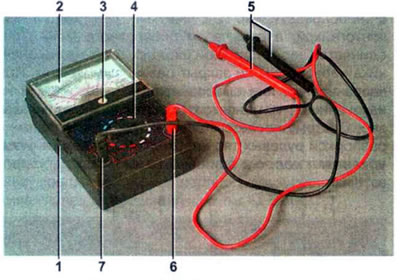
Analog multimeter: 1 — regulator disk "0"; 2 — pointer indicator of the device; 3 - adjusting screw; 4 — device mode switch; 5 - device probes; 6 - positive conclusion; 7 - negative output
As a rule, pointer instruments have a mirror strip on the scale. This is done to ensure that the readings from the device can be taken as accurately as possible. The mirror strip is used in the following way. When looking at the arrow, you need to tilt your head slightly to ensure that the arrow and its reflection in the mirror strip merge into one line. After that, without changing the position of the head, the readings are determined on the corresponding scale of the device.
Despite the difficulty of taking accurate readings, pointer instruments also have advantages over digital ones. The main thing is that they retain their functionality without power supply elements, although not to the full extent - an ohmmeter does not work without power supply.
Pointer instruments are not afraid of frost, which causes liquid crystals to freeze. Despite its high inertia, the pointer indicator allows you to observe rapidly changing processes in dynamics. Therefore, in some cases, the arrow turns out to be more informative than the flashing numbers. For the same reason, the speedometer and tachometer on most modern cars have remained electronic-mechanical, although attempts to introduce purely electronic devices have been made repeatedly.
(The material was created based on information from the website: «ChevyMan.ru»)