


The powder fire extinguisher (OP) is more versatile: it is designed to extinguish fires of petroleum products, flammable liquids and combustible materials, as well as to extinguish electrical equipment under high voltage. The principle of operation is as follows: when it hits a burning substance, the powder creates a surface layer that prevents the flow of oxygen and further combustion.
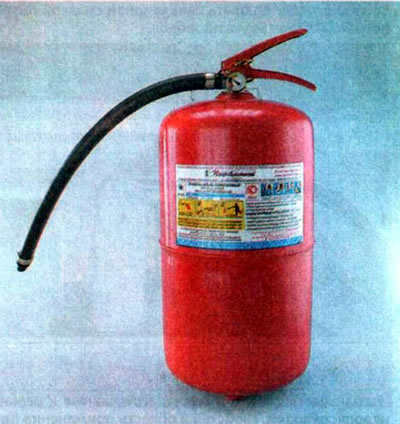
Powder fire extinguishers can be divided into two types: gas generator and pumping.
The operating principle of gas-generating powder fire extinguishers is as follows: when the fire extinguisher's locking device is opened, a capsule with gas opens inside the cylinder and excess pressure is created, causing the fire extinguishing powder to be ejected.
Filled powder fire extinguishers are immediately filled with extinguishing powder and gas (nitrogen, carbon dioxide or air) under high pressure (16 bar). This allows it to be opened and closed with a shut-off device as needed. The advantage of this type of fire extinguisher is the presence of a pressure gauge that shows the degree of charge.
In case of insufficient pressure (red), the fire extinguisher must be refilled.
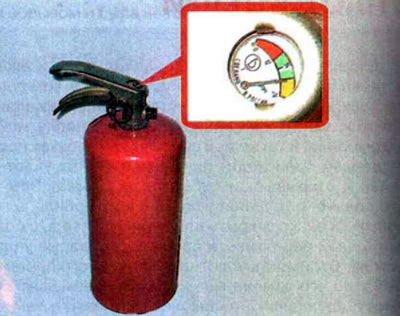
Versatility and efficiency in extinguishing fires of various materials makes powder fire extinguishers the most preferable for equipping vehicles.
The operating principle of a halon fire extinguisher (HFE) is based on the displacement of oxygen from the combustion zone and cooling of the burning substance with a special fire extinguishing gas. Unlike powders, freon fire extinguishers have almost no negative impact on vehicle components and assemblies. In addition, modern fire extinguishers of this type are safe for humans and the environment. It is also important that after use they do not leave marks on the upholstery.
Choose a fire extinguisher recommended for use on motor vehicles. During operation in a vehicle, the fire extinguisher will inevitably be exposed to vibration and temperature changes, and its design must be designed to withstand such loads.
Fire extinguishers with expired shelf life, used ones, with mechanical damage and also without seals must be replaced.
Recommendation. How to use a fire extinguisher must be learned immediately after purchase. To do this, carefully read the instructions on the cylinder and mentally play through the situation several times in which you consistently follow the procedure when a fire occurs.
Note: The fire extinguisher must be located in the most accessible place for the driver, and not stored in the luggage compartment.
Unfortunately, in the passenger compartment of a car, as a rule, there is no special place for a fire extinguisher. It is not easy to place a two-liter fire extinguisher under the seat, and it is even more difficult to remove it from there, especially in a hurry. You can place a fire extinguisher in front of the driver's seat and be sure to secure it (at least with plastic clamps, but so that they do not interfere with its quick extraction). If it spontaneously shifts and gets under the brake pedal, the consequences can be tragic. It is generally not advisable to store a fire extinguisher in the passenger compartment without securing it. After all, in the event of an accident, it can cause serious injuries. Some fire extinguishers are equipped with special mounting brackets.
If for some reason the fire extinguisher has to be stored in the luggage compartment, never block access to it or put luggage on it. In this case, you can purchase an additional fire extinguisher - a small one. This could be a freon fire extinguisher in an aerosol can with a capacity of 0.5-0.75 l. But it should be at hand in the literal sense of the word, so that in a crisis situation you don't waste time searching for and extracting it. Since the fire extinguisher is compact, it can be placed on the side of the driver's seat. Of course, you won't be able to put out a burning car with such a fire extinguisher, but with its help you will be able to put out the fire before it escalates into a conflagration. Thanks to its size, it can be removed with one hand and immediately put into action.
But simply keeping an extra fire extinguisher nearby is not enough. You need to be able to use it. To do this, it is recommended to try to quickly remove the fire extinguisher and simulate its use. It is advisable to repeat this type of training sometimes so as not to forget the sequence of actions. It will only be possible to extinguish a fire at the moment it starts if you begin to act when the first signs of a fire appear (burning smell, smoke, melting electrical insulation, etc.). Immediately take a fire extinguisher and make it ready for combat. While you are looking for the source of smoke or fire, have it in your hand. And it's okay if it turns out that you mistook the steam from under the hood for smoke. But if you detect an open fire, you can immediately use a fire extinguisher without wasting precious seconds. Even if you can't put out the fire completely, but only knock down the flames for a while, you'll have a better chance of de-energizing the car's electrical circuit in a timely manner (disconnect the battery) and prepare the main fire extinguisher for extinguishing. If the fire is discovered when the fire has already begun to spread throughout the car, it is pointless to try to use a small fire extinguisher; the only way to save the car in such a situation is to call the fire department and ask other drivers for help.
It is advisable to have a hand-held fire extinguisher with a capacity of at least 5 liters in the garage. It is permissible to use a carbon dioxide fire extinguisher (for example, OU-5).
Additionally, the garage can be equipped with self-acting powder fire extinguishers (OSP). If the temperature inside the room rises to critical values (usually 80-100°C), the fire extinguisher is triggered: its body opens, and a special powder is poured into the fire. The number of self-acting fire extinguishers and their working volume are determined based on the area of the garage.