


The working volume is determined by the piston stroke, diameter and number of cylinders in the engine. The piston stroke is the distance between top dead center (TDC), that is, when the piston is in its highest position, and bottom dead center (BDC), when the piston is moved downward as far as possible.
The cylinder head is aluminum. It has two camshafts and four valves per cylinder. The use of such a scheme allows to improve the filling of the cylinders and thereby increase the power characteristics of the engine.
The camshafts are driven by a toothed timing belt (gas distribution mechanism).
Thermal clearances in the valve drive are adjusted by selecting tappets. The need to change the thermal clearances may arise if, when checking the technical condition of the engine, characteristic sounds of "clacking" valves are heard from under the cylinder head cover. On the inside of the tappet there is a conventional marking of its size, indicating tenths and hundredths of a millimeter (that is, the number 14 indicates the size of the pusher, equal to 3.14 mm).
Checking the valve clearances is a simple task and can be done independently. It is enough to have a set of flat feeler gauges and remove the cylinder head cover. But to select new tappets, you will need to remove the camshafts, extract and measure the thickness of the tappets to be replaced. Considering the labor intensity of such work, as well as the need to have spare tappets on hand, it is advisable to check and adjust the clearances in the valve drive at a specialized service station.
The block has four cylinders arranged in a row.
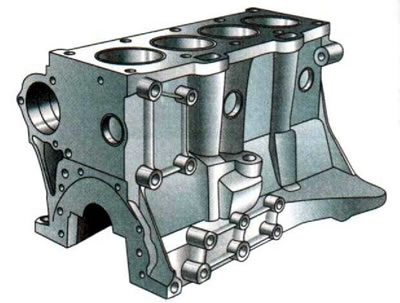
Engine cylinder block
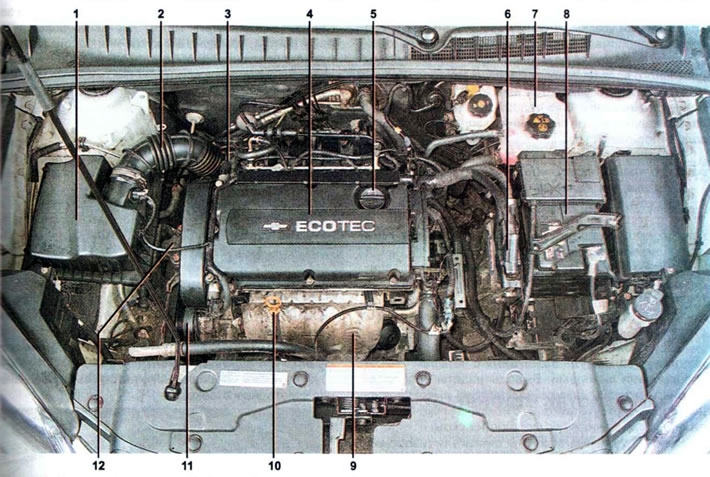
Engine compartment: 1 - air filter; 2 - air duct; 3 - throttle assembly; 4 - decorative engine cover; 5 — oil filler cap; 6 — electronic engine control unit; 7 - expansion tank; 8 — battery; 9 — exhaust manifold; 10 — oil level indicator in the engine crankcase; 11 — auxiliary drive belt; 12 — right support of the power unit
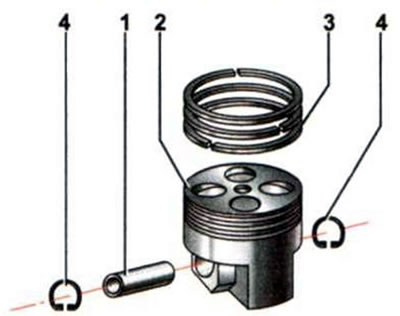
Piston: 1 - piston pin; 2 — piston; 3 - set of piston rings; 4 - piston body retaining rings
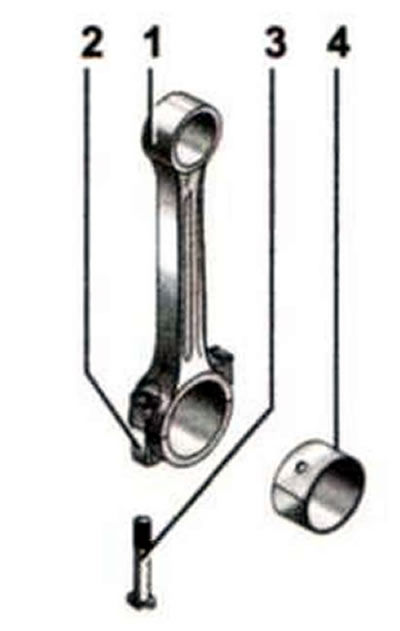
Connecting rod: 1 — connecting rod; 2 — connecting rod cover; 3 — connecting rod cover mounting bolts; 4 — connecting rod bearings
Cylinder pistons made of aluminum alloy.
Piston pins are of the floating type and are fixed in the pistons with retaining rings. The connecting rods are stamped from high-strength steel, the surfaces of the connecting rod bearing shells have microgrooves, which creates an optimal oil gap.
The oil pump is built into the front lower cylinder block cover and is driven directly by the crankshaft (the pump rotor is placed on the shaft journal). The crankshaft is made of steel and rotates in five support bearings.
During long-term operation of a vehicle, wear occurs on the cylinder walls, piston rings, pistons, connecting rod and main bearings. When parts wear out heavily, compression in the engine cylinders decreases and oil pressure in the engine lubrication system drops. By measuring these parameters, you can assess the condition of the engine. This type of work is performed when checking the technical condition of the engine.
The engine is equipped with an automatic variable valve timing system, which improves the filling of the engine cylinders at different crankshaft rotation speeds. This allows the engine to produce more power at high crankshaft speeds without losing traction characteristics in the mid-range.
Two phase regulators of such a system with hydraulic control are driven by oil pressure from the engine lubrication system. Phase regulators are installed on the camshafts. They allow the shaft to rotate relative to its pulley at a certain angle, and thereby change (shift) the valve timing. Oil is supplied to each phase regulator through the oil channel of the camshaft from the cylinder head. The oil supply is regulated by the electromagnetic valve for changing the valve timing, and thus the angle of displacement of the camshaft relative to the pulley is set.
The operation of the electromagnetic valves is controlled by the electronic engine control unit (ECU).
The engine management system monitors the position of both camshafts. To do this, a camshaft position sensor is installed at the end of the cylinder head opposite each shaft. The ECU changes the valve timing depending on the mode in which the engine is operating (accelerates the car, brakes or maintains movement at a constant speed, etc.) and what is the crankshaft speed.
The engine ignition system uses an ignition module with four high-voltage terminals instead of coils. The leads are placed directly on the spark plugs, so there are no high-voltage wires. This eliminates current leakage, which leads to a decrease in spark power.
Engine auxiliary units (cooling system pump, generator, air conditioning compressor) are driven by a poly-V belt from the engine crankshaft.
Cleaning the engine and engine compartment
During vehicle operation, the engine compartment becomes heavily contaminated and, unlike the body and interior of the vehicle, is usually neglected when visiting car washes. However, a heavily soiled engine can cause more problems than a dirty body or interior. Therefore, it is necessary to periodically clean the engine and underhood space.
Engine specifications
| Conventional designation | 1,8 |
| Model (index) | F1BD4 (2H0) |
| Engine type | gasoline, in-line |
| Working volume, l (cm³) | 1,8 (1,796) |
| Cylinder diameter, mm | 80,5 |
| Piston stroke, mm | 88,2 |
| Compression ratio | 10,5 |
| Number of cylinders | 4 |
| Number of valves per cylinder | 4 |
| Type of gas distribution mechanism | DОНС |
| Nominal power, kW (hp) | 104(141) |
| Crankshaft speed at maximum power, min-1 | 6200 |
| Maximum torque, Nm | 176 |
| Crankshaft speed at maximum torque, min⁻¹ | 3800 |
| Crankshaft speed at idle, min⁻¹ | 780-1000 |
| Cylinder firing order | 1-3-4-2 |
| Minimum pressure in the lubrication system of the engine, warmed up to operating temperature, at idle, kPa | 130 |
Warning. There are many electronic components in the engine compartment, therefore we do not recommend cleaning the engine compartment with high-pressure devices (as most car washes do).
To perform the work you will need a special engine cleaner. This product contains highly effective cleaning agents that quickly penetrate through the layer of burnt. oily dirt and dissolve it in the most inaccessible places without additional mechanical action. We clean the engine compartment in the following order:
1. We prepare the car for maintenance and repair.
2. Apply a special cleanser
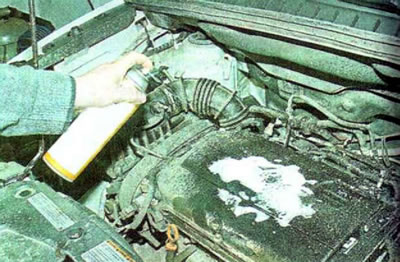
3. Wait a few minutes (see instructions for use of the drug).
4. In case of heavy contamination, clean the engine parts with a paint brush.
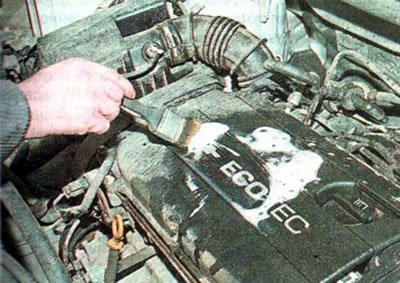
5. Then wipe them dry with a clean cloth.
6. To remove any remaining moisture, blow compressed air from a compressor or foot pump onto the engine and underhood space.