


Compression testing allows you to assess the technical condition of the cylinder-piston group and valves of the gas distribution mechanism without disassembling the engine. Compression is measured for each engine cylinder separately.
We measure compression during the technical condition check of the engine.
Note: It is advisable to combine compression measurement with replacement of spark plugs. Measurements are taken with a fully charged battery and fully open throttle, otherwise the readings will be incorrect.
Compression in engine cylinders
| Minimum permissible compression in engine cylinders, MPa (bar) | 1,0(10) |
| Maximum allowable difference in compression in cylinders MPa (bar) | 0,1(1) |
To perform the work you will need a compression gauge.
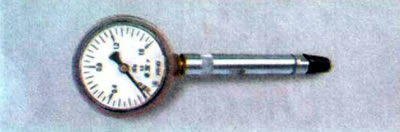
We perform the work with an assistant.
1. We prepare the car for maintenance and repair.
2. Warm up the engine to operating temperature.
3. Unscrew the spark plugs.
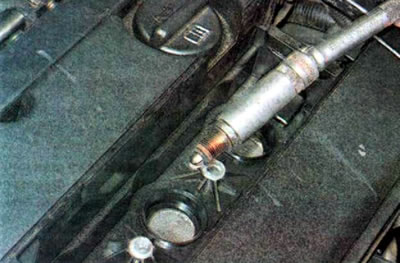
4. Disconnect the fuel pump (the operation is shown when releasing pressure in the fuel supply system).
5. Install the compression gauge into the spark plug hole of one of the engine cylinders.
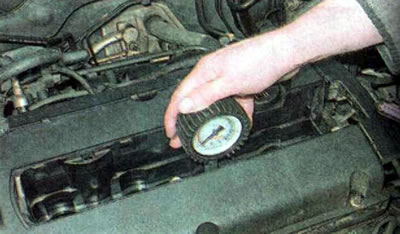
6. The assistant presses the gas pedal all the way down and turns on the starter for 5-10 s.
7. Remember or write down the compression meter readings and reset the device. We repeat the measurements two more times and calculate the arithmetic mean from the obtained values.
8. Similarly, we measure the compression in the remaining engine cylinders.
Comment.
- In a serviceable engine, the compression in the cylinders should be no less than the minimum permissible value indicated in the table (see above), while the difference in compression between the cylinders should not exceed the maximum permissible value. The absolute value of compression can change under various conditions: battery charge level, engine temperature, engine starting system condition, throttle opening degree. Therefore, when checking the measurement results, the main attention should be paid to the difference in compression between the cylinders.
- To determine the cause of the decrease in compression in the cylinder, pour 10-20 ml of clean motor oil into it through the spark plug hole and repeat the check. If the compression value has increased, then the most likely cause is wear of the cylinder or piston, breakage, sticking or wear of the piston rings. If the compression value has not changed, then the cause is most likely a burnt piston or valve plate, or damage to the cylinder head. In any case, disassembly and inspection of engine parts is necessary. It is advisable to entrust this work to a specialized service station.
Recommendation. In a situation where it is necessary to carry out a primary diagnosis (determine the condition of valve plates, pistons and cylinder walls), but for some reason it is not planned to immediately repair the engine, it is better to resort to an endoscopic examination of the engine combustion chambers without disassembling it. The endoscope cable is inserted into the candle hole. Many specialized stations currently offer a similar service. The cost of this work is much lower than engine inspection with disassembly.
9. After completing the inspection, install all removed parts. Compression in engine cylinders
[Information taken from the official website: CHEVYMAN.ru]