

Contents: General diagnostics ↧ Preliminary checks ↧ Lateral vehicle pull ↧ Unusual or excessive tire wear ↧ One-sided tread wear ↧ Wheel bouncing ↧ Shimmy, shaking or vibration ↧ Difficulty steering ↧ Excessive steering play ↧ Poor ability to self-return to the… ↧ Unusual noise in the front suspension ↧ Vehicle swerving or poor handling ↧ Unstable vehicle control when braking ↧ Reduced or uneven body height… ↧ Too "soft" suspension ↧ Too "stiff" suspension ↧ The body leans or rocks when turning… ↧ suspension "breakdowns" ↧ Steering wheel kickback on uneven… ↧ Steering wheel jerking or twitching ↧ Tire concavity ↧ Car pulls away during acceleration ↧ Verification procedure ↧ Hub and bearing ↧
General diagnostics
Steering, suspension, tire and wheel problems may manifest themselves when several systems are operating. Pay attention to all systems when performing diagnostics. Some problems, such as unusual or excessive tire wear, as well as one-sided tread wear, may occur as a result of vigorous driving. First, perform a test drive. If possible, perform this test drive with the customer.
Then proceed to the preliminary checks below. Correct any abnormalities.
Preliminary checks
|
Checks
|
Operation, action
|
|
Check that your tires are inflated and worn evenly.
|
Inflate the tires to the required pressure.
|
|
Check for play or wear at the connection between the steering column and the steering gear.
|
Tighten the intermediate shaft pinch bolts. Replace the intermediate shaft if necessary.
|
|
Check for loose or damaged parts in the front and rear suspension, steering gear, control arms and rods.
|
Tighten the front and rear suspension fasteners. Tighten the steering gear mounting bracket bolts. Tighten the intermediate shaft pinch bolts. Replace the front and rear suspension, if necessary. Replace the steering gear, if necessary. Replace the intermediate shaft, if necessary.
|
|
Check that the tires are not deformed.
|
Perform a runout test with free rotation. Perform tire selection and installation.
|
|
Check the wheel balance, make sure there is no deformation of the wheels, as well as wear or insufficient fixation of the wheel bearings.
|
Balance the wheels. Replace the wheels. Replace the wheel bearings.
|
|
Check the tension of the power steering pump drive belt.
|
Tighten the power steering pump drive belt.
|
|
Check for leaks in the power steering system. Also check the power steering fluid level.
|
Repair leaks. Check power steering. Add power steering fluid if necessary.
|
Lateral vehicle pull
|
Checks
|
Operation, action
|
|
Check that the tires are selected correctly and are identical.
|
Replace the tires.
|
|
Check for broken or sagging springs.
|
Replace the spring.
|
|
Check the lateral force acting on the radial tire.
|
Check wheel alignment. Rotate wheel and tire assemblies. Replace tires if necessary.
|
|
Check the front wheel alignment angles.
|
Adjust the front wheel alignment angles.
|
|
Check the front wheel alignment angles.
|
Reinstall the pinion and control valve assembly. Replace the pinion and control valve assembly if necessary.
|
|
Check for front brake drag.
|
Adjust the front brakes.
|
Unusual or excessive tire wear
|
Checks
|
Operation, action
|
|
Check the front and rear wheel alignment angles.
|
Adjust the front and rear wheel alignment angles.
|
|
Check if the toe-in angle of the front and rear wheels is too great.
|
Adjust the toe-in angle of the front and rear wheels.
|
|
Check for broken or sagging springs.
|
Replace the spring.
|
|
Check tire balancing.
|
Balance the tires.
|
|
Check the shock absorbers for wear.
|
Replace the shock absorbers.
|
|
Check tire rotation.
|
Rotate tires. Replace tires if necessary.
|
|
Check if the vehicle is overloaded.
|
Do not overload the vehicle.
|
|
Check if the tire pressure is sufficient.
|
Inflate the tires to the required pressure.
|
One-sided tread wear
|
Checks
|
Operation, action
|
|
Check that the front and rear wheel alignment is correct.
|
Adjust the toe-in angle of the front and rear wheels.
|
|
Check that the suspension arm is not twisted or bent.
|
Replace the suspension arm.
|
Wheel bouncing
|
Checks
|
Operation, action
|
|
Check the balance of the tire and wheel.
|
Balance the tire or wheel.
|
|
Check that the shock absorbers are working properly.
|
Replace the shock absorbers.
|
Shimmy, shaking or vibration
|
Checks
|
Operation, action
|
|
Check the balance of the tire and wheel.
|
Balance the tire or wheel.
|
|
Check if the wheel hub runout is too great.
|
Measure the hub flange runout. Replace the hub if necessary.
|
|
Check if the brake drum or brake disc is out of balance too much.
|
Adjust the brakes. Replace the brake disc or brake drum if necessary.
|
|
Check the tie rod ends for wear.
|
Replace the outer tie rods.
|
|
Check wheel balancing.
|
Perform wheel balancing.
|
|
Check the lower ball joint for wear.
|
Replace the lower ball joint.
|
|
Check if the wheel runout is too large.
|
Measure the wheel runout. Replace the wheel if necessary.
|
|
Check if the radial runout of the tire and wheel assembly under load is excessive.
|
Perform selection and installation of the tire on the wheel.
|
Difficulty steering
|
Checks
|
Operation, action
|
|
Check the steering gear preload.
|
Adjust the rack bearing preload.
|
|
Check the hydraulic system. Measure the pressure in the power steering system with a pressure gauge.
|
Replace seals and hoses if necessary.
|
|
Check for any binding or grabbing in the steering mechanism.
|
Lubricate the steering gear. Repair or replace the steering gear if necessary.
|
|
Check the tightness of the steering gear fasteners.
|
Tighten the steering gear mounting bracket nuts and bolts.
|
Excessive steering play
|
Checks
|
Operation, action
|
|
Check the front wheel bearings for wear and tightness.
|
Replace the front wheel bearings.
|
|
Check the tightness of the steering gear fasteners.
|
Tighten the steering gear mounting bracket nuts and bolts.
|
|
Check for play or wear at the connection between the steering column and the steering gear.
|
Tighten the intermediate shaft pinch bolts. Replace the intermediate shaft if necessary.
|
|
Check the steering gear preload.
|
Adjust the rack bearing preload.
|
Poor ability to self-return to the middle position
|
Checks
|
Operation, action
|
|
Check that the ball joints and tie rod ends are sufficiently lubricated.
|
Replace ball joints and outer tie rods.
|
|
Check the ball joints for binding.
|
Replace the ball joint
|
|
Check the steering column for binding.
|
Lubricate the steering column. Replace the steering column if necessary.
|
|
Check the front wheel alignment angles.
|
Adjust the front wheel alignment angles.
|
|
Check the steering gear preload.
|
Adjust the rack bearing preload.
|
|
Check if the valve is stuck.
|
Lubricate the pinion and control valve assembly. Replace the pinion and control valve assembly as an assembly if necessary.
|
|
Check if the intermediate shaft in the steering gear is jamming.
|
Replace the intermediate shaft.
|
Unusual noise in the front suspension
|
Checks
|
Operation, action
|
|
Check that the ball joints and tie rod ends are sufficiently lubricated.
|
Replace ball joints and outer tie rods.
|
|
Check if the suspension parts are damaged.
|
Replace damaged suspension parts.
|
|
Check the control arm bushings and tie rod ends for wear.
|
Replace control arm bushings or tie rods.
|
|
Check the fastenings of the stabilizer bar connecting link.
|
Tighten the stabilizer bar connecting link fasteners.
|
|
Check that the wheel nuts are tight.
|
Tighten the wheel nuts.
|
|
Check that the suspension bolts and nuts are tight.
|
Tighten the suspension bolts or nuts.
|
|
Check the shock absorbers and telescopic strut mounting points for wear.
|
Replace the shock absorbers. Tighten the strut mounting bolts.
|
|
Check that the springs of the telescopic struts are positioned correctly.
|
Set the strut spring to the correct position.
|
Vehicle swerving or poor handling
|
Checks
|
Operation, action
|
|
Check that the tires are selected correctly and are identical.
|
Replace the tires.
|
|
Check that the ball joints and tie rod ends are sufficiently lubricated.
|
Replace ball joints and outer tie rods.
|
|
Check the shock absorbers for wear.
|
Replace the shock absorbers.
|
|
Check the fastenings of the stabilizer bar connecting link.
|
Tighten the stabilizer bar connecting link fasteners.
|
|
Check for broken or sagging springs.
|
Replace the spring.
|
|
Check the steering gear preload.
|
Adjust the rack bearing preload.
|
|
Check the front and rear wheel alignment angles.
|
Adjust the front and rear wheel alignment angles.
|
Unstable vehicle control when braking
|
Checks
|
Operation, action
|
|
Check the front wheel bearings for wear and tightness.
|
Replace the front wheel bearings.
|
|
Check for broken or sagging springs.
|
Replace the spring.
|
|
Check for leaks from the wheel brake cylinder or caliper.
|
Replace the wheel cylinder or caliper.
|
|
Check if the discs are warped.
|
Replace the disks.
|
|
Check that the longitudinal inclination angle of the wheel pivot axis is correct and uniform.
|
If the longitudinal tilt angle of the steering axis is outside the range of acceptable values, check the frame and, if necessary, repair it.
|
Reduced or uneven body height relative to wheels
|
Checks
|
Operation, action
|
|
Check for broken or sagging springs.
|
Replace the spring.
|
|
Check if the vehicle is overloaded.
|
Do not overload the vehicle.
|
|
Check that the spring is selected correctly and is not weakened.
|
Replace the spring.
|
Too "soft" suspension
|
Checks
|
Operation, action
|
|
Check the shock absorbers for wear.
|
Replace the shock absorbers.
|
|
Check for broken or sagging springs.
|
Replace the spring.
|
Too "stiff" suspension
|
Checks
|
Operation, action
|
|
Check that the shock absorbers have been selected correctly.
|
Replace the shock absorbers.
|
|
Check that the spring is selected correctly.
|
Replace the spring.
|
The body leans or rocks when turning corners
|
Checks
|
Operation, action
|
|
Check the fastenings of the stabilizer bar connecting link.
|
Tighten the stabilizer bar connecting link fasteners.
|
|
Check the shock absorbers and telescopic strut mounting points for wear.
|
Replace the shock absorbers. Tighten the strut mounting bolts.
|
|
Check if the vehicle is overloaded.
|
Do not overload the vehicle.
|
|
Check for broken or sagging springs.
|
Replace the spring.
|
suspension "breakdowns"
|
Checks
|
Operation, action
|
|
Check the shock absorbers for wear.
|
Replace the shock absorbers.
|
|
Check if the vehicle is overloaded.
|
Do not overload the vehicle.
|
|
Check for broken or sagging springs.
|
Replace the spring.
|
Steering wheel kickback on uneven roads
|
Checks
|
Operation, action
|
|
Check for air in the power steering system.
|
Bleed the power steering system.
|
|
Check the tightness of the steering gear fasteners.
|
Tighten the steering gear mounting bracket nuts and bolts.
|
|
Check for play or wear at the connection between the steering column and the steering gear.
|
Tighten the intermediate shaft pinch bolts. Replace the intermediate shaft if necessary.
|
|
Check that the tie rod ends are tight.
|
Tighten the tie rod ends. Replace the outer tie rods if necessary
|
|
Check the front wheel bearings for wear and tightness.
|
Replace the front wheel bearings.
|
Steering wheel jerking or twitching
|
Checks
|
Operation, action
|
|
Check the hydraulic system. Measure the pressure in the power steering system with a pressure gauge.
|
Replace seals and hoses if necessary.
|
|
Check if the steering gear valve is sticking.
|
Clean the pinion and control valve assembly Replace the pinion and control valve assembly as a whole if necessary.
|
|
Check if the power steering pump drive belt is tight.
|
Adjust the tension of the power steering pump drive belt.
|
Tire concavity
|
Checks
|
Operation, action
|
|
Check the front and rear wheel alignment angles.
|
Adjust the front and rear wheel alignment angles.
|
|
Check the shock absorbers for wear.
|
Replace the shock absorbers.
|
|
Check wheel bearings for wear or looseness.
|
Replace wheel bearings.
|
|
Check to see if the tire or wheel runout is excessive.
|
Perform tire selection and installation. Replace tires if necessary. Replace wheels if necessary.
|
|
Check the ball joint for wear.
|
Replace the ball joint
|
|
Check the steering gear preload.
|
Adjust the rack bearing preload.
|
Car pulls away during acceleration
A pull to the right can occur under high throttle on some front-wheel drive vehicles with drive axles of different lengths. This pull to the right is caused by the right drive axle being longer than the left, which creates a difference in the angular position of the drive axles. On vehicles with intermediate shafts, the axles are almost the same length.
The inequality of the lengths of the drive axles results in a moment that increases the positive toe-in of the left front wheel. The moment that increases the toe-in becomes noticeable when accelerating the car from a standstill or at a low initial speed.
Verification procedure
1. Attach a small piece of tape to the top center point of the steering wheel.
2. Determine the amount of steering wheel turn in inches required to keep the vehicle moving straight during sudden acceleration.
3. Compare this value with that measured on other similar vehicles.
The vehicle's drift during acceleration may increase under the influence of the following factors:
- Differences in tire and wheel assemblies. This factor has the greatest impact on the car's pull during acceleration. The slightly smaller diameter of the right front tire increases the moment causing the car to pull to the right.
- There is a big difference in pressure between the right and left tires.
- Looseness in the bushings of the suspension arms, in the tie rods or in the steering gear mounts. Looseness under torque allows for a greater forward displacement and positive toe-in of the corresponding front wheel compared to the other wheel. Loose suspension elements can lead to a pull to the opposite side when braking.
- Increased height of the front part of the body relative to the wheels. This can lead to an increase in the angle of inclination of the drive axle and wobble of the front wheels at speeds from 24 to 48 km / h (from 15 to 30 miles/hour).
- Binding or excessively tight drive axle connections. Tight drive axle connections or increased front body height relative to the wheels can also cause front wheel wobble at speeds between 24 and 48 km/h (from 15 to 30 miles/hour).
- Incorrect installation, wear or looseness of the engine mounts leads to unfavorable deviation from the norm of the angles of the drive axles.
The steps to eliminate these faults are given in this part, in the section "General diagnostics".
The reasons for the occurrence of an effect similar to the car pulling away during acceleration include:
- Incorrect front or rear wheel alignment.
- Incorrect installation or frame defect.
- Front suspension damage.
- Incorrect installation of the rear cross member.
Hub and bearing
To check for play in the hub and bearing assembly, do the following:
1. Raise the vehicle and place it on the supports provided for this purpose.
2. Remove the rear wheel. See Part 2E. Tires and wheels.
3. Remove the brake caliper and disc. Cm. Part 4E. Rear brakes.
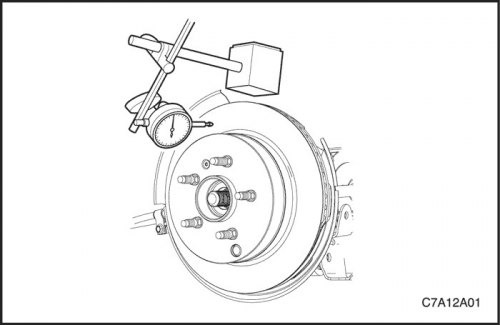
4. Mount the dial indicator with magnetic base on any stationary part of the vehicle.
5. Move the wheel hub along the axis of rotation by hand. If the wheel hub movement exceeds 0.04 mm (0.002 inches), then replace the hub and bearing assembly. See Part 2D. Rear suspension.
6. Install the brake caliper and disc. Cm. Part 4E. Rear brakes.
7. Install the rear wheel. See Part 2E. Tires and wheels.
8. Lower the car.