


Warning: When charging a battery, explosive gas is released. The battery contains corrosive electrolyte. The current level when discharging the battery is high enough to cause burns. To reduce the risk of injury, follow these guidelines:
- Always wear safety glasses.
- Avoid tilting the battery.
- Avoid open flames and sparks near the battery.
- Avoid contact of electrolyte with eyes and skin. If contact occurs, rinse the affected area thoroughly with clean water and seek medical attention.
Note: The vehicle's electrical system is single-wire with the negative wire grounded. The system operates at 12 volts. Before jump starting, make sure the electrical source also operates at 12 volts DC. Using any other type of electrical source may cause damage to electrical components.
1. Position the donor and recipient vehicles so that the batteries can be connected using special cables, but the vehicles should not touch each other and the cables should be electrically sound.
2. Set the automatic transmission selector to position "P".
3. On both vehicles, turn off all electrical loads that are not needed.
4. Turn off the ignition on both vehicles.
Caution: Some vehicles are equipped with a remote positive battery terminal. ALWAYS use this remote terminal when attempting to jump start the vehicle.
5. Connect the red cable to the positive terminal (2) of the recipient vehicle's battery.
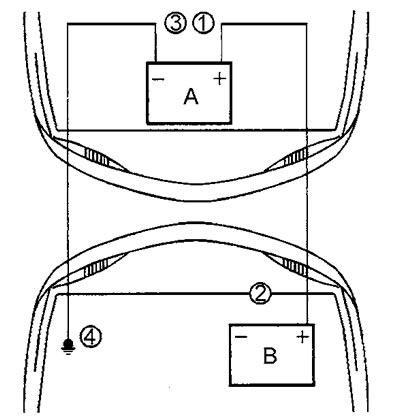
6. Connect the red cable to the positive terminal (1) of the donor vehicle battery.
7. Connect the black cable to the negative terminal (3) of the donor vehicle battery.
Caution: Do not connect the black cable directly to the negative terminal of a dead battery to avoid sparking and explosion of the battery.
8. Connect the black cable to a good ground (4) on the recipient vehicle's engine. This connection should be no closer than 50 cm from the dead battery.
9. Start the donor vehicle engine and do the following:
- Turn off all electrical loads.
- Run the engine at 1500 rpm for five minutes.
Note: Never operate the starter for more than 15 seconds. After 15 seconds of operation, be sure to cool the starter for at least two minutes.
10. Crank the recipient vehicle's engine with the starter. If the engine crankshaft does not turn or turns too slowly, do the following:
- Turn off the ignition.
- Let the donor car's engine run for five minutes at 1500 rpm.
- Try again to start the engine of the recipient vehicle.
11. After starting the engine of the recipient vehicle, remove the connecting cables in the reverse order of connection. Do not allow the cable tips to come into contact with metal parts of the vehicles.