


2. Lay out the piston assemblies with connecting rods and piston ring sets so that the ring set corresponds to the same piston and cylinder both when measuring the gaps in the lock and when assembling the engine.
3. Insert the top (first) ring into the first cylinder and push it into the cylinder with the top surface of the piston (see illustration). The ring should be located at the bottom of the cylinder at the lower limit of the ring stroke.
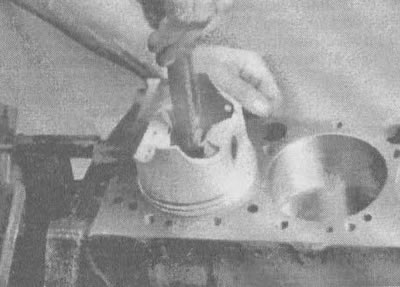
22.3. When checking the gap in the piston ring lock, the ring must be inserted into the cylinder (it can be pushed in there with a piston as shown in the illustration)
4. To measure the gap in the ring lock, insert feeler gauges between the ends of the ring until you select a feeler gauge equal to the width of the gap (see illustration). The feeler gauge should slide between the ends of the ring with slight resistance. Compare the measurement result with the figures given in the section "Technical data". If the gap is less or more than the required value, then before adjusting the gap, check again whether you have selected the right ring.
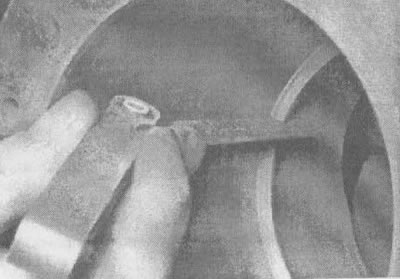
22.4. After inserting the ring into the cylinder, measure the gap between the ends of the ring using a feeler gauge
5. If the gap is too small, it should be increased, otherwise the ends of the ring may close during engine operation, which may lead to serious engine damage. The gap between the ends can be increased by carefully filing the ends of the ring with a fine-grain file. Secure the file in a vice with soft jaws, place the ring on the file so that its ends touch the surfaces of the file and, slowly moving the file, remove material from the ends. When performing this operation, grind the rings only with a movement towards the inside of the ring (see illustration).
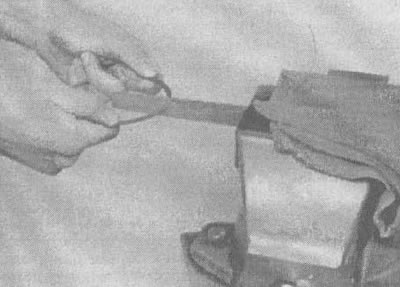
22.5 If the gap between the ends is too small, clamp the file in a vice and file down the ends of the ring (grind only from the outside to the inside) to increase the gap slightly
6. Excessive clearance becomes critical if it exceeds 0.040 inches. Check again that you have selected the correct rings.
7. Repeat the procedure for each ring that will be installed in the first cylinder, and for each ring in the remaining cylinders. The agreed piston-ring sets for each cylinder must not be disturbed.
8. After checking and adjusting the gaps, the rings can be installed on the pistons.
9. The oil scraper ring is installed first (the lowest ring on the piston). It consists of three separate parts. Insert the ring expander into the groove (see illustration). If an anti-roll insert is used, make sure it fits into the drilled hole in the ring groove. Then install the bottom part of the ring. When installing the ring parts, do not use a piston ring installer as this may break the ring parts. Instead, insert one end into the groove between the expander and the wall, hold it firmly in place, and slide your finger around the piston to push the ring into the groove (see illustration). Then insert the top part in the same way.
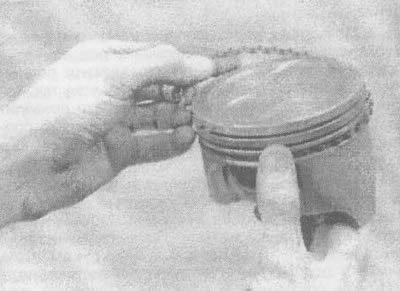
22.9a. Installing the expander into the oil scraper ring groove |
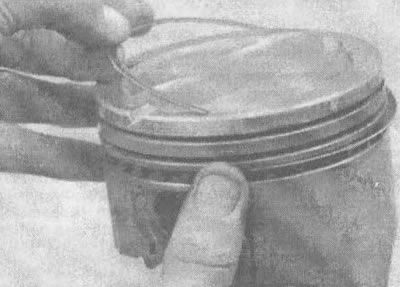
22.9b. Do not use piston ring pliers when installing the oil scraper ring side guides |
10. After installing the ring parts, check that both the upper and lower parts of the ring can rotate while sliding in the groove.
11. The second ring (the middle one) is installed next. It usually has a mark stamped on it, which should be directed towards the top of the piston.
Note: Always follow the instructions printed on the ring packaging - different manufacturers may have different requirements. Do not confuse the top and middle rings as they have different cross sections.
12. Use the piston ring installer and make sure the mark is facing the top of the piston, then install the ring into the middle groove on the piston (see illustration). Do not stretch the ring more than necessary to fit it onto the piston.
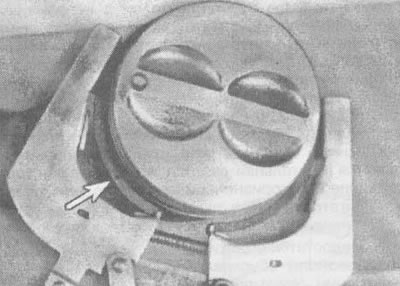
22.12. Installation of compression rings with ring expander. Label (shown by arrow) should be directed upwards
13. Install the first ring (upper) in the same way. Make sure that the mark is facing up. Be careful not to confuse the first and second rings.
14. Repeat the procedure for the remaining pistons and rings.
The original material is located on the website: CHEVYMAN.ru