


General description
The throttle position sensor (TPS) is located on the throttle shaft end of the throttle body. By continuously monitoring the output voltage from the TPS, the ECM/PCM determines the correct fuel delivery based on the throttle angle (according to the pressure on the accelerator pedal). A damaged or loose sensor can cause uneven fuel delivery from the injectors and unstable engine idling, since the ECM/PCM reacts to such faults as if they were throttle valve movements.
Examination
25. To check the sensor, set the ignition key to the "ON" position (without starting the engine) and connect the tester probes to the ground and signal wires on the back of the sensor's electrical connector (see illustrations).
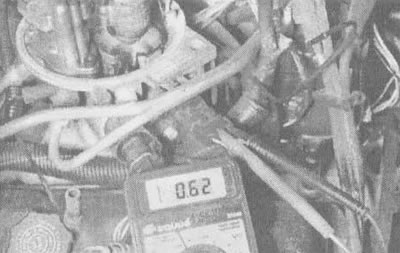
4.25a. On a 3.1L engine, the voltage should be between 0.6 and 4.4 V. Connect the positive lead of the tester to terminal "B" and the negative lead to terminal "A" (short to ground) |
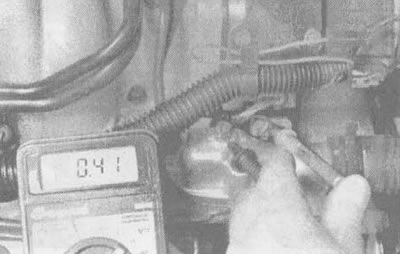
4.25b. On a 3.8L engine, the voltage should be between 0.4-4.2 V. Connect the positive lead of the tester to contact "B" and the negative lead to contact "C" (short to ground) |
26. When the accelerator pedal is not pressed (which corresponds to the engine running at idle speed) the tester should show a voltage in the range of 0.25-0.98 V. Ask an assistant to press the accelerator pedal, simulating a fully open valve - the voltage from the sensor should increase to 4.0-4.8 V. If the voltages you measured do not correspond to the values given above, replace the sensor.
27. Next, you should measure the resistance of the sensor. To do this, disconnect the electrical connector from the sensor and connect the tester probes to its contacts (see illustrations). Slowly open the throttle valve and observe the tester readings (with the transition from idle mode to operation with the throttle fully open, the resistance value of the sensor should change noticeably).
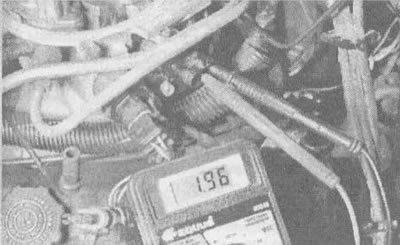
4.27a. On a 3.1L engine, the resistance should be between 1100-5600 Ohms. Connect the positive lead of the tester to terminal "B" and the negative lead to terminal "A" (short to ground) |
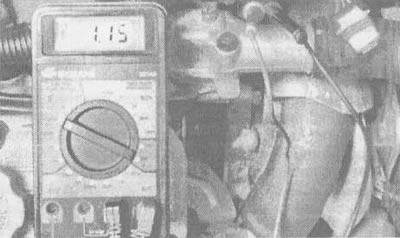
4.27b. On a 3.8L engine, the resistance should be within 1400-4700 Ohms. Connect the positive lead of the tester to terminal "B" and the negative lead to terminal "C" (shorted to ground) (the sensor in the photo has a resistance that is outside the required limits) |
28. If any of the sensor circuits fails, the control unit receives code 21 or 22. When receiving a fault code, the ECM/PCM unit will use a certain conditionally set value as a signal from the sensor and engine performance will be restored to some extent.
Replacement
29. If the throttle position sensor needs to be replaced, refer to the complete description of this procedure contained in section 12 Chapter 4 (for 3.1L engines) or in section 13 (for 3.8L engines).
[The material was created based on information from the website CHEVYMAN]