


Fuel is stored in a 64-litre fuel tank, which is suspended from the underbody at the rear of the vehicle. The fuel tank filler neck is located in a niche on the right rear fender.
The fuel module supplies fuel from the tank to the pipeline under a stable pressure within 296.4-310.3 kPa. The fuel module is located in the fuel tank and is attached to it with a clamping ring. It combines a submersible fuel pump, fuel pressure regulator, check valve, fuel filter and fuel level indicator sensor. The pump creates pressure in the fuel line immediately after the ignition is turned on, and it automatically turns off after a few seconds if the engine is not started.
Warning! When the engine is running, the fuel in the system is under pressure! Therefore, the safety of the vehicle operation depends on the tightness of the system. If you smell fuel, turn off the engine and inspect the fuel line and its connections for leaks and correct the problem.
The fuel pressure regulator is a bypass valve that limits pressure by draining excess fuel back into the tank. The check valve prevents fuel from draining from the fuel line back into the tank after the engine is turned off, which reduces the crankshaft rotation time during start-up.
A mesh fuel filter is installed on the inlet pipe of the fuel pump, which traps various dirt that gets into the fuel tank along with gasoline. After leaving the pump, the fuel passes through a fine filter. Using contaminated fuel will quickly clog the filters and reduce the operating pressure in the system, which will cause a drop in engine power to the point of complete engine shutdown. If the fuel pump fails, the engine will not start. When the fuel pump relay circuit is faulty, the engine management system malfunction indicator lamp on the instrument cluster comes on.
The fuel level indicator sensor consists of a float on a wire lever and a resistor board, the resistance of which changes depending on the angle of rotation of the lever. Based on the position of the float, the ECU determines the fuel level in the tank and sends information to the instrument panel via the data transmission circuit.
Fuel rail 2 with injectors 3 is located on the intake manifold.
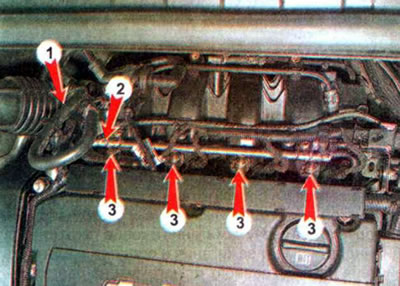
Fuel enters through hose 1 and, passing through the ramp, is distributed to the injectors. Four nozzles (one per cylinder) are fixed to the fuel rail and installed in the holes of the intake manifold. When the ignition is on, 12 V is constantly supplied to one of the injector terminals. To open the injector, the ECU connects the second terminal of the injector to ground. When the injector opens, fuel is injected under pressure into the space above the inlet valve. The ECU regulates the amount of injected fuel by changing the injector opening time. The tightness of the connections is ensured by rubber sealing rings placed on the nozzle pipes. The sealing rings must be replaced each time they are disconnected.
Note: You can check the serviceability of the injector by measuring the resistance at its terminals. A serviceable injector should have a resistance of 11-14 Ohms at a temperature of 10-32°C.