



In addition, it is worth paying attention to the environmental aspect of operating a car in winter. Compared to the summer period, the time it takes to warm up a car increases significantly and, as a result, the amount of toxic emissions into the atmosphere increases, which has an adverse effect on the environmental situation.
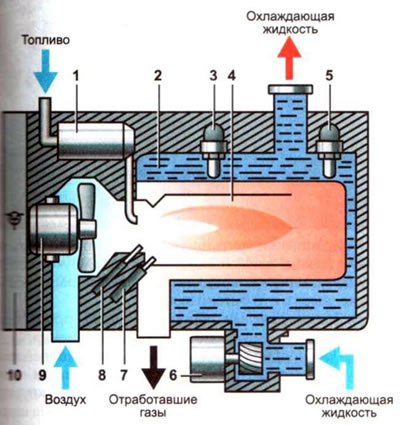
Pre-heater: 1 - fuel dosing pump; 2 - heat exchanger; 3 - temperature sensor; 4 — combustion chamber; 5 - overheating sensor; 6 - electric pump; 7 - flame sensor; 8 - glow plug; 9 — electric fan; 10 — control unit
Starting the engine at sub-zero temperatures also reduces its service life. To solve these problems, many cars in Scandinavian countries are equipped with pre-heaters.
The pre-heater is designed to warm up the engine coolant and, therefore, to reliably start the engine after the car has been parked for a long time in winter. It consists of a heating unit, which is located in the engine compartment, and an electronic control unit. The heating unit includes a glow plug, combustion chamber, fuel pump, injector, fan, electric coolant pump and exhaust system. The pump supplies fuel through the injector (diesel or petrol) into the combustion chamber of the heater. A fan forces air into the combustion chamber. The fuel-air mixture is ignited by a spark plug or a tungsten coil. During combustion, the mixture heats the heat exchanger, which in turn heats the coolant (antifreeze). The pump ensures the circulation of the heated coolant in the engine cooling system. The electronic control unit, depending on the program embedded in it, controls the switching on of the heating unit and the operation of the heater fan to warm up the car interior.
For ease of control of autonomous pre-heaters, depending on the car owner's requirements, the switching time and the required temperature are programmed either using a timer or using a radio or telephone remote control.
A non-autonomous heater, unlike an autonomous one, operates on the principle of convection, i.e. without forced circulation of the cooling liquid. The heating element is installed in the engine compartment or directly in the engine cylinder block. The heater operates on 220 V. The main disadvantage of this heater is that the electrical outlet is not always accessible.
All pre-heaters require increased attention during operation and maintenance. A faulty heater may cause a fire.
Cars in standard configuration are usually not equipped with pre-heaters. The installation of the pre-heater should be carried out in a certified service center, whose personnel have been trained in the installation of this equipment.
Warning! If the vehicle is under warranty, to avoid voiding the warranty, the pre-heater should only be installed by an authorized dealer.