


The exhaust system components include an exhaust manifold with a catalytic converter/intake pipe with a vibration-isolating coupling, an exhaust pipe with a main and additional muffler installed on it.
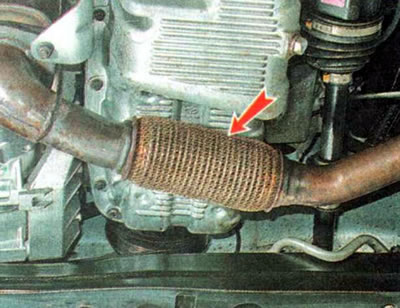
The exhaust manifold is connected to the inlet pipe. To reduce the transmission of vibrations to the body and reduce the load on the system during vibrations of the power unit, a vibration-isolating coupling - a bellows - is built into the intake pipe.
The catalytic converter is designed to reduce the level of toxicity of exhaust gases and, above all, to reduce the emission of products of incomplete combustion of fuel. The neutralizer is a container whose entire internal space is filled with tubular honeycombs.
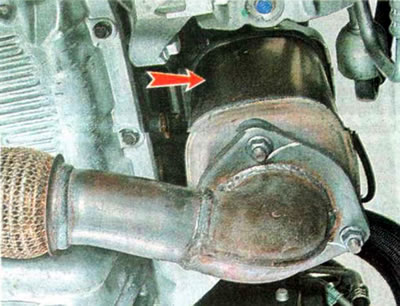
A control oxygen concentration sensor is installed at the top of the exhaust manifold, above the catalytic converter.
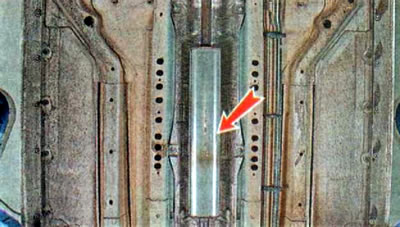
An additional muffler is installed in the central part of the exhaust system on the exhaust pipe.
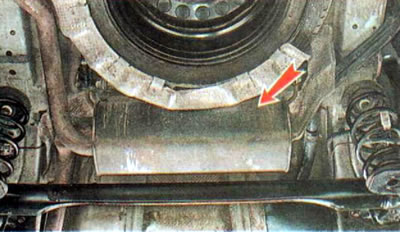
The main muffler of the engine exhaust system is installed transversely, in the rear overhang of the car.
All connections of the exhaust system elements are made rigid and sealed with gaskets.
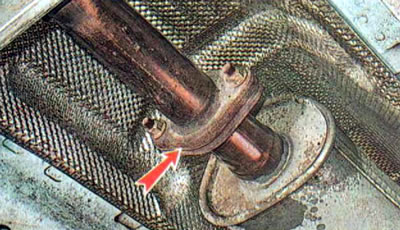
The exhaust system is suspended on rubber supports - cushions. These cushions are put on the brackets of the exhaust system and the brackets of the body. Two types of pillows are used. Main muffler suspension cushions...
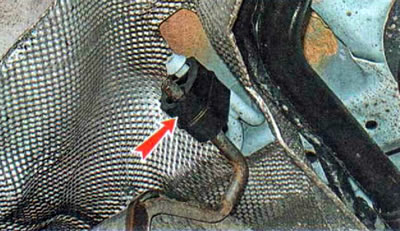
..and an additional muffler.
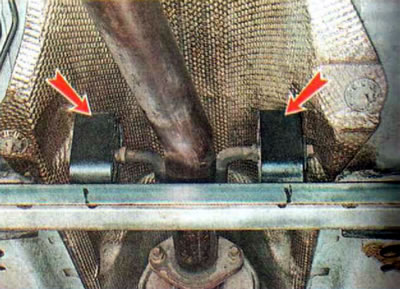
The vehicle parts are protected from high temperatures (individual elements of the exhaust system heat up to over 300°C) by heat shields located on the exhaust manifold and on the vehicle body.
During vehicle operation, the exhaust system components are exposed to high temperatures, vibration, as well as water, snow and reagents used to spray the road in winter. Therefore, as a rule, individual elements of the exhaust system serve on a vehicle for no more than five years. The partitions in the muffler burn out, through corrosion appears, and the tightness of the connection of the exhaust system elements is broken. Such malfunctions lead to an increase in the noise level of the exhaust of the running engine. We can visually identify areas where the seal is broken by traces of carbon deposits.
Warning! To avoid burns, work should be performed after the exhaust system parts have cooled to a safe temperature. When checking with the engine running, do not touch hot parts.
The location of the gas leak can be detected by running your hand near the exhaust system parts. This can be useful when damage cannot be detected by carbon deposits (for example, when gases break through upwards, observing from below, it is difficult to detect the place of the breakthrough).
Recommendation. Defective system elements damaged by through corrosion must be replaced. Restoring the tightness of the exhaust system using welding only gives a short-term effect.
Signs of a faulty catalytic converter may include a noticeable loss of engine power and rough idling.