


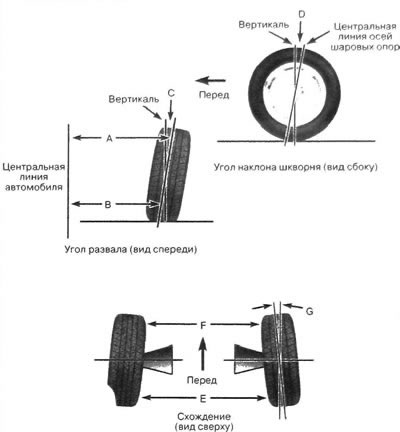
26.1. Front Wheel Alignment Parameters A-B = C (camber, in degrees); D = rack tilt angle, in degrees; E - discrepancy, in inches; G = toe-in (converted to degrees)
Since checking the correct wheel alignment requires both special measuring equipment and the ability to use it correctly, it is recommended that the check and adjustment be performed at a service station. Below is information that provides an idea of the front wheel alignment angles, familiarization with which will allow you to better understand the adjustment process, as well as to discuss in detail with a specialist the scope of the necessary work.
Wheel alignment is determined by their rotation in the vertical plane. Adjusting the toe-in ensures that the front wheels rotate parallel. At zero toe-in, the distance between the symmetrical points on the leading edges of the wheels will be equal to the distance between the points on the trailing edges.
Normal toe-in values are between 2 and 12 mm. Adjustment is made by turning the steering rod adjustment tubes to increase or decrease their length. Incorrect alignment results in intensive tire wear caused by increased friction with the road surface. Toe-in can be adjusted by turning the steering rod adjusting bushings an equal number of turns in one direction.
Camber is the angle between the plane of the wheel and the vertical drawn through the wheel axis and the center of the tire contact area with the supporting surface when viewing the vehicle from the front or rear. Camber is considered positive if the top of the wheel is tilted outward relative to the vertical, and negative if inward.
The degree of camber is determined by the angle from the vertical in degrees, which is sometimes called the front camber angle. Correct adjustment of the camber angle affects the tightness of the tire tread to the road, and also ensures the balancing of the imbalance of forces that occurs when driving on an uneven road or entering a turn.
The strut angle is the angle between the suspension strut axis and a line drawn through the center of each wheel and the midpoint of the tire contact patch when viewed from the side of the vehicle. The longitudinal inclination angle is considered positive if the point of intersection of the suspension axis with the supporting surface is in front of the point of intersection with this surface of the vertical line passing through the wheel axis, and negative if it is behind.
When adjusting, first the angle of the rack is corrected, then the camber angle, and after that the toe angle.
(The article is reprinted from the website: «CHEVYMAN.ru»)