
ChevyMan.ru
Mazda Mitsubishi Toyota Land Rover Honda Kia Nissan
English Русский
Български
Беларускі
Український
Српски
Hrvatski
Română
Polski
Slovenský
Magyar
|
Articles | Sitemap | Contacts |


Home   Aveo   Captiva   Cruze   Lacetti   Lanos   Niva   Tahoe   Others  
Orlando 1 (2010-2018) Trailblazer 1 (2001-2008, petrol) Lumina 1 (1989-1994)
  • Home
  • Chevrolet
  • Trailblazer 1
  • Power unit
  • Cooling and heating
  • Radiator — removal and installation

Radiator — removal and installation (Chevrolet Trailblazer 1)

            0

Warning 1: The air conditioning system is under high pressure. Do not loosen the couplings or remove components without first discharging the system when contacting an authorized or specialized service station. When disconnecting the air conditioning system couplings, wear protective glasses or a mask.


Warning 2: Before proceeding with this procedure, wait until the engine has cooled down completely.


Note: The vehicles described use spring-loaded radiator hose clamps. If you decide to continue using the hoses, make sure the hose surface on the branch pipe is clean and dry before securing them with spring clamps. Do not secure replacement hoses with spring clamps - replace them with worm drive fasteners.


1. If the procedure is performed on a vehicle without an additional (rear) air conditioning system, drain the refrigerant (see Warning at the beginning of this subsection).

2. Disconnect the negative cable from the battery.

3. Drain the coolant from the system (see chapter 1), then remove the fan together with the casing and drive coupling (see subsection 5).

4. Raise the vehicle and support it on vertical stands.

5. Disconnect the lower hose from the radiator.

6. If necessary, remove the radiator bracket shield.

7. Disconnect the transmission cooling lines from the radiator (see illustration). First, you need to disconnect the plastic ring, then remove the clamp and disconnect the quick-release coupling. After disconnecting, plug the lines to prevent coolant from leaking out. To catch spilled liquid, it is necessary to prepare a suitable container. Before subsequent installation, it is necessary to inspect the sealing rings of the transmission cooling lines.
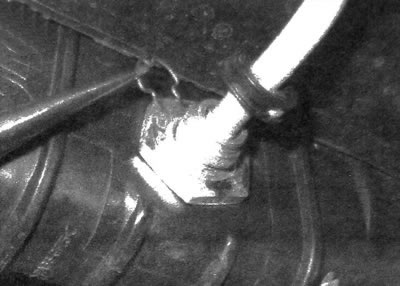


6.7. As a rule, to disconnect the quick-release coupling of the transmission coolant line, it is…

6.7. As a rule, to disconnect the quick-release coupling of the transmission coolant line, it is necessary to disconnect the plastic ring and remove the clamp


Note: Do not remove the clutch clamp by simply pulling it out. Holding one side with your fingers, grab the outer edge with tweezers (with curved tips) and remove the clamp using a rotating motion. The clamp is installed using a similar technique, without direct pressing.


8. Lower the vehicle onto a supporting surface.

9. Remove the radiator support bridge (see illustration) and a cooling system hose connected to the expansion tank.
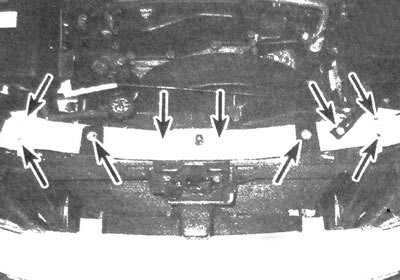
6.9. Radiator support crossbar fasteners

6.9. Radiator support crossbar fasteners


10. Disconnect the side panels and remove the radiator.

Note: On models without rear air conditioning, the condenser is removed together with the radiator. The separation of the elements occurs when the bolts of the capacitor bracket are unscrewed.


11. Before installing the radiator, if necessary, replace damaged hoses and clamps.

12. The radiator is installed in the reverse order of removal. After installation, make sure that the radiator is securely seated in the lower saddles and that the upper brackets are securely fastened. Before connecting the transmission coolant lines, install the clamps into the quick release couplings, then secure the lines with the couplings. Don't forget to secure the coupling clamps with plastic rings.

Note: If the plastic rings do not connect easily to the couplings, the assembly is not done correctly.


13. After installation, fill the cooling system (see chapter 1) and check the engine oil and automatic transmission fluid levels.

14. If the vehicle is not equipped with a rear air conditioning system, contact a specialized station to refill the system with refrigerant.

[The original material is located on the website «ChevyMan»]

The article was checked: Vladimir Romannikov
This article is available at russian, bulgarian, belarusian, ukrainian, serbian, croatian, romanian, polish, slovak, hungarian

Share information:

Previous articles
Trailblazer 1: Cooling and heating
Next articles

Cooling system fan, its coupling and casing — removal and installation
Cooling system fan and its clutch — checking the functionality
Thermostat — Checking Performance and Replacement
Antifreeze — general information
General information
Coolant pump — checking performance and replacement
Coolant Temperature Sensor — Checking Functionality and Replacement
Heater fan and its electrical circuit — checking the functionality
Heater Fan — Removal and Installation
Control panel for heating and air conditioning systems — removal and installation


See similar articles on the topic of Chevrolet cars:
Removal and installation of the electric fan of the radiator of the engine cooling system in assembly with the casing Chevrolet Aveo T300 (2012-2018)
Engine oil filter and radiator Chevrolet Captiva 1 (2006-2018)
Removal and installation the electric fan of the radiator of the cooling system Chevrolet Cruze 1 (2008-2016)
Removal the radiator fan Chevrolet Lacetti 1 (2002-2009)
Removal the radiator fans Chevrolet Lanos T150 (2002-2009)
Radiator — removal and inspection Chevrolet Niva 1 (2002-2016)
Radiator — removal and installation Chevrolet Tahoe 1 (1992-2000)
Link in different formats to this page


Visitor comments

No comments yet


How much will 10 + 44 =


Orlando 1 (2010-2018) 
  • General information
  • Introduction to manual
  • User manual
  • Maintenance
  • Troubleshooting
  • Power unit
  • Engine repair
  • Fuel and control system
  • Cooling and lubrication system
  • Ignition system
  • Transmission
  • Clutch
  • Gearbox
  • Drive shafts
  • Chassis
  • Car suspension
  • Steering
  • Brake system
  • Body
  • Exterior (external elements)
  • Doors, locks and windows
  • Electrical equipment
  • Equipment and devices
  • Windscreen wipers
  • Power devices
  • Electrical diagrams


Trailblazer 1 (2001-2008) 
  • General information
  • User manual
  • Troubleshooting
  • Maintenance
  • Power unit
  • Engine in a car
  • Engine overhaul
  • Cooling and heating
  • Fuel and exhaust system
  • Engine electrical equipment
  • Engine control
  • Transmission
  • Automatic gearbox
  • Transfer case
  • Drive shafts and cardan
  • Chassis
  • Brake system
  • Car suspension
  • Steering
  • Body
  • Exterior (external elements)
  • Interior (internal elements)
  • Doors, locks and windows
  • Electrical equipment
  • Equipment and devices
  • Electrical circuits


Lumina 1 (1989-1994) 
  • General information
  • Maintenance
  • Power unit
  • Engine 3.1L V6
  • Engine 3.8L V6
  • Engine overhaul
  • Cooling system
  • Power and exhaust system
  • Fuel injection
  • Engine electrical equipment
  • Reduced exhaust gas toxicity
  • Transmission
  • Automatic gearbox
  • Drive shafts
  • Chassis
  • Brake system
  • Car suspension
  • Steering
  • Body
  • Heating and air conditioning
  • Repair of body elements
  • Doors, covers and windows
  • Interior (internal elements)
  • Electrical equipment
  • Equipment and devices
  • Electrical circuits


ChevyMan.ru © 2017-2026 · Mobile version · Feedback · Site search · Interesting to read · Sitemap: EN BG BY UA RS HR RO PL SK HU

Aveo 2003-2008 · Aveo 2006-2011 · Aveo 2012-2018 · Captiva 2006-2018 · Cruze 2008-2016 · Lacetti 2002-2009 · Lanos 2002-2009 · Niva 2002-2016 · Tahoe 1992-2000 · Tahoe 2000-2014 · Lumina 1 1989-1994 · Trailblazer 1 2001-2008 · Orlando 1 2010-2018 ·
🛡️ For your security and to improve our service, this site uses cookies. You can disable them in your browser.