


Contents: Checking functionality ↧ Replacement ↧
Note: The thermostat is an integral part of the housing.
Checking functionality
1. Before deciding that the thermostat is faulty, check the coolant level, drive belt tension (see chapter 1) and the performance of the sensor (or indicator) temperature.
2. If the engine takes too long to warm up (which can be determined by the cold air coming out of the heater or by the temperature indicator readings), then it is possible that the thermostat is stuck in the open position. Make a replacement.
3. If the engine is warm, touch the lower radiator hose with your hand. If the hose does not heat up, then the thermostat is probably stuck in the closed position and does not allow coolant to pass from the cooling jacket to the radiator - replace it.
Warning: Do not operate the vehicle without a thermostat. The engine control unit will constantly record an open thermostat condition, which will reduce the efficiency of exhaust gas toxicity control and lead to increased fuel consumption.
4. A hot lower radiator hose indicates that coolant is circulating in the system, which is only possible when the thermostat is open. To determine the cause of engine overheating, refer to the "Determining the Causes of Malfunctions" subsection at the beginning of this manual.
Replacement
Warning: Allow the engine to cool completely before performing this procedure.
5. Disconnect the negative battery cable.
Partially drain the coolant from the cooling system. If the condition allows, the drained liquid can be reused for its intended purpose. If you are planning to change the fluid, please refer to the safety requirements for handling antifreeze in subsection 2.
6. Remove the generator (see chapter 5).
7. Locate the thermostat housing, which is located in the upper radiator hose, on the left side of the cylinder block (see illustration).
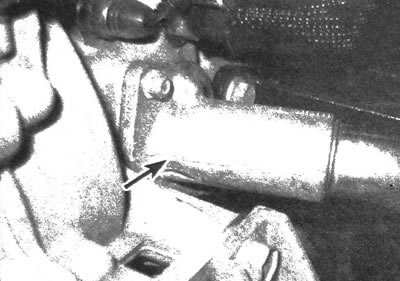
3.7. The thermostat housing is located on the left side of the cylinder block (for clarity, shown with the generator removed); it should be noted that the thermostat is not separated from the casing
8. Loosen the clamp and disconnect the radiator hose from the thermostat housing. If necessary, grasp the hose near the fitting with a pipe wrench and twist it to disconnect. It may be necessary to cut the old hose during removal in order to replace it during subsequent assembly.
9. If the outer surface of the thermostat adjacent to the hose is subject to corrosion, has cavities or other defects, then further damage may occur when the hose is removed. In this case, it is necessary to replace the thermostat housing.
10. Remove the bolts and detach the thermostat housing. If necessary, use a soft-faced hammer to remove the casing. If the casing becomes depressurized, coolant may leak out.
11. Clean the mating surfaces of the cylinder block and thermostat housing. Install a new sealing ring into the groove of the casing (see illustration).
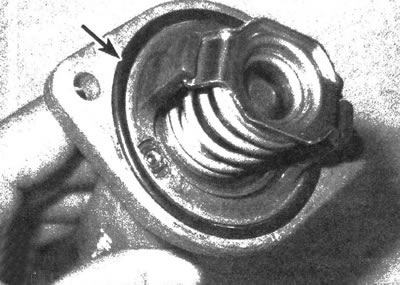
3.11. After cleaning the casing or when replacing the thermostat, it is necessary to install a new sealing ring
12. Connect the thermostat housing to the intake manifold and tighten the mounting bolts to the required torque.
13. The rest of the assembly is carried out in the reverse order of removal. At the same time, one should not miss the convenient opportunity to inspect and replace the cooling system hoses as necessary (see chapter 1).
14. Fill the cooling system as described in chapter 1. Start the engine and check for coolant leaks.
15. Repeat the operations described in paragraphs 1-4 to ensure that the reasons that led to the replacement were eliminated during the replacement.