
ChevyMan.ru
Mazda Mitsubishi Toyota Land Rover Honda Kia Nissan
English Русский
Български
Беларускі
Український
Српски
Hrvatski
Română
Polski
Slovenský
Magyar
|
Articles | Sitemap | Contacts |


Home   Aveo   Captiva   Cruze   Lacetti   Lanos   Niva   Tahoe   Others  
Aveo T300 (2012-2018) Aveo T250 (2006-2011) Aveo T200 (2003-2008)
  • Home
  • Aveo
  • T250 (2006-2011)
  • Engine 1.5 SOHC
  • Cooling system
  • Thermostat — Removal, Checking and Installation

Thermostat — Removal, Checking and Installation (Chevrolet Aveo T250)

            0

Contents: Checking the Thermostat ↧ Removal the thermostat ↧ Installing a thermostat ↧
Thermostat — Removal, Checking and Installation


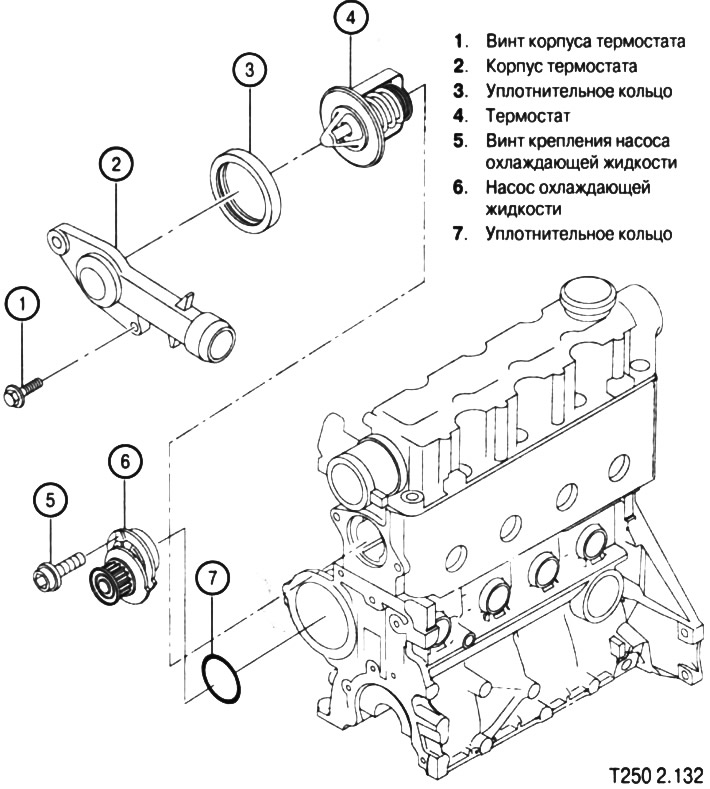
The thermostat controls the flow of coolant through the system and is housed in a housing and mounted on the front of the cylinder head

To ensure rapid heating and temperature regulation, the thermostat partially or completely blocks the flow of coolant circulation through the radiator.

After the engine warms up, the thermostat opens. This allows the coolant to flow through the radiator and release heat into the surrounding space.

The elastic ball in the thermostat is hermetically sealed in a metal housing. It expands when heated and contracts when cooled.

Checking the Thermostat


1. Remove the thermostat.

2. Make sure that the valve spring is tightly compressed when the thermostat housing is completely closed. If the spring is not tightly compressed, replace the thermostat.

3. Place the thermostat and thermometer in a container with a 50/50 solution of ethylene glycol and water. Do not allow the thermostat and thermometer to rest on the bottom of the container, as uneven heat distribution across the bottom may cause inaccurate temperature readings.


4. Heat the solution.

5. Monitor the temperature of the solution during heating.

The thermostat should start opening at 87°C and should fully open at 102°C. If it doesn't open at these temperatures, replace the thermostat.

Removal the thermostat


Caution: Before removing the expansion tank cap, wait until the engine has cooled down to prevent the release of hot fluid or steam.


1. Drain the coolant.

2. Remove the rear part of the timing belt cover

3. Loosen the hose clamp on the upper radiator hose at the thermostat housing.

4. Disconnect the upper hose from the radiator.

5. Unscrew the screws securing the thermostat housing to the cylinder head.

6. Remove the thermostat housing from the cylinder head.

7. Remove the thermostat from its seat in the cylinder head.

8. Inspect the valve seat for foreign objects that could cause it to not close tightly.

9. Check that the thermostat is working properly.

10. Clean the thermostat housing and mating surfaces of the cylinder head.

Installing a thermostat


1. Install the thermostat into the mounting location.

2. Install the thermostat housing.

3. Secure the thermostat housing by tightening the mounting screws to a torque of 20 Nm.

4. Install the removed elements in the reverse order of removal.

[The original article is on the website ChevyMan.ru]

The article was checked: Vladimir Romannikov
This article is available at russian, bulgarian, belarusian, ukrainian, serbian, croatian, romanian, polish, slovak, hungarian

Share information:

Previous articles
Aveo T250: Cooling system
Next articles

Removal coolant and filling the cooling system
Expansion tank
Description of the cooling system
Coolant pump
Radiator cooling fan
Radiator — removal and installation


See similar articles on the topic of Chevrolet cars:
Checking oil pressure Chevrolet Captiva 1 (2006-2018)
Checking the wheels Chevrolet Cruze 1 (2008-2016)
Removal and checking the thermostat Chevrolet Lacetti 1 (2002-2009)
Removal and checking the thermostat Chevrolet Lanos T150 (2002-2009)
Checking the engine on a car after repair Chevrolet Niva 1 (2002-2016)
Checking the air filter with thermostat Chevrolet Tahoe 1 (1992-2000)
Checking and replacing the thermostat Chevrolet Lumina 1 (1989-1994)
Link in different formats to this page


Visitor comments

No comments yet


How much will 10 + 50 =


Aveo T300 (2012-2018) 
  • General information
  • Vehicle device
  • User manual
  • Main malfunctions
  • Maintenance
  • Power unit
  • Engine
  • Lubrication system
  • Cooling system
  • Supply system
  • Exhaust system
  • Transmission
  • Clutch
  • Manual gearbox
  • Automatic gearbox
  • Front wheel drives
  • Chassis
  • Front suspension
  • Rear suspension
  • Steering
  • Brake system
  • Body
  • Exterior
  • Interior
  • Doors and trunk
  • Security systems
  • Electrical equipment
  • Engine electrics
  • Equipment and devices
  • Heating and air conditioning
  • Electrical circuits


Aveo T250 (2006-2011) 
  • Manual
  • Driver's workplace
  • Salon equipment
  • Vehicle characteristics
  • Maintenance
  • Engine 1.5 SOHC
  • Engine repair
  • Fuel supply system
  • Control system
  • Cooling system
  • Engine 1.6 DOHC
  • Engine repair
  • Control system
  • Transmission
  • Clutch
  • Manual gearbox
  • Automatic gearbox
  • Wheel drive
  • Chassis
  • Wheel suspension
  • Steering
  • Brake system
  • Body
  • Exterior
  • Interior


Aveo T200 (2003-2008) 
  • General information
  • User manual
  • Power unit
  • Engine repair 1.5L SOHC
  • Fuel system
  • Control system
  • Cooling system
  • Transmission
  • Clutch
  • Manual gearbox
  • Automatic gearbox
  • Drive shafts
  • Chassis
  • Front suspension
  • Rear suspension
  • Steering
  • Brake system
  • Body
  • Exterior (external elements)
  • Interior (internal elements)
  • Electrical equipment
  • Equipment and devices
  • Electrical circuits


ChevyMan.ru © 2017-2026 · Mobile version · Feedback · Site search · Interesting to read · Sitemap: EN BG BY UA RS HR RO PL SK HU

Aveo 2003-2008 · Aveo 2006-2011 · Aveo 2012-2018 · Captiva 2006-2018 · Cruze 2008-2016 · Lacetti 2002-2009 · Lanos 2002-2009 · Niva 2002-2016 · Tahoe 1992-2000 · Tahoe 2000-2014 · Lumina 1 1989-1994 · Trailblazer 1 2001-2008 · Orlando 1 2010-2018 ·
🛡️ For your security and to improve our service, this site uses cookies. You can disable them in your browser.