


Contents: Removal ↧ Installation ↧
The car is equipped with a lightweight aluminum tubular-fin radiator. There are three models of the radiator depending on the climatic conditions:
- light duty model,
- standard model,
- model for difficult conditions.
The models differ only in the volume of coolant. Plastic tanks are attached to the right and left of the tubular part of the radiator.
On vehicles equipped with an automatic transmission, the transmission coolant lines pass through the left radiator tank. The coolant drain cock is located on the radiator.
Removal
1. Disconnect the "-" battery cable.
2. Drain some of the coolant from the cooling system.
3. Remove the fan.
4. Disconnect the upper hose from the radiator.
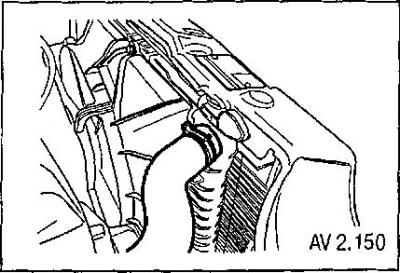
5. Disconnect the lower radiator hose.
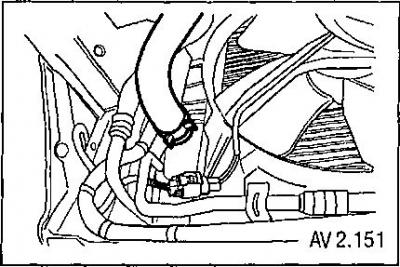
6. Disconnect the expansion tank hose from the radiator.
7. Remove the left and right upper radiator mounting brackets.
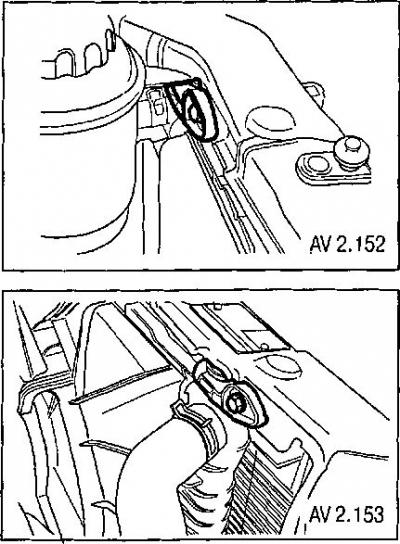
8. Remove the radiator.
Warning: There is still a significant amount of coolant in the radiator. Drain the remaining liquid into a container.
Installation
1. Install the radiator in place, placing rubber shock-absorbing pads under the radiator.
2. Install the radiator fasteners back into place.
3. Install the right and left upper radiator mounting brackets.
4. Secure the radiator by tightening the mounting screws to a torque of 10 Nm.
5. Connect the expansion tank hose to the radiator and secure it with a clamp.
6. Reinstall the upper and lower radiator hoses and secure them with clamps.
7. Install the fan.
8. Fill the engine cooling system.
9. Connect the "-" wire of the battery.
[Original version of the article on the website «ChevyMan.ru»]