


2. Setting the piston (s)to the TDC position is an essential part of a variety of procedures, such as removing the camshaft, drive chain, and timing chain.
3. Remove the spark plugs (see chapter 1, section 32).
4. Place the automatic transmission in the Park position and lock the rear wheels of the vehicle. Raise the front of the vehicle and support it securely on jack stands.
5. When looking at the engine from the drive belt side, the normal rotation of the crankshaft is clockwise. To set any piston to the TDC position, it is necessary to turn the crankshaft with a socket wrench with a ratchet (ratchet) by the bolt screwed into the center of the anti-vibrator on the crankshaft.
6. Have your assistant turn the crankshaft with a ratchet socket as described above while you hold your finger over the spark plug hole of cylinder 1 (see illustration).
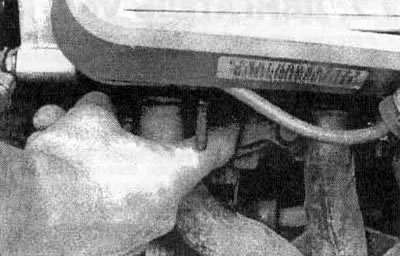
3.6 Hold your finger over the spark plug hole until you feel air coming out
Note: To locate the location of cylinder 1, refer to the illustration in the Technical Data section of this chapter.
7. When the piston approaches TDC, air pressure will be felt at the spark plug hole. Have your assistant turn the crankshaft slowly.
8. Insert the plastic handle into the spark plug hole (see illustration). As the piston rises, the handle will begin to be pushed out. Pay attention to the point where the handle stops - this is TDC.
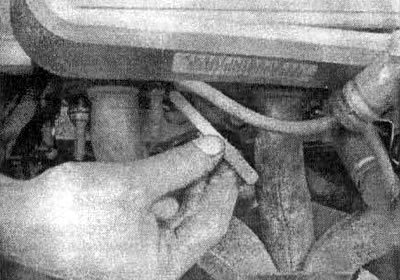
3.8. Insert a plastic pen into the spark plug hole to detect piston movement
9. Once cylinder 1 is at TDC on the compression stroke, the top dead centers for the remaining pistons can be found by rotating the crankshaft clockwise 120° in accordance with the firing order of the cylinders, or steps 6-8 can be repeated to find TDC for each specific cylinder.
(The original source of the article is the website «CHEVYMAN.ru»)