


Examination
Make sure the correct spark plugs are installed. The wrong type of spark plug will cause poor engine drivability.
Make sure the spark plug is the correct heat range. Installing a spark plug with the wrong heat range will result in:
- spark plug contamination, replace with a hotter spark plug;
- premature ignition, leading to damage to the spark plug or engine, replace with a colder spark plug.
Inspect the terminal (1) of the spark plug wire for signs of damage. Check the reliability of the terminal screwing (it shouldn't rotate).
Inspect the insulator (2), look for cracks or soot deposits. Cracks or soot cause breakdown between terminal (1) and "ground" instead of breakdown between electrodes (3) and (4).
Measure the gap between the central electrode (4) and the ground electrode (3). An excessively large gap may cause irregular spark plug operation.
Shake the spark plug: a rattling sound indicates internal damage to the spark plug (looseness of the central electrode (4) reduces the power of the spark discharge).
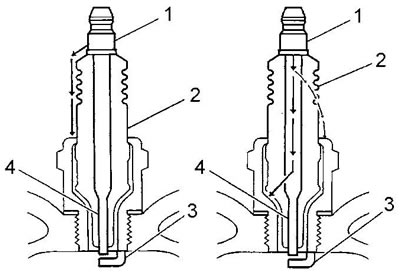
Checking spark plugs |
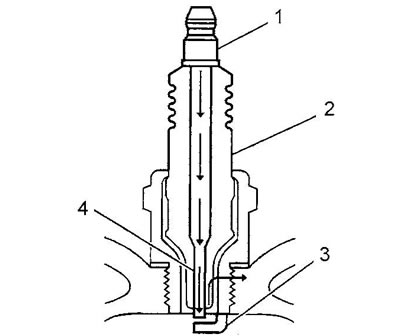
Measuring the gap between the central and side electrodes |
Inspect the area of the spark plug protruding from the cylinder head. Dirty or damaged threads indicate improper installation of the spark plug.
During normal spark plug operation, the color of the insulator changes from gray-yellow to brown with small inclusions of a powdery substance (combustion products of additives in fuel and oil).
Dry and fluffy carbon deposits can be caused by the following:
- a) Rich air-fuel mixture
- leaking injectors
- excessive fuel pressure
- dirty air filter
- incorrect combustion
- b) Low output voltage
- ignition coil defect
- spark plug wire defect
- incorrect spark plug gap
- c) Long-term operation at idle or low speeds.
Removal
1. Remove the wire from the spark plug.
- a) Turn the spark plug wire boot half a turn.
- b) Pull the cover to remove the wire.
2. Clean the area around the spark plug.
3. Remove the spark plug. If you remove several spark plugs, mark their installation locations.
Installation
1. Check that the spark plug sealing washer is present and installed correctly.
2. Check the gap between the spark plug electrodes and adjust if necessary.
3. Screw the candle in by hand until it stops.
4. Tighten the spark plug. Tightening torque 15 N·m.
5. Install the spark plug wire.
6. Check that the wire is installed correctly - squeeze the sides of the cover and make sure it fits tightly.