


Note: The EGR system was not installed on 3.8L engines produced in 1990-1992.
Engines with a displacement of 3.1 liters (eGR vacuum valve)
General description
1. The exhaust gas recirculation (EGR) system is used to reduce the content of NOx compounds formed due to high temperatures during fuel combustion (nitrogen oxides) in exhaust gases. This is achieved by reducing the combustion temperature. To reduce the temperature, exhaust gases are returned from the exhaust system to the intake manifold during engine operation in economical mode. The presence of these gases leads to a decrease in combustion temperature and, in turn, to a decrease in the content of NOx compounds formed during fuel combustion.
2. The exhaust gas recirculation (EGR) system installed on 3.1L engines consists of a negative or positive backpressure EGR valve, a manifold vacuum source tube, and an electronically controlled vacuum valve (EVRV) solenoid that controls this source.
Examination
3. If the exhaust gas recirculation flow is too strong, the fuel combustion is weakened, as a result of which the engine starts to run unevenly or even stalls. Excessive exhaust gas recirculation causes the engine to stall after a cold start or at idle when the engine speed is reduced, and the vehicle begins to move jerkily at economical speeds or its idling becomes uneven. If the EGR valve is constantly open, the idle mode may not work at all.
4. If the exhaust gas recirculation flow is too weak or absent, the fuel combustion temperature increases excessively with increasing engine speed or when the engine is operating under load. This may result in detonation, engine overheating and failure to pass the exhaust gas composition and quantity test.
5. The following tests will help you identify faults affecting the operation of the EGR system. When the job description recommends lifting the EGR valve diaphragm, wear heat-protective gloves to avoid burns.
Exhaust gas recirculation valve
6. The recirculation system valve is controlled by a normally open solenoid, which, when voltage is applied to it, activates the valve, supplying a vacuum to the system. The solenoid, powered by the ECM, activates the exhaust gas recirculation system and continuously monitors flow parameters using the EGR thermostat. The ECM controls the EGR system when three conditions are met: the coolant temperature must be above 45°C, the throttle position sensor (TPS) signals that it is partially open, and the MAP sensor is in the middle of the operating range. If a fault is detected in the vacuum solenoid, thermal relay or vacuum source, the system generates code 32.
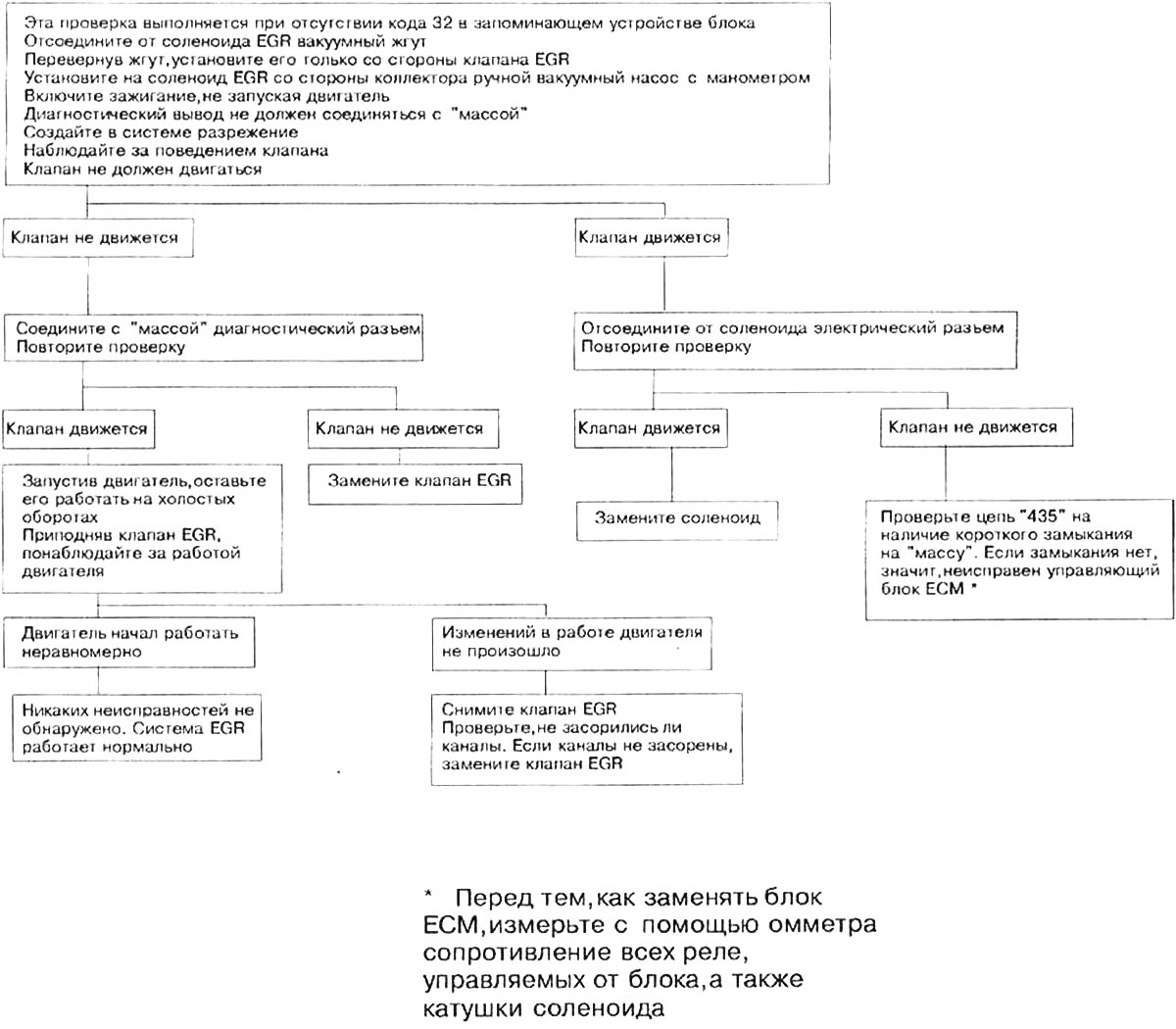
7. The attached diagram shows the sequence for checking the EGR valve, illustrated with photographs.
Open large image in new tab →
7.7 a. Diagram of the sequence of checking the valve of the exhaust gas recirculation system with control from the ECM unit (for 3.1L engines only)
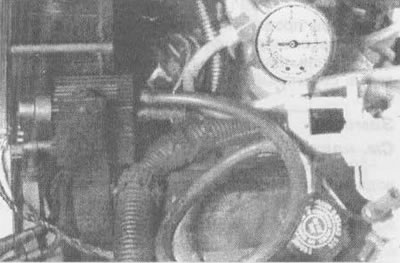
7.7b. Create a vacuum in the EVRV valve on the EGR system side and, without shorting the diagnostic output of the ALDL unit to ground, observe any movement of the EVRV valve... |
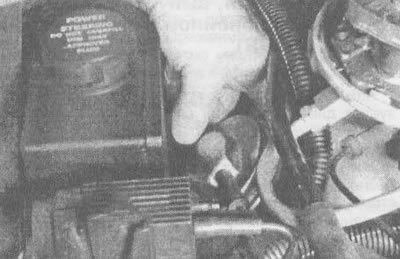
7.7v....by placing your finger directly on the diaphragm inside the EGR valve body (there should be no valve movement) |
Exhaust Gas Recirculation Control System
8. When the code 32 is displayed by the lamp glowing "SERVICE ENGINE SOON" or "CHECK ENGINE" ("Check Engine") you can immediately identify the most likely sources of the recirculation system malfunction. When selecting the optimal recirculation activation time, the EGR system takes into account factors such as signals from the coolant temperature sensor, TPS sensor, MAP sensor, BARO sensor, torque converter clutch position, and engine speed.
9. The exhaust gas recirculation (EGR) vacuum valve (EVRV) control solenoid is controlled by the pulse width set by the ECM when the solenoid is activated by the EGR. Under normal conditions, the valve is open and the vacuum source is the transfer signal. The ECM module switches the EGR system on and off ("duty cycle") by closing the "435" circuit (gray wire) to "mass". The duty cycle is zero percent (exhaust gases are not recirculated), when the gear shift lever is in the neutral or park position, when the TPS input signal is below the set value, and when the "WOT" (wide open throttle) signal is applied.
Replacement of system elements
EGR valve
10. When purchasing a new EGR valve, make sure you are purchasing the correct valve for your vehicle. To do this, check the identification code stamped on the top of the valve body.
11. Disconnect the cable from the negative terminal of the battery.
12. Remove the air filter housing (see chapter 4, section 8).
13. Disconnect the vacuum line from the EGR valve.
14. Loosen the EGR valve mounting bolts.
15. Remove the EGR valve from the manifold together with the gasket. The gasket can be thrown away.
16. Using a wire brush, remove the carbon layer from the mounting surface on the manifold and, if you intend to reuse the removed valve, do the same with the mounting surface on the valve itself. Check for traces of carbon deposits in the exhaust port. Remove deposits with a screwdriver.
Attention! Do not wash the valve in solvents or degreasing compounds - if any of these liquids get on its diaphragm, it will gradually deteriorate. Sandblasting is also not recommended: its consequences may negatively affect the operation of the valve.
17. If there is too much combustion product deposits in the EGR channel, grind them off with a wire wheel. To avoid clogging the EGR valve with carbon particles and getting them into the engine, after finishing the channel treatment, check that it is completely clean.
18. The valve is installed in the reverse order.
Hoses
19. If you need to replace hoses, make sure that the hoses you purchase are labeled "Fluoroelastomer". When installing new hoses, refer to the diagram on the VECI label (fixed to the fan casing). Detailed information on the procedure for checking the technical condition of the hoses and their maintenance is contained in section 10 Chapter 1.
Electronic Vacuum Regulator Valve (EVRV)
20. Disconnect the cable from the negative terminal of the battery.
21. Remove the air filter housing (see chapter 4, section 8).
22. Disconnect the electrical connector from the solenoid.
23. Disconnect both vacuum hoses, having first clearly marked them.
24. After unscrewing the mounting bolt, remove the solenoid.
25. Installation is carried out in reverse order.
3.8L engines produced since 1993. (with linear valve EGR system)
General description
26. The linear EGR valve system is used to reduce the content of NOx compounds formed due to high temperatures during fuel combustion (nitrogen oxides) in exhaust gases. This is achieved by lowering the combustion temperature of the fuel. In a linear system, as in a vacuum system, combustion gases are directed from the exhaust system back to the intake manifold under most engine operating conditions. Due to their presence, the combustion temperature drops, and along with it, the amount of NOx compounds formed decreases.
27. The EGR linear recirculation valve is designed to ensure uninterrupted supply of exhaust gases to the engine regardless of the degree of vacuum in the intake manifold. This valve has the same rotary axis as the vacuum valves, but here the axis is driven by a computer-controlled stepper motor (from the RSM block). Usually the linear EGR valve is triggered (opens) whenever the engine has warmed up to normal operating temperature and is running above idle speed. The PCM unit determines when and how much the valve should be opened (rotate its axis) by continuously monitoring signals from the coolant temperature sensor (ECT), throttle position sensor (TPS) and mass air flow (MAF) sensor.
Examination
28. This valve requires a special scanning device to check, so take it to a service center or repair shop to perform diagnostic procedures.
Replacement
29. Disconnect the cable from the negative terminal of the battery.
30. Remove the EGR valve from the intake manifold by unscrewing the two nuts (see illustration).
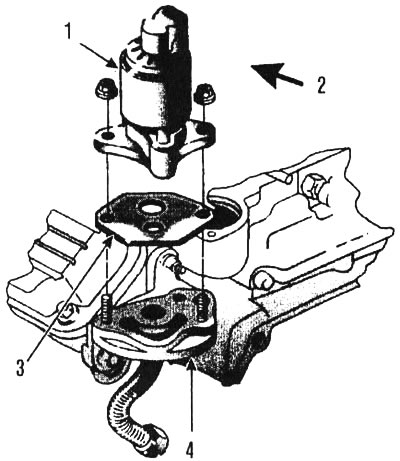
7.30. Details on the EGR valve installed on 3.8L engines since 1993: 1 - EGR linear valve, 2 - front part, 3 - gasket, 4 - EGR valve adapter
31. Remove the gasket and clean the valve and adapter mounting surfaces. If necessary, remove any traces of the old gasket material from them using a scraper.
32. After installing the new gasket and valve, tighten the nuts securely.
33. Connect the connector to the valve.