


Contents: General description ↧ Main recirculation valve ↧ Solenoid valve (only cars up to 8500… ↧ Solenoid valve (cars after 8500 GVW) ↧
Models before 1995
General description
1. The recirculation system includes a recirculation valve (see photo), solenoid valve and ECM processor unit.
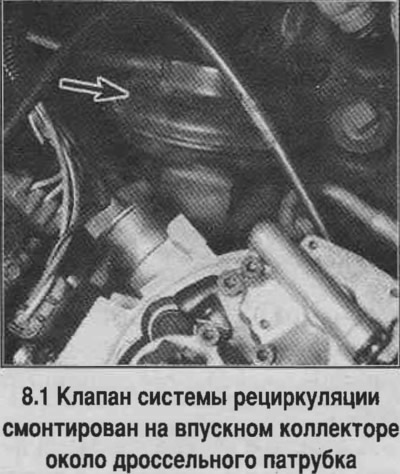
2. The need to check the system arises when the engine starts to run unstably at idle speed and traction deteriorates during acceleration. You can check the condition of the hoses and valves yourself. The processor unit is checked at a car service center.
Main recirculation valve
3. Start the engine. At idle, disconnect the vacuum hose from the recirculation valve and connect a hand vacuum pump.
4. Create a vacuum. The engine should lose speed or stall. If the idle speed does not change or changes very little, replace the valve.
Solenoid valve (only cars up to 8500 GVW)
5. Turn off the ignition.
6. Disconnect the solenoid valve vacuum hose from the intake manifold and connect a hand vacuum pump (see photo).
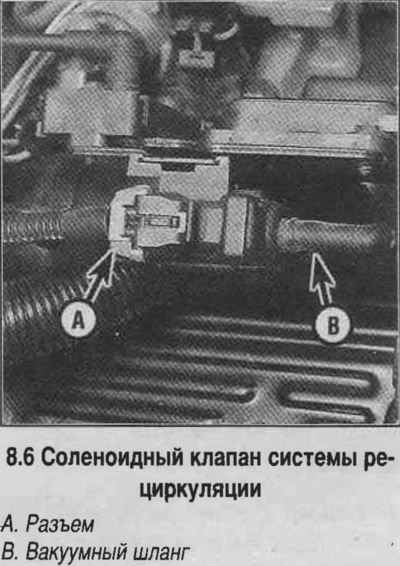
7. Create a vacuum. If the valve does not hold the vacuum, replace the valve.
Solenoid valve (cars after 8500 GVW)
8. Turn off the ignition.
9. Disconnect the solenoid valve vacuum hose from the intake manifold and connect a hand vacuum pump.
10. Create a vacuum. If the valve stem moves, disconnect the connector from the solenoid and repeat the test. If the valve stem still moves, replace the valve.
Models since 1996.
11. The recirculation system is controlled digitally from the RCM processor unit. There are no pneumatic drives in the system. The main part of the system is a proportional metering valve with electronic control, which includes a stepper motor that moves the rod. The system is checked and adjusted in a car service center.