
ChevyMan.ru
Mazda Mitsubishi Toyota Land Rover Honda Kia Nissan
English Русский
Български
Беларускі
Український
Српски
Hrvatski
Română
Polski
Slovenský
Magyar
|
Articles | Sitemap | Contacts |


Home   Aveo   Captiva   Cruze   Lacetti   Lanos   Niva   Tahoe   Others  
Orlando 1 (2010-2018) Trailblazer 1 (2001-2008, petrol) Lumina 1 (1989-1994)
  • Home
  • Chevrolet
  • Lumina 1
  • Power unit
  • Reduced exhaust gas toxicity
  • Electronic ignition control system (ESC) or with knock sensor (KS)

Electronic ignition control system (ESC) or with knock sensor (KS) (Chevrolet Lumina 1)

            0

Contents: Engine with a working volume of 3.1… ↧ Engine with a working volume of 3.8… ↧
Electronic Spark Advance Control (ESC) (for engines produced in 1990-1992) or a system with a knock sensor (KS) (for engines produced since 1993.).


Note: In 1993, the name of the Electronic Spark Plug (EST) system was changed. The system still works as before, but is now called a knock sensor (KS) system.


Engine with a working volume of 3.1 liters


General description


1. The appearance of detonation in a running engine may be caused by the different quality of fuel of different brands.

2. The Electronic Spark Control (ESC) system is designed to change the ignition timing by angles up to 20° in order to eliminate detonation in the engine. This allows the engine to use ignition timing with maximum efficiency, which improves engine performance and fuel economy.

3. If there is no detonation, the ESC system knock sensor (see illustration) sends a signal of 8-10 V to the ECM, after which the ECM ensures the normal timing advance is set. When the sensor detects an increased vibration level (when detonation occurs), the ESC unit disconnects the circuit going to the ECM control unit, and the voltage on its contact "B7" drops to zero. The ECM then sends a spark retard signal to the EST distributor until the detonation stops.
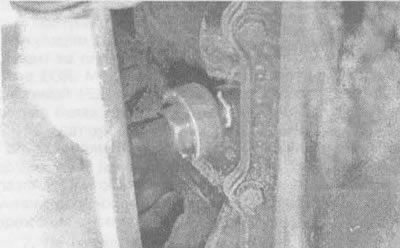
6.3. The knock sensor is located in the lower part of the engine compartment, closer to the…

6.3. The knock sensor is located in the lower part of the engine compartment, closer to the passenger compartment


4. A faulty signal from the ESC knock sensor or a broken ground wire in the ESC unit will cause the signal voltage to the ECM to remain high. Under these conditions, the ECM will control the EST system as if there is no detonation. Therefore, the distributor will not set the ignition delay and when the engine is running under high load, the detonation level can become very high. Then the ECM will issue code 43.

5. If there is no signal from the ESC system to the ECM, the latter will continuously send a signal to the EST to set the ignition delay. As a result, the engine throttle response will slow down and the ECM will issue code 43.

Examination


6. The sequence of checking the ESC system is shown in the diagram (see diagram).
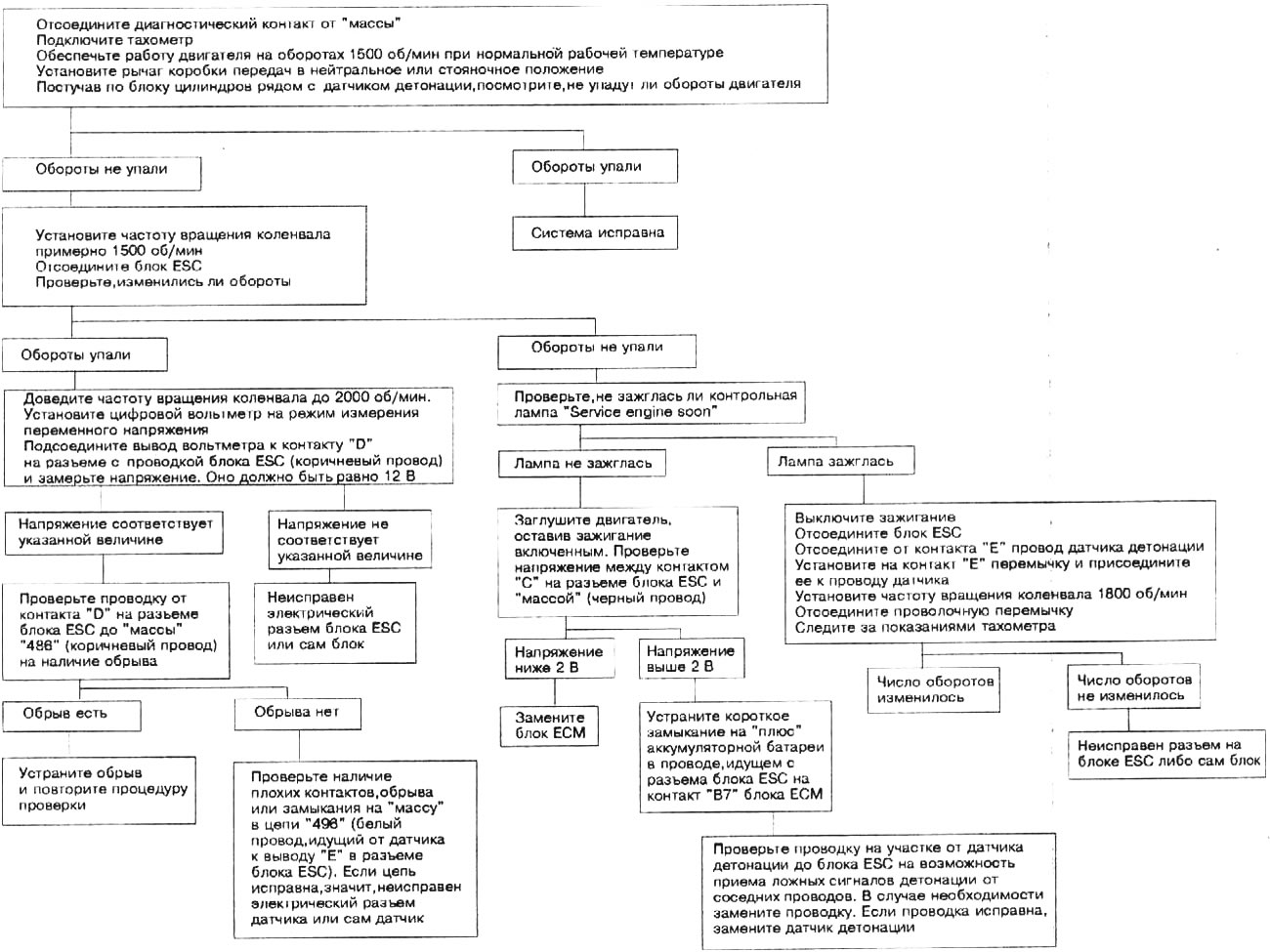
6.6. Sequence diagram of the ESC (or KS) system test on a 3.1L engine
Open large image in new tab →


6.6. Sequence diagram of the ESC (or KS) system test on a 3.1L engine
This scheme should only be used after checking all other possible factors contributing to the occurrence of detonation, such as the amount of ignition advance, the serviceability of the exhaust gas recirculation system (EGR), engine temperature, excessive noise during operation, etc.


Replacement of elements


ESC knock sensor

7. Disconnect the cable from the negative terminal of the battery.

8. Pull the insulating tube off the sensor and disconnect the electrical connector from it.

9. Remove the knock sensor from the cylinder block.

10. The sensor is installed in the reverse order.

ESC block

11. Disconnect the cable from the negative terminal of the battery.

12. Remove the glove box (see chapter 11, section 26).

13. Locate the unit mounted on the ECM bracket behind the glove box.

14. Disconnect the connector from the unit.

15. After unscrewing the bolts, remove the block from the car.

16. The unit is installed in the reverse order.

Engine with a working volume of 3.8 liters


General description


17. The ESC system in this engine consists of a knock sensor and a PCM unit. The MEM-CAL unit installed on the engine has the same functions as the ESC units that are equipped with other engine models. All diagnostic procedures for checking this system must be carried out at a service center or a specialized repair shop.

The article was checked: Vladimir Romannikov
This article is available at russian, bulgarian, belarusian, ukrainian, serbian, croatian, romanian, polish, slovak, hungarian

Share information:

Previous articles
Lumina 1: Reduced exhaust gas toxicity
Next articles

Electronic Spark Timing Control (EST)
Knock Sensor — General Description
Intake Air Temperature (IAT) Sensor (for 3.8L engine)
Crankshaft Position Sensor (for 3.8L engine)
Camshaft position sensor (on 3.8L engine)
Exhaust gas recirculation system (EGR 3.1 l and 3.8 l since 1993)
Evaporative Emission Control System (EECS)
Positive Crankcase Ventilation (PCV) System
Thermostatic air filter (THERMAC) (3.1L engine)
Transmission torque converter clutch


See similar articles on the topic of Chevrolet cars:
Removal and installation of the electronic control unit of the passive safety system Chevrolet Aveo T300 (2012-2018)
Electronic climate control system Chevrolet Captiva 1 (2006-2018)
Removal and installation of the electronic control unit of the passive safety system Chevrolet Cruze 1 (2008-2016)
Schematic diagram of the electronic engine management system with the MR-140 control unit Chevrolet Lacetti 1 (2002-2009)
Removal the electronic control unit Chevrolet Lanos T150 (2002-2009)
Electronic anti-theft system Chevrolet Niva 1 (2002-2016)
Ignition system with electronic ignition timing control (EST system) Chevrolet Tahoe 1 (1992-2000)
Link in different formats to this page


Visitor comments

No comments yet


How much will 34 + 11 =


Orlando 1 (2010-2018) 
  • General information
  • Introduction to manual
  • User manual
  • Maintenance
  • Troubleshooting
  • Power unit
  • Engine repair
  • Fuel and control system
  • Cooling and lubrication system
  • Ignition system
  • Transmission
  • Clutch
  • Gearbox
  • Drive shafts
  • Chassis
  • Car suspension
  • Steering
  • Brake system
  • Body
  • Exterior (external elements)
  • Doors, locks and windows
  • Electrical equipment
  • Equipment and devices
  • Windscreen wipers
  • Power devices
  • Electrical diagrams


Trailblazer 1 (2001-2008) 
  • General information
  • User manual
  • Troubleshooting
  • Maintenance
  • Power unit
  • Engine in a car
  • Engine overhaul
  • Cooling and heating
  • Fuel and exhaust system
  • Engine electrical equipment
  • Engine control
  • Transmission
  • Automatic gearbox
  • Transfer case
  • Drive shafts and cardan
  • Chassis
  • Brake system
  • Car suspension
  • Steering
  • Body
  • Exterior (external elements)
  • Interior (internal elements)
  • Doors, locks and windows
  • Electrical equipment
  • Equipment and devices
  • Electrical circuits


Lumina 1 (1989-1994) 
  • General information
  • Maintenance
  • Power unit
  • Engine 3.1L V6
  • Engine 3.8L V6
  • Engine overhaul
  • Cooling system
  • Power and exhaust system
  • Fuel injection
  • Engine electrical equipment
  • Reduced exhaust gas toxicity
  • Transmission
  • Automatic gearbox
  • Drive shafts
  • Chassis
  • Brake system
  • Car suspension
  • Steering
  • Body
  • Heating and air conditioning
  • Repair of body elements
  • Doors, covers and windows
  • Interior (internal elements)
  • Electrical equipment
  • Equipment and devices
  • Electrical circuits


ChevyMan.ru © 2017-2026 · Mobile version · Feedback · Site search · Interesting to read · Sitemap: EN BG BY UA RS HR RO PL SK HU

Aveo 2003-2008 · Aveo 2006-2011 · Aveo 2012-2018 · Captiva 2006-2018 · Cruze 2008-2016 · Lacetti 2002-2009 · Lanos 2002-2009 · Niva 2002-2016 · Tahoe 1992-2000 · Tahoe 2000-2014 · Lumina 1 1989-1994 · Trailblazer 1 2001-2008 · Orlando 1 2010-2018 ·
🛡️ For your security and to improve our service, this site uses cookies. You can disable them in your browser.