


Contents: Voltage measurement ↧ Determining the short circuit point… ↧ Grounding check ↧ Checking the circuit for an open… ↧ Locating a Circuit Breaker ↧ Connectors ↧
A typical circuit consists of electrical devices, switches, relays, fuses or fuse links, and wiring and connectors that connect the components to each other and to the battery and chassis. To simplify the process of determining the causes of faults in electrical circuits, wiring diagrams are provided at the end of this chapter.
Before you begin to determine the cause of a malfunction, you must study the corresponding wiring diagram to get a complete picture of the location of the elements included in this circuit. Identifying possible sources of a fault is made easier by making sure that other components in the circuit are working properly. If several devices or circuits fail at the same time, the problem may be with a fuse or ground wire.
Electrical circuit failures usually occur due to simple reasons, such as loose contacts in connectors, a broken ground loop, or a failed fuse or relay. Before you begin testing the functionality of the devices in the faulty circuit, inspect the fuses, wires, and connectors included in it.
If it is planned to conduct a circuit study using special equipment and tools, in order to determine the procedure for checking the operability of devices and circuit elements, it is necessary to first study the corresponding wiring diagram.
The main tools used in the process of determining the causes of faults in electrical circuits are a tester or voltmeter (a 12-volt test light may also be used for some tests) and jumper (preferably with a fuse), which is used to bypass an electrical circuit (see illustrations). Before you begin working with the instruments, study the wiring diagram to determine the points where measurements should be taken.
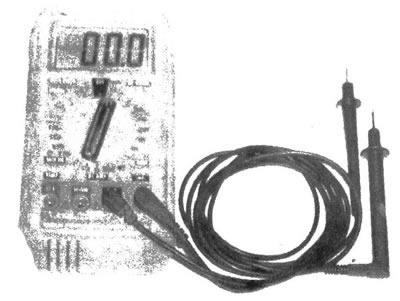
2.5a. Most often, in the process of determining the causes of faults in electrical circuits, a digital multimeter is used, using which voltage is measured, current is determined, and the circuit is checked for breaks
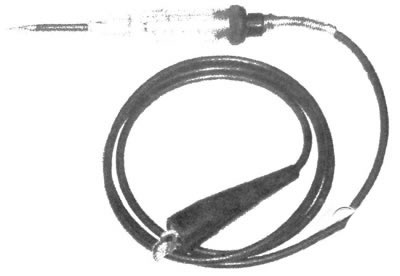
2.5b. When determining the presence of voltage in a circuit, it is recommended to use an easy-to-use test lamp
Voltage measurement
Voltage measurement is carried out when a fault occurs in an electrical circuit. Connect one tester lead to the negative battery terminal or one of the ground points. The second tester lead should be connected to the terminal of the circuit being tested, preferably the one closest to the battery or fuse (see illustration). If there is voltage in the circuit (or the control light is on), this means that the section of the circuit between the corresponding connector and the control race is OK. Continue checking the remaining sections of the circuit using the same technique. When a point in the circuit is reached where no voltage is detected when the tester is connected, the section of the circuit containing the source of the fault is identified. This is the section of circuit between the point where there is no voltage and the previously tested point. Inspect this section of the circuit for faults. The fault usually lies in a loose connector.
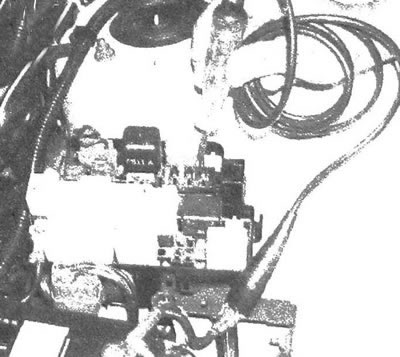
2.6. When using a test lamp, it is necessary to connect its wire to the ground point and touch the probe to the test point of the circuit (plug, wire, socket), the lamp turning on confirms the presence of battery voltage in the circuit
Note: It should be noted that some circuits only work when the ignition is on (the switch is in the "Ace" or "Run" position).
Determining the short circuit point of a circuit
Remove the short circuit fuse and connect the test light wires to the fuse terminals (make two extension wires with corresponding contact terminals, connect the wires to the contacts in the fuse box and include a test lamp in the circuit). The presence of voltage should be noted in the circuit. Wiggle the wire that is likely to be shorted while watching the test light. If the lamp switches off, this means that this section of the circuit is shorted to ground. It is possible that the short circuit occurs due to exposed wiring.
Grounding check
To check if a circuit device is properly grounded, disconnect the battery and connect one lead of a tester or ohmmeter with a self-powered power source to a ground point. Connect the second wire of the device to the wiring connector or ground point of the device being tested. The presence of grounding is confirmed by the control lamp lighting up or low resistance (up to 50 m) in this area.
Checking the circuit for an open circuit
This test is performed to determine if there are any breaks in the electrical circuit. After de-energizing the circuit, perform a check using a test device or a multimeter with an independent power source. Connect the control device to both wires of the circuit (or to the power wire and the grounding point of the circuit). The control lamp lights up to indicate that there is no break in the circuit (see illustration). Low resistance (below 50m) also indicates that the circuit is not broken. If the light does not come on (or the resistance is more than 10 ohms), this means that the chain has a break.
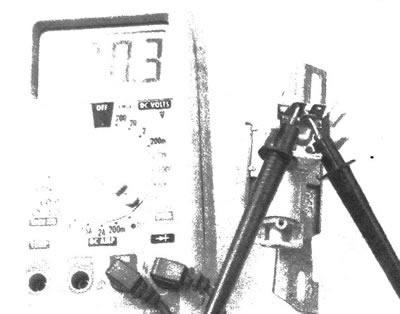
2.9. When the ohmmeter function is turned on on the tester, determine the resistance in the section of the circuit between the two contact terminals; when checking for breaks, low resistance indicates that there are none; high resistance indicates that there is a break in the circuit or a source of high resistance
In the same way, you can check any switch by connecting the electrodes of the control device to the contact terminals. When the switch is in the position corresponding to the circuit closure, the control lamp should light up (or a low resistance value is obtained).
Locating a Circuit Breaker
The location of a circuit break is often difficult to determine by visual inspection, as oxidized wires or open contacts are usually hidden under the insulation or connector housing. Determine the source of the intermittent fault (usually due to a loose connector or damaged insulation) you can do it by simply moving the wire. If, when moving a wire, the contact in the circuit alternately disappears and appears, then the source of the fault is located on the section of the circuit that is being affected.
When determining the cause of a fault in an electrical circuit, it is important to consider that current flows from the battery through wires, switches, relays, fuses and fuse links to each electrical device (lamp, electric motor, etc.), and goes to the grounding point, returning from there again to the battery. Any malfunction in the electrical circuit is hidden in the wiring and elements through which the current generated by the battery circulates.
Connectors
Most of the connections in the electrical circuits of the vehicles described are made using plastic multi-pin connectors. As a rule, the connector elements have a connecting clamp. Often the components are connected by a bolt running through the middle of the connector, such as on electrical wiring connectors located under the instrument panel.
Before disconnecting the connector, you must detach its retainer using a small screwdriver. When disconnecting the connector, you should hold its elements with your fingers, but not the wires, since failure to follow this recommendation may result in damage to both the wiring and the contact terminals inside the connector. Before disconnecting, carefully inspect the connector. The connection principle of some fasteners is not easy to determine at a glance. Moreover, some connectors have multiple locks.
Each connector consists of a plug and a socket. When looking at connector designations on wiring diagrams, it is necessary to determine which side they are displayed on: the electrical device side or the wiring harness side. The arrangement of the plug contact pins is a mirror image of the socket contact pins, so when examining the corresponding connector elements from different sides (right and left) the display of the location of the contact pins of the plug and socket coincides.
It is often necessary to measure the voltage in a circuit without disconnecting the connector. Carefully insert a small thin pin into the back of the plug (not a tester electrode) so that the pin comes into contact with the corresponding terminal of the connector, then connect the tester electrode to the pin (see illustration). When inserting the pin, do not allow the contact terminal to become deformed, as this may result in unreliable contact and corrosion on the connector terminals. Inserting a small thin pin instead of the tester electrode helps prevent deformation of the connector contact pin.
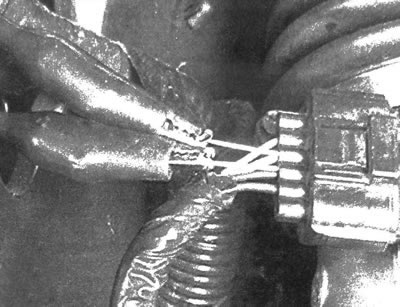
2.15. For testing, it is necessary to insert a small sharp electrode (needle type) from the back of the connector into the corresponding contact terminal so that the electrode enters the metal contact. Connect the electrodes to the tester and test the circuit for proper operation