


Note: Vehicles have an on-board diagnostic system called OBD, which can be used to determine the cause of problems with the charging system. IN chapter 6 the decoding of diagnostic codes is provided, and the procedure for reading them from the electronic memory of the on-board computer is described.
1. If problems occur in the charging circuit, do not assume first that the generator is faulty. In this case, it is necessary to carry out the following series of checks in advance:
- a) Check the condition of the battery wire connections. Make sure the terminals are clean and securely connected to the battery posts.
- b) Check the density of the electrolyte in the battery cells (inspect the battery charge indicator). If necessary, recharge.
- c) Check the condition of the generator wiring and connectors.
- d) Check the condition and tension of the drive belt (see chapter 1).
- e) Make sure that the generator mounting bolts are securely tightened.
- f) Start the engine and make sure that the generator does not make any unusual noise.
2. Without starting the engine, measure the battery output voltage using a voltmeter. The voltage value for a fully charged battery should be within 12.4-12.6 V (see illustration).
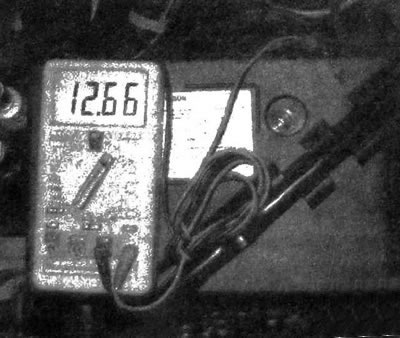
9.2 To measure the battery voltage. connect the voltmeter electrodes to the battery terminals (engine off). When measuring voltage, the engine must be running
3. Start the engine and measure the battery voltage again. In this case, the voltage must have a value higher than the limit given in paragraph 2, but not exceed 14.7 V.
4. If the voltage does not correspond to the specified values, deviating upward or downward, contact the authorized station to diagnose the charging system.
Note: Many parts stores will inspect the alternator after it has been removed. Please contact your nearest store, which may offer this service.