
ChevyMan.ru
Mazda Mitsubishi Toyota Land Rover Honda Kia Nissan
English Русский
Български
Беларускі
Український
Српски
Hrvatski
Română
Polski
Slovenský
Magyar
|
Articles | Sitemap | Contacts |


Home   Aveo   Captiva   Cruze   Lacetti   Lanos   Niva   Tahoe   Others  
Orlando 1 (2010-2018) Trailblazer 1 (2001-2008, petrol) Lumina 1 (1989-1994)
  • Home
  • Chevrolet
  • Trailblazer 1
  • Power unit
  • Engine control
  • Exhaust Gas Monitoring and Engine Management Systems — General Information

Exhaust Gas Monitoring and Engine Management Systems — General Information (Chevrolet Trailblazer 1)

            0

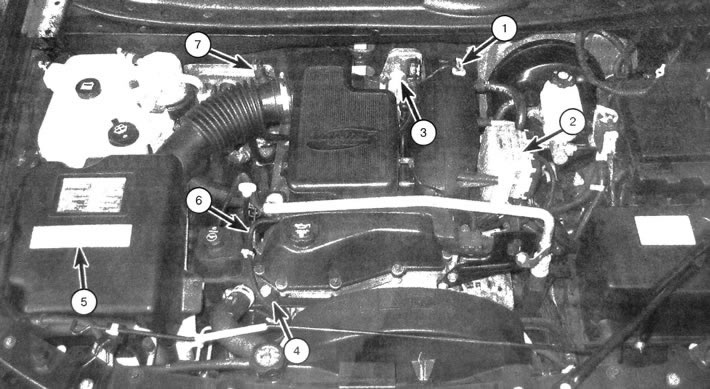
1.1. Location of engine management and exhaust gas toxicity control system components 1. Manifold…

1.1. Location of engine management and exhaust gas toxicity control system components 1. Manifold Absolute Pressure (MAP) Sensor; 2. Control unit (PCM); 3. Throttle block; 4. Camshaft position sensor (CPS); 5. Vehicle Emission Control Information (VECI) Label; 6. Camshaft Phase Correction Device Solenoid Valve - Replacement; 7. Supply air temperature sensor


The use of an electronic engine control system reduces the content of unburned fuel-air mixture residues and fuel vapors in the exhaust. This design provides improved engine performance and increased fuel efficiency. The control system includes the following elements and subsystems:
  • Electronic engine management system
  • Crankcase ventilation system
  • Exhaust gas recirculation system
  • Fuel vapor recovery system
  • Additional air injection system
  • Catalytic converter

All of the listed subsystems, one way or another, relate to the general exhaust toxicity reduction system.

The subsections of this chapter include general information as well as descriptions of inspection and testing procedures that are within the competence of the amateur mechanic. Descriptions of procedures for replacing elements of all the above subsystems are also provided.


Before making an assumption about the failure of the exhaust toxicity reduction system components, it is necessary to exclude a malfunction of the ignition and fuel injection system components. Diagnostics of most engine systems and emission control require the use of specialized devices and equipment. Performing such procedures requires the mechanic to have the necessary experience. If the complexity of diagnostic and maintenance procedures is beyond the capabilities of the car enthusiast, contact a service and repair station with the appropriate level of qualification.

It should be noted that most Emission Control System problems are caused by damaged or loose vacuum hose connections or electrical connectors, so the inspection should begin with a thorough inspection of the hoses and wiring.

Although the engine management and emission control systems on newer vehicle models are extremely complex, most inspections and maintenance can be performed by the vehicle owner using common tools and equipment, as well as relatively inexpensive measuring instruments.

Note: Before affecting emission control system components, verify warranty coverage by obtaining reliable information from a source directly related to the manufacturer. After the warranty period has expired, in order to save money, you can independently perform the diagnostic and component replacement procedures described in this chapter.


Strictly follow the safety requirements given in this chapter. It should be noted that there may be a discrepancy between the arrangement of elements in the illustrations provided and on a specific vehicle, which is explained by the constant modification that the manufacturer carries out during the production of this model.


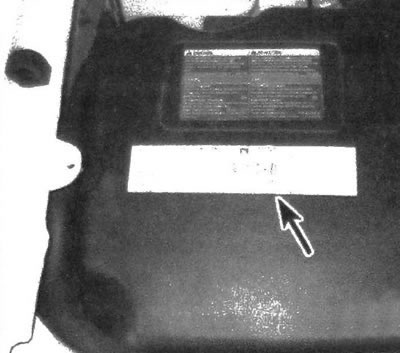
The Vehicle Emission Control Information (VECI) label is located in the engine compartment (see illustration). The vehicle used to create this manual had such a plate located on the underside of the hood. Sometimes it is located on the top crossbar of the radiator. The plate contains the adjustment parameters, as well as a diagram of the location of the vacuum hoses and other elements. Before servicing the engine management system or emissions control system, make sure the label is in place. If there is any discrepancy between the information provided on the label and in this manual, the information provided on the VECI label shall take precedence.
1.6. The Vehicle Emission Control Information (VECI) label, located in the engine compartment,…

1.6. The Vehicle Emission Control Information (VECI) label, located in the engine compartment, provides information about the system components, vacuum hose routing, etc.

The article was checked: Vladimir Romannikov
This article is available at russian, bulgarian, belarusian, ukrainian, serbian, croatian, romanian, polish, slovak, hungarian

Share information:

Previous articles
Trailblazer 1: Engine control
Next articles

On-Board Diagnostics (OBD) and Trouble Codes
PCM control unit — removal and installation
Throttle Position Sensor (TPS) — Replacement
Accelerator Pedal Position Sensor (APP) — Replacement
Manifold Absolute Pressure (MAP) Sensor — Replacement


See similar articles on the topic of Chevrolet cars:
Instruments for diagnostics of engine management system Chevrolet Aveo T300 (2012-2018)
General description and operation of engine management systems Chevrolet Captiva 1 (2006-2018)
Design Features of the Engine Management System Chevrolet Cruze 1 (2008-2016)
Engine management system device Chevrolet Lacetti 1 (2002-2009)
Table of engine and its systems faults Chevrolet Lanos T150 (2002-2009)
Starting the engine Chevrolet Niva 1 (2002-2016)
Description of engine components and its systems Chevrolet Tahoe 2 and 3 (2000-2014)
Link in different formats to this page


Visitor comments

No comments yet


How much will 27 + 39 =


Orlando 1 (2010-2018) 
  • General information
  • Introduction to manual
  • User manual
  • Maintenance
  • Troubleshooting
  • Power unit
  • Engine repair
  • Fuel and control system
  • Cooling and lubrication system
  • Ignition system
  • Transmission
  • Clutch
  • Gearbox
  • Drive shafts
  • Chassis
  • Car suspension
  • Steering
  • Brake system
  • Body
  • Exterior (external elements)
  • Doors, locks and windows
  • Electrical equipment
  • Equipment and devices
  • Windscreen wipers
  • Power devices
  • Electrical diagrams


Trailblazer 1 (2001-2008) 
  • General information
  • User manual
  • Troubleshooting
  • Maintenance
  • Power unit
  • Engine in a car
  • Engine overhaul
  • Cooling and heating
  • Fuel and exhaust system
  • Engine electrical equipment
  • Engine control
  • Transmission
  • Automatic gearbox
  • Transfer case
  • Drive shafts and cardan
  • Chassis
  • Brake system
  • Car suspension
  • Steering
  • Body
  • Exterior (external elements)
  • Interior (internal elements)
  • Doors, locks and windows
  • Electrical equipment
  • Equipment and devices
  • Electrical circuits


Lumina 1 (1989-1994) 
  • General information
  • Maintenance
  • Power unit
  • Engine 3.1L V6
  • Engine 3.8L V6
  • Engine overhaul
  • Cooling system
  • Power and exhaust system
  • Fuel injection
  • Engine electrical equipment
  • Reduced exhaust gas toxicity
  • Transmission
  • Automatic gearbox
  • Drive shafts
  • Chassis
  • Brake system
  • Car suspension
  • Steering
  • Body
  • Heating and air conditioning
  • Repair of body elements
  • Doors, covers and windows
  • Interior (internal elements)
  • Electrical equipment
  • Equipment and devices
  • Electrical circuits


ChevyMan.ru © 2017-2026 · Mobile version · Feedback · Site search · Interesting to read · Sitemap: EN BG BY UA RS HR RO PL SK HU

Aveo 2003-2008 · Aveo 2006-2011 · Aveo 2012-2018 · Captiva 2006-2018 · Cruze 2008-2016 · Lacetti 2002-2009 · Lanos 2002-2009 · Niva 2002-2016 · Tahoe 1992-2000 · Tahoe 2000-2014 · Lumina 1 1989-1994 · Trailblazer 1 2001-2008 · Orlando 1 2010-2018 ·
🛡️ For your security and to improve our service, this site uses cookies. You can disable them in your browser.