


General description
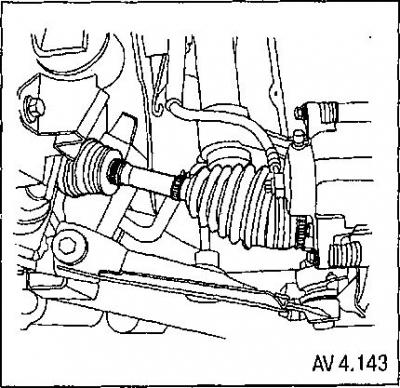
Drive shafts are elements of torque transmission to the front wheels, which allow the wheel to move freely within the permissible suspension movements and rotate around the wheel rotation axis when the steering is in operation. In this case, the torque is transmitted smoothly, without jerks. This is facilitated by the use of special constant velocity joints (CV joints). The peculiarity of such joints, in contrast to cardan joints, is the equality of angular velocities of the input and output joint links at any angular position of the joint links.
The inner CV joint of the drive shaft has angular and axial degrees of freedom. The outer CV joint has only an angular degree of freedom.
The ends of the drive shaft are connected to the main transmission gears and to the hub using splines.
Different types of CV joints are used on cars with automatic transmission. The outer CV joint is of the ball type, the inner one is of the three-pin type.
On cars with manual transmission, CV joints of the same type but different shapes are used. These CV joints are ball-type joints.
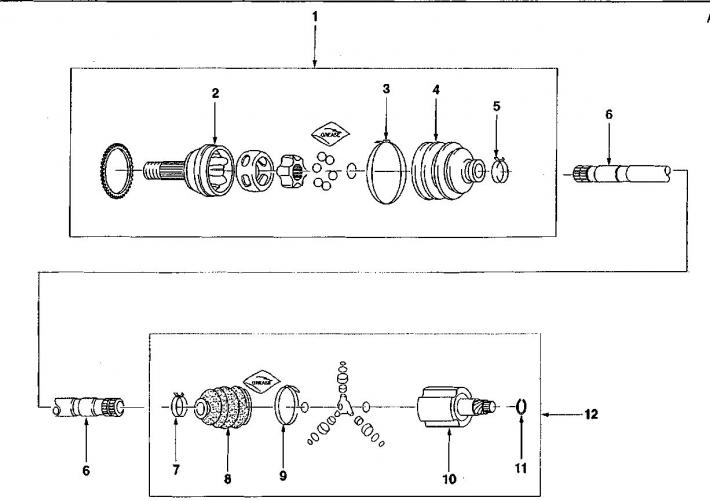
1. Constant velocity ball joint (CV joint) assembly (type Rzeppa); 2. Hub shaft; 3, 5, 7, 9. Cover clamp; 4. Cover of the outer joint of the drive 10. Housing of the inner joint of equal shaft; angular velocities of the three-stud type; 6. Drive shaft; 11. Retaining ring; 8. Cover of the inner joint of the drive 12. Inner joint of equal angle shaft; three-spike type speeds.
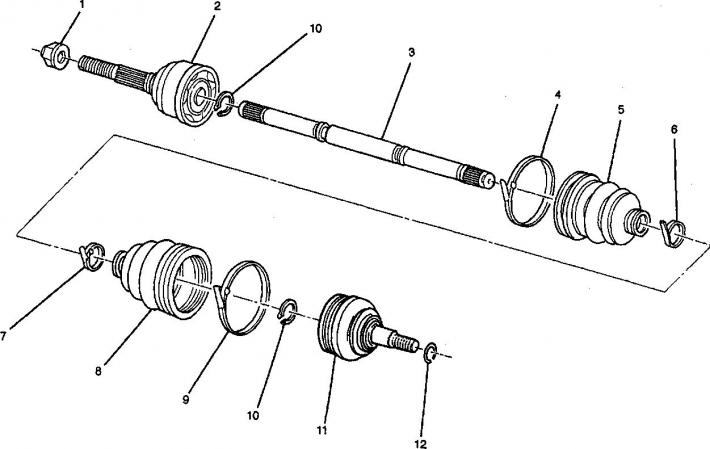
1. Drive shaft fastening nut; 2. Outer CV joint; 3. Drive shaft; 4, 6, 7, 9. Cover clamp; 5. Outer CV joint cover; B. Inner CV joint cover; 10. Retaining ring; 11. CV joint with transverse groove (internal ball type); 12. Retaining ring.
[The original article is on the website CHEVYMAN.RU]