


Note: The recommended service intervals must not be exceeded by more than 1000 km or 1 month.
If the vehicle is mainly used in severe conditions, as described below, then more frequent maintenance is required for some items of the maintenance plan:
1. Road conditions.
- a) Operation on bumpy, muddy, snow-covered or water-covered roads, or operation in hilly terrain.
- b) Operation on dusty roads.
- c) Operation on roads sprinkled with salt or other anti-icing agents.
- d) Operation at low ambient temperatures (temperature constantly below -20°C).
2. Driving conditions.
- a) Towing a trailer or using a roof rack on a vehicle.
- b) Repeated short trips of less than 10 km at low ambient temperatures.
- c) Long periods of idling and/or driving at low speed over long distances.
- d) Regular driving at high speed (more than 80% of the vehicle's maximum speed for more than 2 hours).
If the vehicle is equipped with a service message warning system, the system automatically reminds the driver of the need for scheduled maintenance. However, depending on the vehicle operating conditions listed above, the frequency of scheduled maintenance may be reduced. Therefore, also use the table "Frequency of maintenance".
Note: After performing maintenance, it is necessary to reset the system counter to zero, see the section "Resetting the engine oil change service indicator".
Under normal operating conditions, when the system display shows the message "CHANGE ENGINE OIL" this means that it is necessary to carry out scheduled maintenance according to chart No.1.
Note: The recommended service intervals must not be exceeded by more than 1000 km or 1 month.
After performing maintenance according to chart No.1, it is necessary to perform maintenance according to chart No.2. Subsequently, the frequency of maintenance according to chart No.1 or No.2 is selected based on the operating conditions. It is also recommended to use the table "Frequency of maintenance".
Maintenance chart #1: Maintenance is performed after the service message is displayed "CHANGE ENGINE OIL" or after 10 months from the date of purchase of the vehicle, or after service has been completed using card No.2.
Maintenance card No.2: Maintenance is performed after maintenance according to card No.1, or once a year, even if the service message has not been displayed for one year (i.e. maintenance according to card No.1 has not been performed).
Table. Maintenance intervals
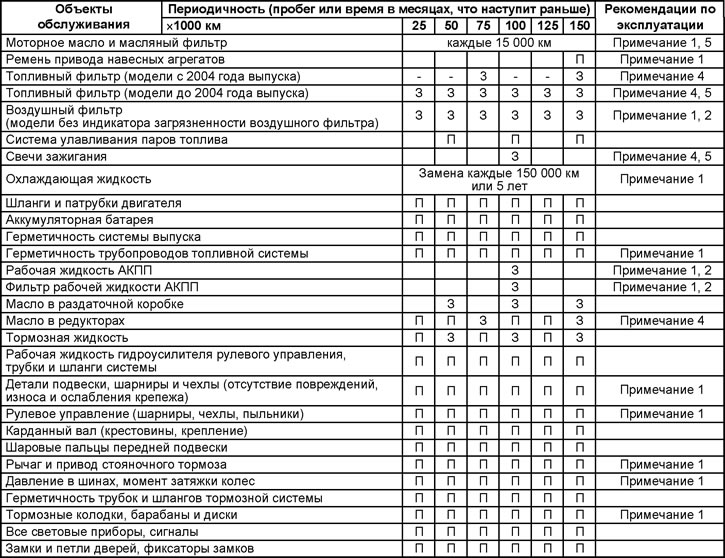
Note: P - check and/or adjust (repair or replacement if necessary); 3 - replacement; C - lubrication; M3 - tightening to the specified torque.
1. When operating in difficult conditions, perform maintenance twice as often.
2. When operating on dusty roads, check every 2500 km (or 3 months.).
3. Additional checks, the implementation of which is not mandatory, but only recommended.
4. We recommend replacing the component after it actually fails.
5. See the relevant section.
Table. Maintenance cards
| Maintenance procedures | Map #1 | Map #2 |
| Changing engine oil and oil filter (after replacement reset the counter) | • | • |
| Checking and, if necessary, lubricating ball joints, front suspension rods, steering, gear shift mechanisms, parking brake | • | • |
| Visual inspection of all components for leaks and damage | • | • |
| Checking the condition of the air filter (pollution indicator) and, if necessary, replacing the filter | • | • |
| Checking the uniformity of wheel rotation, pressure, imbalance and damage | • | • |
| Checking the brake system components: absence of damage and leaks in pipelines and hoses, thickness of brake pads, damage and wear of brake discs and other components | • | • |
| Checking the level and condition of the coolant | • | • |
| Perform maintenance procedures according to the table "Maintenance intervals" | • | • |
| Checking suspension and steering components: loosening of connections, damage to components, condition of power steering system pipes and hoses, boots and covers | • | |
| Checking the cooling system: condition of hoses, tubes, connections (clamps, fasteners), tightness of the cooling system, expansion tank cap, condition of air conditioner radiators and coolant | • | |
| Windscreen wiper blade condition and operation | • | |
| Checking the active safety system of the driver and passengers: seat belts. The passive safety system (SRS) does not require maintenance | • | |
| Lubrication of body parts: door locks and hinges, hood, seat drive mechanisms, fuel filler flap hinge and lock; checking the reliability of fastening panels, trims, etc., the condition of the door seals, hood, rear door | • | |
| Checking the level and condition of the automatic transmission fluid and, if necessary, adding/replacing, replacing the automatic transmission filter | • |
(The original article can be found on the resource CHEVYMAN.ru)