
ChevyMan.ru
Mazda Mitsubishi Toyota Land Rover Honda Kia Nissan
English Русский
Български
Беларускі
Український
Српски
Hrvatski
Română
Polski
Slovenský
Magyar
|
Articles | Sitemap | Contacts |


Home   Aveo   Captiva   Cruze   Lacetti   Lanos   Niva   Tahoe   Others  
Aveo T300 (2012-2018) Aveo T250 (2006-2011) Aveo T200 (2003-2008)
  • Home
  • Aveo
  • T250 (2006-2011)
  • Engine 1.5 SOHC
  • Fuel supply system
  • Fuel vapor recovery system

Fuel vapor recovery system (Chevrolet Aveo T250)

            0

Contents: Fuel vapor recovery system capacity ↧ Removal the fuel vapor recovery… ↧ Installation of fuel vapor recovery… ↧
The fuel vapor recovery system operates on the principle of using a container filled with activated carbon. Fuel vapors are fed from the fuel tank into a fuel vapor collection container (with activated carbon) during engine shutdown. With the engine running, fuel vapors are forced out of the carbon element by the incoming air stream and into the intake manifold for subsequent combustion in the cylinders. The gasoline vapors flow from the fuel tank line into a tube marked TANK. These vapors are absorbed by the carbon.

The purge of the tank is controlled by the engine control unit (ECM) when the engine is running for a certain period of time. Air is introduced into the tank and mixed with the vapors. The air-fuel mixture then enters the intake manifold.

The ECM closes the power circuit to the EVAP purge solenoid valve. This valve is pulse width modulated (PWM), meaning it turns on and off several times per second. The EVAP canister purge PWM sleep mode varies depending on operating conditions determined by air mass flow, fuel trim, and inlet air temperature.

Poor idle, stalling and poor drivability may occur under the following conditions:
  • eVAP Canister Purge Solenoid Valve Malfunction;
  • tank damage;
  • rupture, cracks in hoses, incorrect connection of tubes.

Fuel vapor recovery system capacity


The Evaporative Emissions (EVAP) Canister is an emission control device that incorporates charcoal pellets. The EVAP Canister is used to store fuel vapor from the fuel tank. When the proper conditions are met, the ECM activates the EVAP Canister Purge Solenoid, which allows the fuel vapor to be directed into the engine cylinders and burned.


Removal the fuel vapor recovery system components


Warning: System components may contain hot vapors. Avoid open flames and do not smoke nearby.


1. Remove the exhaust evaporative canister evaporative hoses.

2. Remove the bolt securing the EVAP canister flange to the vehicle.

3. Remove the EVAP canister.
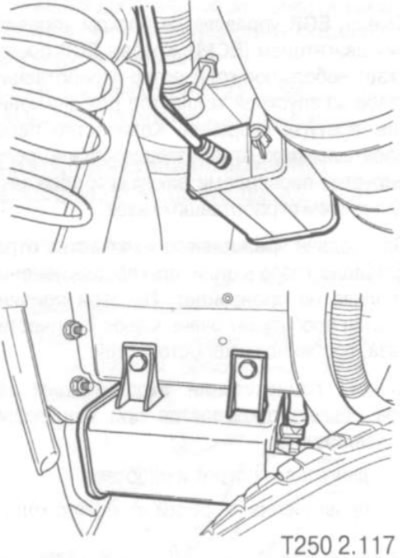
3. Remove the EVAP canister.


Installation of fuel vapor recovery system components


1. Place the fuel vapor recovery system container in the runners, install it in place and tighten the flange mounting bolt to 20 Nm.

2. Connect the hoses.

[The original source of the article is the website «chevyman.ru»]

The article was checked: Vladimir Romannikov
This article is available at russian, bulgarian, belarusian, ukrainian, serbian, croatian, romanian, polish, slovak, hungarian

Share information:

Previous articles
Aveo T250: Fuel supply system
Next articles

Installing the fuel manifold and injectors
Removal the fuel manifold and injectors
Fuel manifold and injectors
Installing a fuel filter
Removal the fuel filter
Forced crankcase ventilation system


See similar articles on the topic of Chevrolet cars:
Adsorber of the gasoline vapor recovery system (SUPB) in assembly Chevrolet Captiva 1 (2006-2018)
Fuel vapor recovery system Chevrolet Cruze 1 (2008-2016)
Removal the fuel vapor recovery system canister Chevrolet Lacetti 1 (2002-2009)
Removal the fuel vapor recovery system canister Chevrolet Lanos T150 (2002-2009)
Main malfunctions of the gasoline vapor recovery system Chevrolet Niva 1 (2002-2016)
Cleaning the fuel vapor recovery system Chevrolet Tahoe 2 and 3 (2000-2014)
Fuel System Check (every 7,500 miles or 12 months) Chevrolet Lumina 1 (1989-1994)
Link in different formats to this page


Visitor comments

No comments yet


How much will 48 + 39 =


Aveo T300 (2012-2018) 
  • General information
  • Vehicle device
  • User manual
  • Main malfunctions
  • Maintenance
  • Power unit
  • Engine
  • Lubrication system
  • Cooling system
  • Supply system
  • Exhaust system
  • Transmission
  • Clutch
  • Manual gearbox
  • Automatic gearbox
  • Front wheel drives
  • Chassis
  • Front suspension
  • Rear suspension
  • Steering
  • Brake system
  • Body
  • Exterior
  • Interior
  • Doors and trunk
  • Security systems
  • Electrical equipment
  • Engine electrics
  • Equipment and devices
  • Heating and air conditioning
  • Electrical circuits


Aveo T250 (2006-2011) 
  • Manual
  • Driver's workplace
  • Salon equipment
  • Vehicle characteristics
  • Maintenance
  • Engine 1.5 SOHC
  • Engine repair
  • Fuel supply system
  • Control system
  • Cooling system
  • Engine 1.6 DOHC
  • Engine repair
  • Control system
  • Transmission
  • Clutch
  • Manual gearbox
  • Automatic gearbox
  • Wheel drive
  • Chassis
  • Wheel suspension
  • Steering
  • Brake system
  • Body
  • Exterior
  • Interior


Aveo T200 (2003-2008) 
  • General information
  • User manual
  • Power unit
  • Engine repair 1.5L SOHC
  • Fuel system
  • Control system
  • Cooling system
  • Transmission
  • Clutch
  • Manual gearbox
  • Automatic gearbox
  • Drive shafts
  • Chassis
  • Front suspension
  • Rear suspension
  • Steering
  • Brake system
  • Body
  • Exterior (external elements)
  • Interior (internal elements)
  • Electrical equipment
  • Equipment and devices
  • Electrical circuits


ChevyMan.ru © 2017-2026 · Mobile version · Feedback · Site search · Interesting to read · Sitemap: EN BG BY UA RS HR RO PL SK HU

Aveo 2003-2008 · Aveo 2006-2011 · Aveo 2012-2018 · Captiva 2006-2018 · Cruze 2008-2016 · Lacetti 2002-2009 · Lanos 2002-2009 · Niva 2002-2016 · Tahoe 1992-2000 · Tahoe 2000-2014 · Lumina 1 1989-1994 · Trailblazer 1 2001-2008 · Orlando 1 2010-2018 ·
🛡️ For your security and to improve our service, this site uses cookies. You can disable them in your browser.