


Permissible trailer weight:
- Chevrolet Tahoe:
- K-1500 (5300 V8) - 3402 kg
- K-2500 (6000 V8 with 4WS system) — 3357 kg
- K-2500 (8100 V8) - 4672 kg
- Cadillac Escalade:
- AWD 6.0L — 3674 kg
- ESVAWD 6.0L — 3493 kg
- ESVPlatinum AWD 6.0L - 3311 kg
Attention:
- The trailer is an additional load on the engine, transmission and suspension of the car. Therefore, do not tow a trailer during the first 800 km of running ("running-in").
- Never climb a steep hill with the automatic transmission in "D" mode, as this may cause damage to the transmission.
- The permissible towing load is tested at sea level. If you are going to the mountains, please note that the engine power and permissible towing load will be slightly reduced.
- Different trailer hitches have different towing capacity ratings set by the manufacturer. Even if the vehicle is physically capable of towing more weight, the driver must determine the maximum towing capacity for the specific hitch and never exceed it.
- Trailer tires must be inflated to the pressure recommended by the trailer manufacturer based on the total weight of the trailer.
- Before driving, check the distribution of the load in the trailer, with the drawbar bearing approximately 10% of the load.
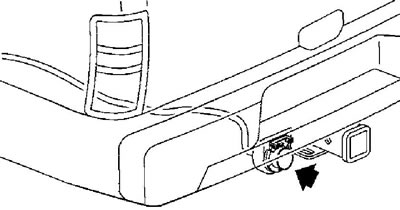
To connect the trailer's electrical equipment, your vehicle is equipped with a corresponding seven-pin connector, located as shown in the figure.
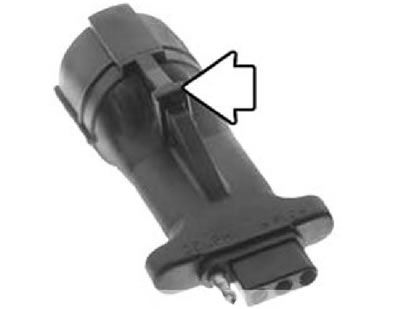
The kit may also include an adapter that allows you to connect a four-pin trailer connector to your vehicle.
Recommendations for towing a trailer
1. Because the braking distance of a car with a trailer is increased, the distance to the car in front should be increased by at least one car with a trailer for every 10 km/h of speed. Avoid sudden braking, as this may cause skidding, which will cause the trailer to sway and cause loss of control. This is especially true when the road surface is wet or slippery.
Attention:
- Observe the maximum speed limits established by traffic regulations when towing a trailer.
- Reduce speed and use engine braking (shift into a lower gear early) before descending a steep or long slope. When selecting gears, follow the recommendations in the section "Driving a car with an automatic transmission".
2. Avoid sharp steering movements and sharp turns. The trailer may hit your vehicle when turning sharply. Slowly reduce speed before turning to avoid unnecessary or sharp braking.
3. Reversing with a trailer is difficult and requires practical skill. To move the trailer to the left, you need to turn the steering wheel to the right, and to move the trailer to the right, you need to turn the steering wheel to the left. (This procedure is the exact opposite of what is done when reversing without a trailer). It is also recommended to turn the steering wheel a little at a time, avoiding sharp or prolonged rotation. Have someone guide you when reversing to reduce the risk of an accident.
4. Be careful when overtaking other cars. Overtaking requires a significant distance. After overtaking a car, do not forget about the length of the trailer and make sure you have enough space before changing lanes.
5. Due to the additional load from the trailer, the vehicle engine may overheat on hot days (at temperatures above 30°C) when climbing a long or steep slope with a trailer.
If the engine coolant temperature gauge indicates overheating, stop the vehicle immediately in a safe place and follow the procedures in the Engine Overheating subsection of this chapter.
6. Always place wheel chocks under the wheels of the car and trailer when parking. Apply the parking brake securely. Set the automatic transmission selector to the "P" position. Avoid parking the car with a trailer on a slope, but if this is unavoidable, first do the following:
- a) Press the brake pedal and hold it in this position.
- b) Ask someone to place wheel chocks under the wheels of the trailer and the car.
- c) Once the chocks are placed under the wheels, slowly release the brake pedal until the vehicle and trailer are secured on the chocks.
- d) Apply the parking brake securely.
- d) Set the automatic transmission selector to position "P" and turn off the engine.
To start moving after parking on a slope, follow these steps:
- a) Start the engine (the brake pedal is pressed).
- b) Put the transmission into gear (the brake pedal is pressed).
- c) Release the parking brake and brake pedal. Slowly drive forward or backward away from the wheel chocks.
- d) Ask someone to remove the stops.
(The article was borrowed from the website CHEVYMAN.RU)