


Engine stops while driving
1. Reduce speed gradually. Move the car to a safe place.
2. Turn on the hazard warning lights.
3. Try to start the engine.
Note: When the engine is not running, the brake and power steering will not function, so the steering and braking system will require more effort from the driver than usual.
Engine overheating
Note: If the engine coolant temperature gauge indicates overheating, the multifunction display will show messages "ENGINE COOLANT HOT", "ENGINE OVERHEATED" and "REDUCED ENGINE POWER", You feel a loss of power or hear a noise like a light metallic knock, the engine is probably overheating. When the engine is overheating, the message lights up on the multifunction display "REDUCED ENGINE POWER", which indicates that the engine is operating in a safe mode. In this mode, you will feel a loss of power and a decrease in engine performance, but this mode will allow you to drive the car to a safe place without damaging the engine.
Warning: prolonged movement is prohibited (more than 1.5 km) or continuing to tow a trailer while the engine is running in a safe mode.
Move the car to a safe place. Set the selector to position "P" and apply the parking brake. Turn off the air conditioner, if it is running.
If coolant or steam is escaping from under the hood
If coolant or steam is escaping from under the hood, the engine must be stopped. Leave the vehicle until steam stops coming from under the hood. Open the hood only after you are sure that there is no steam or coolant escaping.
Attention:
- If the coolant is not boiling or splashing out, leave the engine running.
- To avoid thermal burns, leave the hood closed until steam escapes. Escaping steam or coolant is a sign of very high pressure.
- Continuing to drive a vehicle with steam escaping from under the hood may result in the vehicle catching fire.
If there is no steam or coolant escaping from under the hood
If your coolant temperature gauge indicates overheating, but you don't see steam or hear escaping steam, the cause of your engine overheating may not be serious. Sometimes the following conditions can cause your coolant temperature to rise:
- Long climb on a hot day;
- Stopping after high speed driving;
- Long-term engine idling during urban driving;
- Towing a trailer.
In this case, try the following steps:
- a) Turn on the heater fan to maximum speed and set the maximum temperature. Open the windows if necessary.
- b) If you are driving in heavy traffic, set the automatic transmission selector to the "N" position. Under normal driving conditions, shift to a higher gear.
- c) If the engine overheating message goes out, you can continue driving. Drive the vehicle for ten minutes without excessive load on the engine. If the coolant temperature does not increase any further, continue driving in a normal manner.
If the above method failed to eliminate engine overheating:
- a) Move the vehicle to a safe place. Set the selector to position "P" and apply the parking brake.
- b) If there are no signs of escaping coolant or steam, press the accelerator pedal so that the speed of the crankshaft is doubled compared to the idle speed of the crankshaft. Hold this frequency for three minutes.
- c) If the engine overheating message does not go out, stop the engine and leave the vehicle until the engine has cooled down.
- d) Open the hood.
- d) Do not take any action if the coolant in the expansion tank is boiling. Wait until the liquid stops boiling.
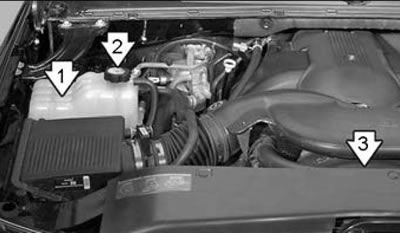
1 - expansion tank, 2 - expansion tank cap, 3 - electric fan of the cooling system radiator
The coolant level must be at the "FULL COLD" mark on the expansion tank, otherwise there is a coolant leak through the expansion tank cap, through the cooling system radiator or heater radiator hoses, through the radiator or coolant pump.
Warning: Do not continue driving if coolant leaks are detected. This may result in a complete loss of coolant and engine failure.
Note: To avoid burns, do not touch the radiator hoses, heater hoses or other engine components.
If there are no obvious signs of coolant leakage, restart the engine. When the idle speed doubles when pressing the accelerator pedal, the speed of the radiator electric fan should also increase. If the speed of the radiator electric fan does not change, turn off the engine and contact a car repair shop for repair.