


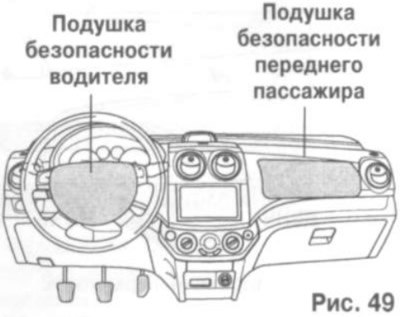
Airbags are designed to protect the head, neck and chest from impact with the instrument panel, steering wheel or windshield during a frontal collision.
They do not deploy in rear impacts, rollovers, or most side impacts. The airbags are designed to deploy in collisions with g-forces equal to or greater than those of a vehicle colliding at 15 to 23 km/h into a rigid, stationary wall.
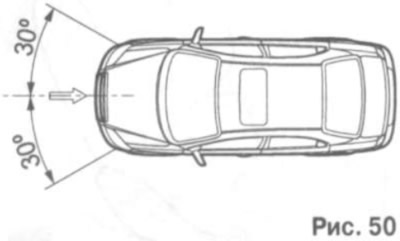
The airbag system is activated either in severe frontal collisions or when the angle of impact does not deviate from a straight line by more than 30°.
The overload level for vehicles at which the airbag deploys ensures that it deploys at an overload level no higher than the level for which statistical data has established the risk of death in a frontal collision.
In practice, cars rarely collide with stationary walls. Airbags are deployed in most cases when cars collide with each other. The actual speed at which airbags deploy in practice may be higher, since real accidents usually involve more complex multi-car collisions, at angles and not completely frontal, and the objects of the collision are usually not stationary.
The airbags deploy when the sensor detects a frontal collision with sufficient g-force to deploy the airbags. In this case, the deceleration sensor initiates a signal to deploy the airbag. This ignites a flammable compound that quickly burns inside the airbag module, releasing enough nitrogen gas to inflate the airbag. This chemical process and the nitrogen gas are harmless to people in the vehicle. Within 0.045 seconds of detecting a collision, the inflation pressure of the airbag ruptures the plastic panel of the module, which in turn deploys the steering wheel hub pad or the instrument panel on the passenger side.
The airbag fully deploys, forming a surface that stops the forward movement of the person's head and upper torso.
When a person comes into contact with the airbag, gas is released from the airbag through holes in the base, cushioning the impact of the load from the person's movement.
The entire process, from initial contact to inflation and release, takes about 0.2 seconds - before you can blink. A collision lasts a fraction of a second, and the colliding vehicles do not come to a complete stop until a few seconds after initial contact. So to protect the driver and passengers, the SRS must register a collision and deploy the airbags almost instantly.
Disabling the front passenger airbag (optional)
The airbag switch is located in the glove compartment. To turn off the airbag, insert the ignition key and set the switch to the OFF position. The airbag off indicator light located near the clock on the instrument panel will light up.
To turn on the airbag, set the switch to the ON position.
Side airbags (optional)
The side airbag modules are located in the backrests of the front seats on the door side.
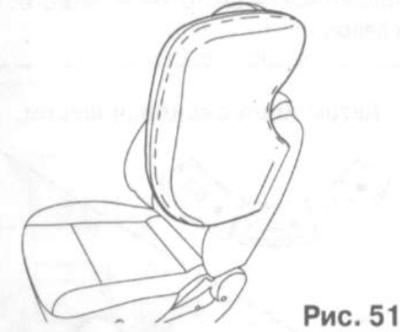
Side airbags are designed to protect the head, neck, arms and shoulders from impact with the front door or door window during a side collision.
The side air bags deploy if the sensor detects a side impact with sufficient g-force to deploy the side air bags. The side air bags are designed to deploy in side impacts with g-forces equal to or greater than those of a vehicle colliding with a deformable barrier moving at speeds of 15 to 25 km/h. If the side air bags do not deploy in a collision with your vehicle, this does not necessarily indicate a malfunction of the side air bags. The side air bags are designed to deploy in a side impact and will not deploy in a frontal impact, rear impact, or rollover unless the impact force is sufficient to deploy the side air bags.
[The article is reprinted from the website ChevyMan.ru]