


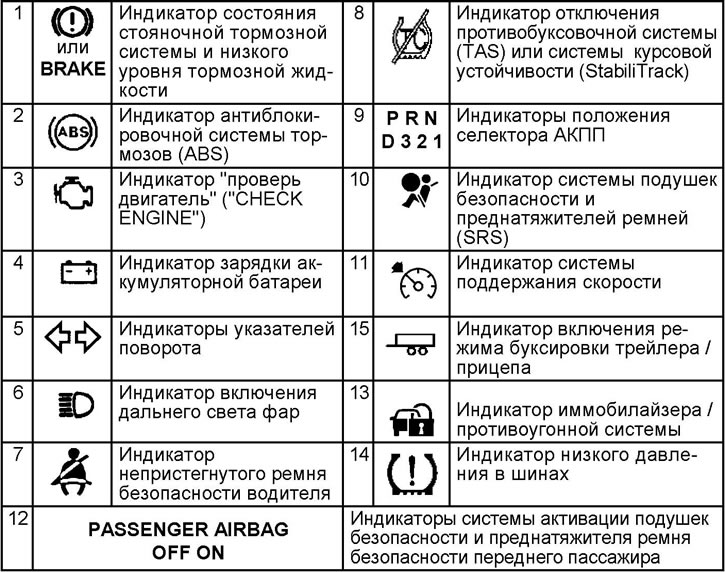
The indicator number in the table corresponds to the item number.
1. Parking brake system status and low brake fluid level indicator.
The indicator lights up when you turn the ignition key to the "ON" position and should go out after a few seconds.
- a) The indicator lights up if:
- parking brake engaged;
- low brake fluid level or brake booster leak;
- the electrical circuit of the indicator is faulty.
Note: When the brake booster system pressure decreases, the indicator lights up and the warning signal sounds continuously.
- b) If the indicator lights up while driving, you need to slow down, pull off the road and carefully stop the car. You can slow down by braking with the engine and using the parking brake, but do not forget to press the brake pedal to turn on the brake lights to warn drivers behind you about braking. Check the parking brake, it may be on. If the parking brake is off and the indicator lights up after it is turned off, then there is a malfunction in the brake system. Check the brake fluid level in the reservoir.
- If the brake fluid level is low, add fluid and check the vehicle's braking efficiency in a safe location. If you think the brakes are still working well enough, carefully drive the vehicle to the nearest repair facility. If the brakes do not work, the vehicle must be towed or removed for repair.
- If the brake fluid level is normal, then the brake booster may not be working effectively or the indicator electrical circuit may be faulty.
Warning: Driving a vehicle with low brake fluid levels is dangerous.
2. Anti-lock braking system (ABS) indicator.
- a) After turning the ignition key to the "ON" position, the indicator lights up for a few seconds and then goes out.
Note: If you are starting the engine using a booster battery, please refer to the relevant section for engine starting features on models with ABS.
- b) If the indicator lights up when the engine is running, lights up while driving, or does not light up for a few seconds after turning the ignition key to the "ON" position, this means that there may be a malfunction in the ABS system (the ABS system does not work and only the normal braking system works (see chapter "Anti-lock braking system (ABS)")).
Caution: Pressing the brake pedal repeatedly may cause the indicator to come on for a few seconds.
Note: If the indicator lights up while driving, slow down by gently pressing the brake pedal, stop the car in a safe place and turn off the ignition. To check the serviceability of the ABS system, start the engine again and continue driving at a speed of at least 20 km/h. If the indicator goes out, there is no malfunction.
3. Indicator "check engine" ("CHECK ENGINE").
The indicator lights up when the ignition key is turned to the "ON" position for a few seconds and then goes out, informing the driver that the engine management system is being checked.
If the indicator continues to light or lights up while driving, this indicates that there are faults in the electronic engine management system. In this case, you need to go to the repair shop and diagnose the engine management system.
4. Battery charge indicator.
- a) The indicator lights up when the ignition key is turned to the "ON" position and should go out after the engine starts.
- b) If the indicator lights up while driving, the charging system is faulty or weak (or torn off) alternator drive belt. However, the engine will continue to run until the battery is completely discharged. Turn off additional equipment (air conditioning, radio, etc.) and move to the repair site.
5. Turn signal indicators. The indicators flash when the turn signals are turned on. Excessive flashing of the indicator lamps indicates a poor connection in the turn signal circuit or a failure of the turn signal lamp.
6. High beam indicator. Lights up when the high beam headlights are turned on.
7. Driver's seat belt indicator.
The indicator lights up when the ignition is turned on for a few seconds and then goes out. If the driver is not wearing a seat belt, the indicator on the instrument cluster flashes. On some models, a signal sounds in addition.
8. Traction control system (TAS) or stability control system off indicator (StabiliTrack).
The indicator lights up when the ignition is turned on for a few seconds and then goes out.
Models with TAS system
While driving, the indicator lights up only when the traction control system is switched off or if it is faulty. For more information, see the section "Traction Control System (TAS)".
Models with StabiliTrak system
The indicator lights up when the StabiliTrack system is turned off by pressing the StabiliTrack system switch or when the system is faulty. For more information, see the "StabiliT rack system" section.
9. Automatic transmission selector position indicators ("P", "R", "N", "D", "3", "2" or "1").
When the automatic transmission selector is moved to any position, the corresponding indicator lights up on the instrument cluster "P", "R", "N", "D", "3", "2" or "1". For more details, see the section "Driving a car with automatic transmission".
10. Airbag and seat belt pretensioner system (SRS) indicator.
The indicator lights up when the ignition switch is in the "ON" or "ACC" position. The indicator goes out after a few seconds. If the indicator does not light up or lights up (flashes) while driving, there is a malfunction in the SRS system components.
11. Cruise control system operation indicator.
The indicator lights up when the cruise control system is turned on. For more information, see the section "Cruise control system".
12. The trailer/towing mode indicator lights up when the towing mode is engaged. For more information, see "Driving a car with automatic transmission".
13. Immobilizer/anti-theft system indicator.
The immobilizer indicator will come on when the key is turned to the "ON" position and should go out after approximately five seconds, informing the driver that the system is operational and the engine can be started.
If the indicator continues to flash for more than five seconds, the engine may be started with the wrong key or the immobilizer may be faulty. In this case, wait about 10 minutes (the immobilizer indicator should go out) and try to start the engine again. If the engine does not start, contact your dealer to have the problem corrected.
14. Low tire pressure indicator.
- a) The indicator comes on for a few seconds when the ignition key is in the "ON" position and then goes out.
- b) If the indicator lights up when the engine is running or lights up while driving, the pressure in one or more tires is below normal. You must stop and check the tire pressure.
- c) If the indicator does not light within three seconds after turning the ignition key to the "ON" position, this means that there may be a malfunction in the tire pressure monitoring system.
Note: The multifunction display will also show "CHECK TIRE PRESSURE".
15. Indicators of the airbag activation system and front passenger seat belt pretensioner.
Indicator "PASSENGER AIRBAG OFF" will light when the ignition key is in the "ON" position or when the engine is started. If the activation system does not detect the presence of a passenger in the seat (there is no passenger or his weight is too low), then the indicator will continue to light, if not, then the indicator will light "PASSENGER AIRBAG ON". For more details, see the section "Airbag and front passenger seat belt pretensioner activation system".
[The original article is on the website CHEVYMAN.RU]