


Contents: Washing ↧ Examination ↧
Caution: When repairing the crankshaft, be careful not to damage the running surfaces of the connecting rod and main journals or the teeth of the synchronizing ring (1) of the crankshaft position sensor. Damage to the teeth of the synchronizing ring may adversely affect the operation of the on-board diagnostic (OBD) II system.
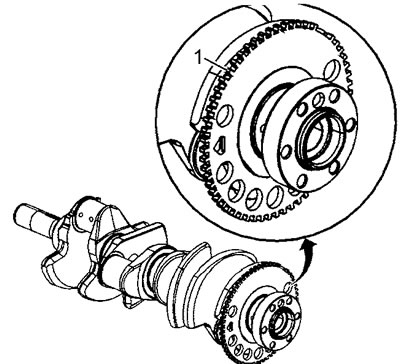
Washing
1. Wash the crankshaft with solvent.
2. Thoroughly clean all oil supply channels (2) and, if present, remove burrs from the channel outlet.
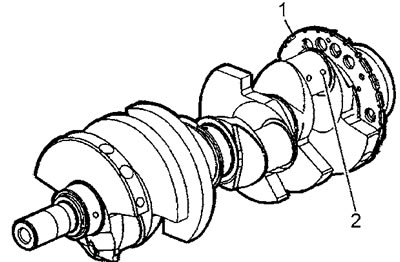
3. Dry the crankshaft with compressed air.
Caution: Wear safety glasses when blowing out the crankshaft.
Examination
1. Check the condition of the teeth of the crankshaft position sensor synchronizing ring. If the teeth are defective, replace the crankshaft.
2. Check the condition of the crankshaft journals. The surface of the journals should be smooth, without scratches, tarnish, signs of obvious wear, pitting and other damage.
3. Check the condition of the crankshaft flange where the rear oil seal lip operates.
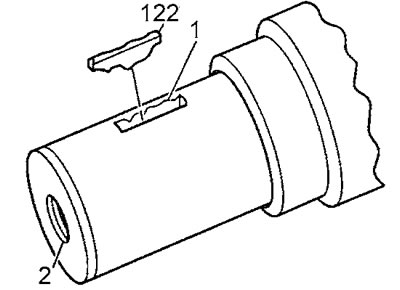
4. Check the condition of the crankshaft key (122), keyway (1) and threaded hole (2).
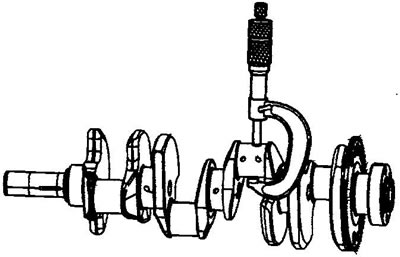
5. Measure the outer diameter of the crankshaft journal in two places along the length of the journal and in two mutually perpendicular planes, determine the taper and ovality of all crankshaft journals.
6. Measure the distance (a) between the central main journal cheeks for installing the thrust bearing. If this distance is greater than 26.2 mm, replace the crankshaft.
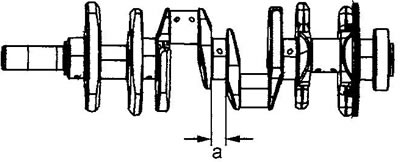
7. Mount the shaft on the outer main journals on V-shaped prisms or in a machine with centers. Measure the crankshaft runout on all main journals, the runout of the rear flange and the runout of the synchronizing ring.
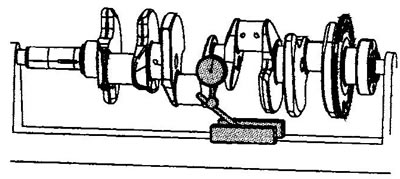
When measuring the runout of the synchronizing ring, set the indicator leg 1 mm below the tooth gullets. If the runout of the synchronizing ring is more than 0.7 mm, replace the crankshaft.
8. Check the condition of the friction surface of the main bearing shells, look for signs of chipping, cracking and other defects. If the lower (bearing) shell is worn or damaged, replace both shells. If the lower shell is in good condition, the upper shell will usually be in good condition too.
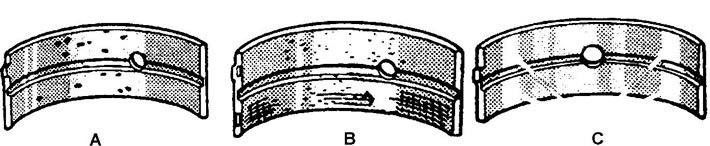
Checking the condition of the friction surface of the main bearing shells (to point 8). A - fatigue spalling; B - scuffs and tarnishing, inclusions of foreign material; C - incorrect installation of the liner or defects of the cover or neck (bright polished areas).