


Contents: Front passenger airbag deployment ↧ Location of airbags ↧ Side airbag (optional) ↧ Side airbag deployment ↧
Your vehicle is equipped with an additional passive safety system that includes an inflatable airbag that protects the driver's head and chest from injury in a serious traffic accident. A front passenger airbag and side airbags may be installed as an option.
The airbag is activated automatically in the event of a severe frontal impact of the vehicle or if the direction of the impact does not go beyond the angular sector shown in the figure (±30 degrees in each direction from the longitudinal plane of the vehicle).
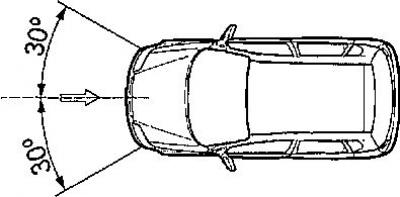
Front passenger airbag deployment
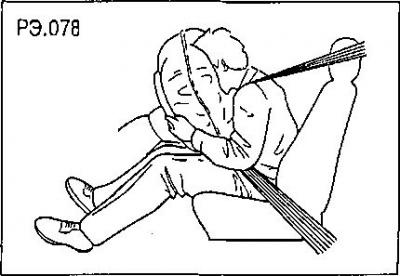
Location of airbags
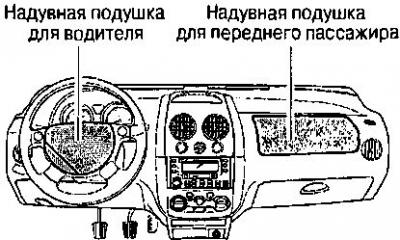
The driver's airbag is located under the steering wheel hub pad.
Front passenger airbag (optional)
The airbag is located in a socket above the glove compartment.
Side airbag (optional)
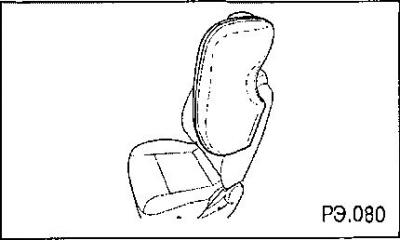
Side airbag deployment
The airbag inflates within milliseconds of a frontal impact, protecting the driver from injury from the steering wheel. Once deployed, the airbag deflates immediately, thereby preserving the driver's visibility and maintaining the ability to control the vehicle using the steering wheel and other controls.
The front passenger airbag is basically the same as the driver's airbag, but it is larger and inflates at a faster rate. If deployed, the airbag can injure a front passenger if the passenger is not seated correctly or is not wearing a seat belt.
Caution: Since the airbag inflates at a high rate, proper seat and back adjustment is essential for its effective operation. The driver's seat should be adjusted so that the driver can reach the steering wheel with slightly bent elbows. The front passenger should move his seat as far away from the control panel as possible and sit firmly against the backrest.
The activation of the airbag is accompanied by a loud bang and the release of a small amount of gas. The gas is harmless and is not a sign of combustion.
It should be borne in mind that in a severe accident there is always a possibility of serious injury or death of the people in the car, even despite the correct use of seat belts and the presence of airbags. There is no passive safety system that would guarantee complete protection of the driver and passengers in the event of a severe car accident. Based on the nature and severity of the damage that the car received in the accident, it can be very difficult to reliably determine whether the airbag should have deployed in each specific case. In some cases, the airbag does not deploy, and the car body after the accident has very strong deformations. This indicates that most of the impact energy was absorbed due to plastic deformation of the car body elements. In other cases, on the contrary, the deployment of the airbag is combined with minor accident damage to the car. This is observed, for example, during hard impacts against an obstacle with the chassis of the car. In this case, the car experiences significant deceleration, which leads to the deployment of the airbag, and the car itself may not receive significant visible damage to the body.
Information taken from the official website «CHEVYMAN.RU»