


If a brake pad replacement is necessary, replace the pads of all wheels on one axle.
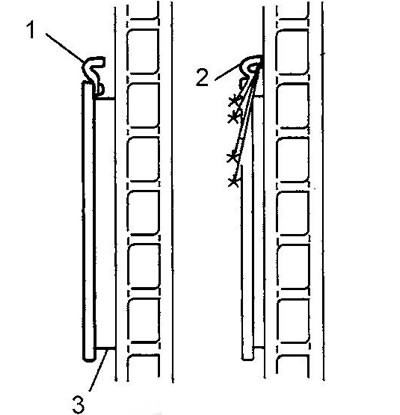
Check the thickness of the pad (3) at both ends. The highest wear rate is usually at the rear edge of the pad.
Brake pad wear should be approximately equal on both wheels of the same axle.
The brake pads are equipped with a wear sensor (1). When the pads wear down to the minimum permissible thickness, the wear sensor comes into contact with the disc (2), generating a high-frequency sound.
The brake pad should be replaced when the friction layer thickness is 0.76 mm.
Remove the brake caliper. Inspect the friction surfaces of the inner and outer brake pads. The pads should wear approximately equally. Place the pads with the friction surfaces facing each other. Measure the gap between the surfaces. If the gap is greater than 0.13 mm (approximately in the middle of the friction surface), replace the pads.
Make sure the brake shoe adjusting shims are in place and not damaged or heavily rusted.
Replace the pads if the friction material has separated from the base, or if there are cracks or other defects.