


Caution: Contact with frame, body or engine system hoses will cause abnormal power steering system operation noise.
2. Check that the power steering hoses are securely connected.
Caution: Loose hose fasteners may not result in visible leakage of working fluid, but may cause air to be sucked into the system.
Note: When air is sucked into the system, the correct fluid level in the power steering pump reservoir cannot be determined. The presence of air in the system leads to cavitation on the pump blades, which causes noisy operation of the pump and, after some time, the destruction of the pump.
3. Remove the power steering pump reservoir cap.
4. Fill the tank with clean working fluid up to the FULL COLD mark.
Note: Always use only the type of hydraulic fluid recommended by the manufacturer. Using an alternative fluid may damage the hoses and seals in the system.
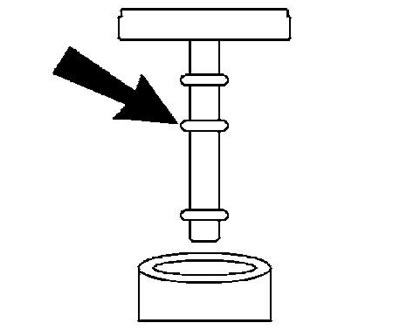
5. Connect the special plug to the hand vacuum pump.
6. Install the plug in place of the pump tank cover.
Caution: When performing the bleeding procedure, maintain the correct fluid level in the pump reservoir.
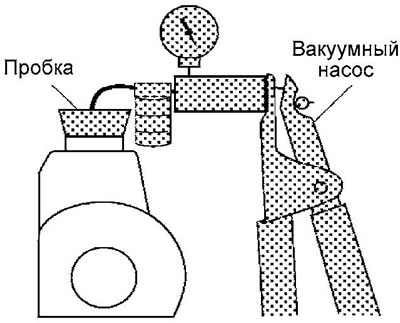
7. Create a vacuum in the tank of about 68 kPa, but no more.
8. Wait for about five minutes. During this time, the vacuum may decrease by 7-10 kPa. If the vacuum does not remain constant, diagnose the causes of the vacuum drop (see description at the end of the pumping procedure). —
9. Remove the plug and vacuum pump.
10. Replace the tank lid.
11. Start the engine at idle speed.
12. Turn off the engine.
13. Check and adjust the fluid level. Repeat steps 11-13 until the fluid level stabilizes.
14. Start the engine at idle speed.
15. Turn the steering wheel 180-360 degrees in both directions five times.
Caution: Do not turn the steering wheel all the way.
16. Turn off the ignition.
17. Check the fluid level.
18. Remove the pump tank cover.
19. Repeat steps 5-8.
20. Check the fluid level.
21. Install the pump reservoir cover.