


Contents: Cylinder head ↧ Camshafts ↧ Crankshaft ↧ Toothed timing belt ↧ Lubrication system ↧ Exhaust manifold ↧ Intake manifold ↧ Exhaust gas recirculation system ↧
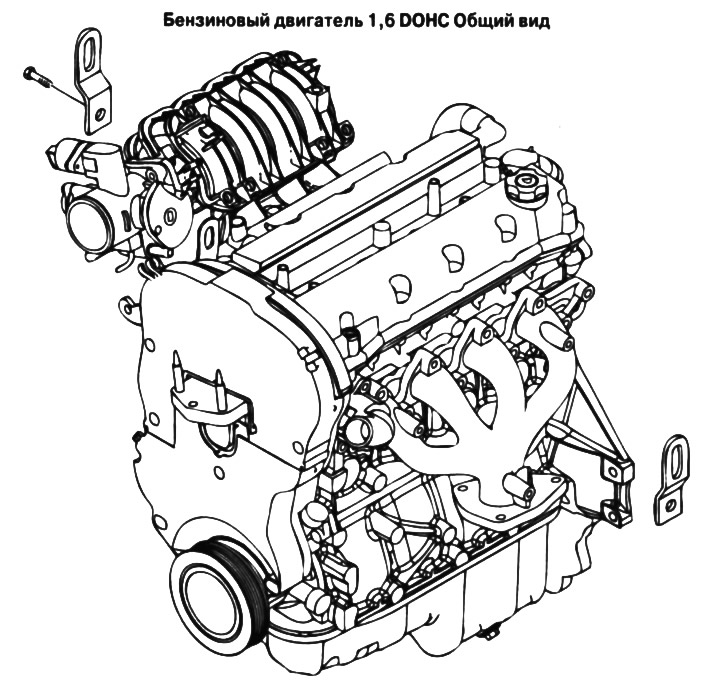
Cylinder head
The cylinder head (hereinafter referred to as the CBC) is made of aluminum alloy. The intake and exhaust ports are located on opposite sides of the CBC. The spark plug is located in the center of each combustion chamber.
Camshafts
The engine is equipped with two camshafts installed in the cylinder head. The first shaft controls the intake valves, and the second - the exhaust valves. Channels are machined in the camshafts to improve lubrication.
Crankshaft
The crankshaft rests on five main bearings. The third bearing is a radial thrust bearing. The main bearings are lubricated by oil supplied under pressure to the main oil line of the cylinder block.
Toothed timing belt
A toothed camshaft drive belt connects the crankshaft and camshafts, maintaining rotation synchronization between them. The timing belt of the camshaft drive also drives the coolant pump to rotate. The timing belt of the camshaft drive and the gear pulleys are engaged so that there is no slippage between them. The tensioning roller maintains the correct tension of the camshaft timing belt. The gear belt of the camshaft drive is made of rigid reinforced rubber, similar to that used in the V-belt drive of auxiliary mechanisms.
Lubrication system
The oil pan is mounted at the bottom of the engine block. The oil pan is made of pressed sheet metal. Engine oil is pumped from the oil pan by an oil pump. After the oil passes through the oil filter, it is fed through two channels to lubricate the engine block and cylinder head. In one channel, oil is pumped through oil channels into the crankshaft to the connecting rods, then to the pistons and cylinders in the engine block.
The oil then drains back into the oil pan. In the second channel, oil is forced through the oil passages to the camshaft. The oil passes through an internal bypass channel in the camshaft to lubricate the valve assemblies in the cylinder head, and then drains back into the oil pan.
The oil pickup filter is installed in front of the oil pump inlet to remove foreign matter that could clog or damage the oil pump or other engine parts.
At high engine speeds, the oil pump delivers much more oil than is needed to lubricate the engine. The oil pressure regulator prevents too much oil from being delivered to lubricate the engine passages. When the oil supply is normal, a coil spring holds the bypass passage closed, directing all the pumped oil into the engine. When the amount of oil delivered increases, the pressure becomes high enough to overcome the spring force. This causes the oil pressure regulator valve to open, allowing excess oil to flow through the valve and back into the oil pan.
Exhaust manifold
This engine uses a single four-port exhaust manifold with a rear lower mount. The exhaust manifold is designed to remove exhaust gases released from the combustion chamber. An oxygen sensor is installed in the manifold.
Intake manifold
The intake manifold consists of four independent channels. To improve the engine's performance in the low and medium speed range, the design uses the principle of dynamic supercharging.
Exhaust gas recirculation system
The exhaust gas recirculation system is used to reduce the level of nitrogen oxide emissions produced due to high combustion temperatures. The main element of the system is the exhaust gas recirculation valve, which is driven by the electronic engine control unit.
The exhaust gas recirculation valve feeds small amounts of exhaust gas into the intake manifold to reduce combustion temperatures. The amount of exhaust gas added to the intake tract is controlled by the exhaust gas back pressure. If too much exhaust gas is introduced, combustion will not occur. Therefore, only a very small amount of exhaust gas can be added through the valve, especially at idle speed.
The exhaust gas recirculation valve is controlled by the electronic engine control unit, depending on the engine operating mode.
Attention: Before removing or installing any assembly, disconnect the negative wire from the battery (hereinafter referred to as the battery). Disconnecting this wire prevents personal injury and vehicle damage. The ignition must also be switched off, unless otherwise specified.
[The original article is on the website «chevyman.ru»]