


The vehicle's steering system consists of a steering wheel, a steering column, a steering gear, a working fluid pump, two steering rods and their two ends, connected by ball joints to the steering knuckles of the front suspension.
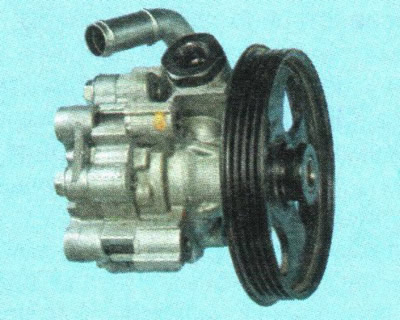
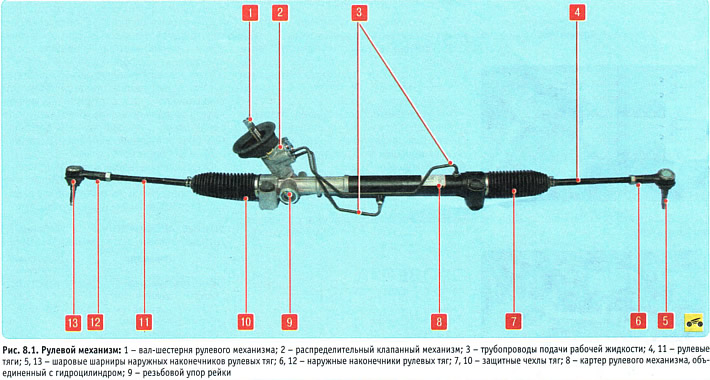
The pressure of the working fluid in the hydraulic booster is created by a vane-type pump, which is mounted on the engine bracket and is driven by a poly-V belt from the water pump pulley, which in turn is also driven by a poly-V belt from the crankshaft pulley. From the tank, the working fluid is fed under high pressure by the pump to the valve timing mechanism 2 (figure 8.1), mounted on the steering gear housing and connected to the steering column. When the steering wheel is turned, the valve mechanism connects one of the cavities of the hydraulic cylinder, made in the housing 8 of the steering gear, to the high-pressure line, and the second - to the pipeline for draining fluid into the tank. The toothed rack, connected to the piston of the hydraulic cylinder, moves in the steering gear housing under the action of the gear and the pressure difference in the hydraulic cylinder. Moving, the rack transmits force to the steering knuckles through the steering rods, which leads to the rotation of the front wheels of the car. If the amplifier fails, the ability to control the car is preserved, but the force on the steering wheel increases.
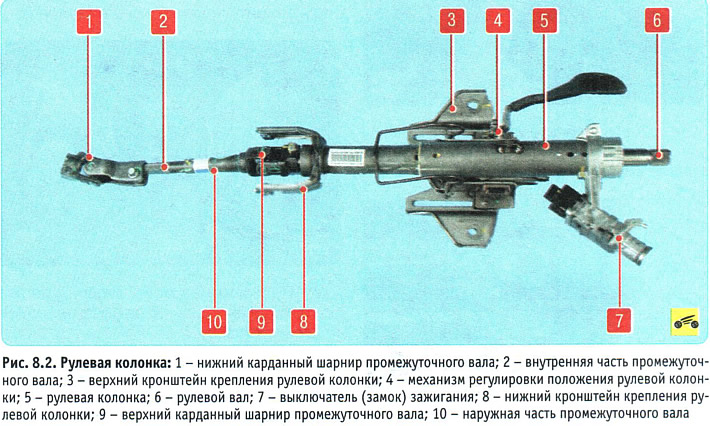
A trauma-safe steering column is installed on the car (figure 8.2) with a mechanism 4 for adjusting its position by reach and tilt angle. The intermediate shaft consists of two parts 2 and 10 with a splined connection. When the body is deformed during a frontal collision, the shaft parts telescopically slide into each other, reducing the possibility of injury to the driver from hitting the steering wheel. The intermediate shaft is connected to the steering shaft and the steering gear shaft-pinion by cardan joints 9 and 1, respectively. The steering column houses the ignition switch 7 with an anti-theft device that blocks the steering wheel shaft from turning, as well as controls for the headlights, turn signals, horn, washer and wiper of the windshield and the rear door glass, combined into a block of steering column switches.
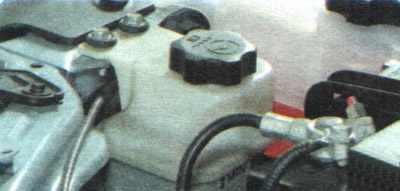
The power steering reservoir is installed in the front part of the engine compartment on the upper cross member of the radiator frame and is connected by hoses to the power steering pump and to the working fluid return line. To control the fluid level, level marks are applied to the translucent wall of the reservoir.
The steering rods are attached to the steering rack and to the steering knuckles of the front suspension by ball joints 5 and 13 (see figure 8.1). The steering rods are secured against turning in the tips with lock nuts. The toe-in of the steered wheels is adjusted by rotating the steering rod in the ball joint relative to the tip.