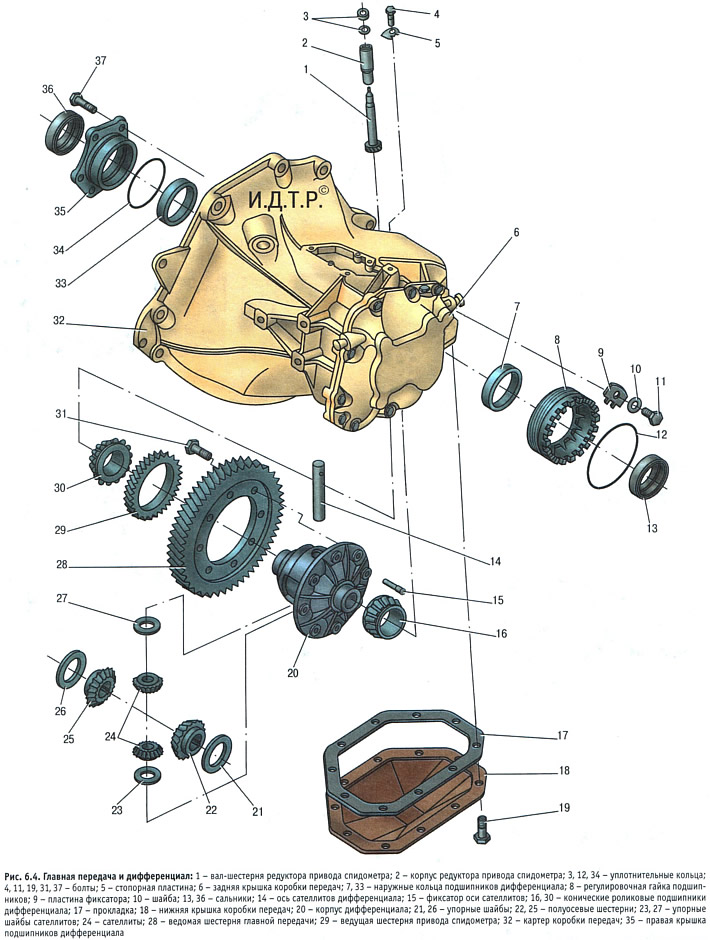


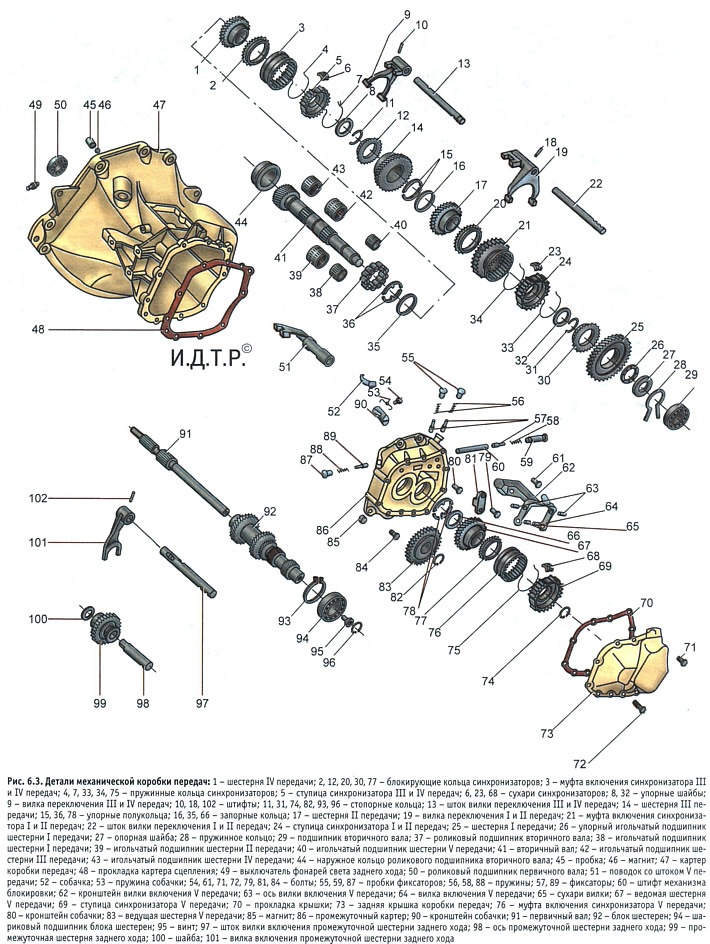
The manual gearbox is a two-shaft design with five synchronized forward gears and one unsynchronized reverse gear. The gearbox and final drive with differential have a common housing, and in addition, the gearbox has an additional intermediate housing and cover. The primary shaft is pressed into the gear block and connected to it by splines.
The secondary shaft of the gearbox contains the leading cylindrical gear of the main transmission, driven gears and gear synchronizers. The pairs of forward gears of the gearbox are in constant engagement. The gears of the fourth gear in the neutral position rotate freely on the secondary shaft.
Forward gears are engaged by axial movement of the corresponding synchronizer clutches mounted on the secondary shaft. Reverse gear is engaged by moving the intermediate reverse gear along its axis.
The gear shift mechanism is located in a cover installed on top of the gearbox housing.
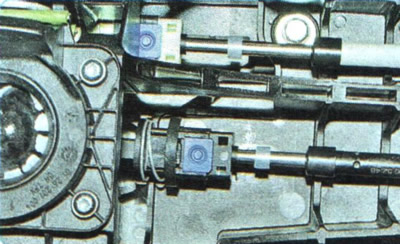
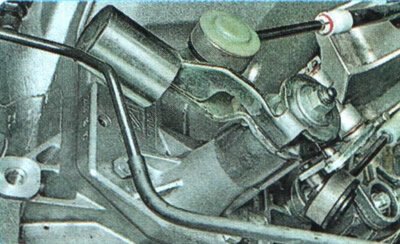
The gearbox control drive consists of a gear shift lever linkage with a ball joint mounted on the body base, and two cables connecting the linkage levers and the mechanism located in the gearbox housing.
NOTE: Floor tunnel lining removed for clarity.
The main transmission is made in the form of a pair of cylindrical gears, selected for noise. Torque is transmitted from the driven gear of the main transmission to the differential and then to the front wheel drives.
The differential is bevel, two-satellite. The tightness of the connection of the internal joints of the front wheel drives with the differential gears is ensured by seals 13 (figure 6.4) and 36.