


Checking the limiting valves
To check the master cylinder related limiting valves on vehicles without anti-lock brake systems, use two pressure gauges.
These valves limit the output pressure of the master cylinder to the rear brakes when the master cylinder reaches a predetermined pressure. On vehicles with ABS, the hydraulic modulator assembly controls the hydraulic pressure to the rear and front wheel cylinders.
When checking the brake system limiting valves, make sure that the pressure in the hydraulic pipes is measured simultaneously for a pair of wheels located diagonally (for example, front left and rear right).
To measure your blood pressure, follow these steps:.
1. Remove the bypass valve and install a pressure gauge on one of the rear brake cylinders.
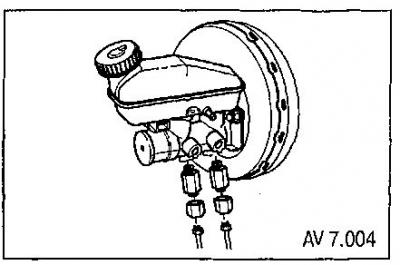
2. Remove the bypass valve and install another pressure gauge to the brake line of the diagonally opposite wheel.
3. Build up pressure by quickly pressing the brake pedal several times. (The pressure read on the gauge is not adjustable and is the actual hydraulic pressure of the brake system.)
4. Increase the pressure until the test values specified in the following pressure limiting valve test table are reached.
|
Engine 1.5SOHC |
Reference value for gradient and cut-in pressure on the valve body |
Input pressure read from the pressure gauge on the front axle |
Output pressure read from the pressure gauge on the rear axle |
|
0,3/30 |
4,500 kPa |
3 450 + 200 kPa |
Caution: If the pressure increases above 10,000 kPa, the pressure value read from the rear pressure gauge will be incorrect.
5. Remove the pressure gauges from the brake circuit being tested.
6. Reinstall the bypass valves and tighten to 6 Nm.
7. Repeat the test on the remaining front and rear brake circuits.
8. Reinstall the bypass valves and tighten to 6 Nm.