


Contents: Disassembly ↧ Assembly ↧
Disassembly
1. Remove the brake master cylinder.
2. Remove the brake fluid reservoir.
3. Remove the cylinder cavity sealing ring.
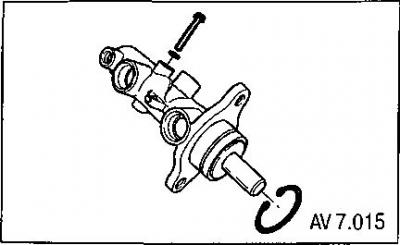
Note: A rod or similar tool can be used in the compensation hole to hold the piston in the depressed position.
4. Using a screwdriver, remove the retaining ring from the cylinder body. (The figure shows the housing of the master cylinder for brakes without anti-lock braking system.)
Note: When removing the snap ring, avoid damaging the piston or cylinder walls.
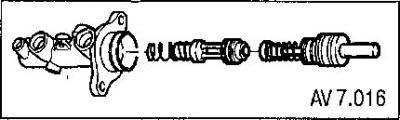
5. Remove the primary piston. (The figure shows the housing of the master cylinder with an anti-lock braking system.)
6. Carefully remove the secondary piston assembly and spring from the master cylinder cavity.
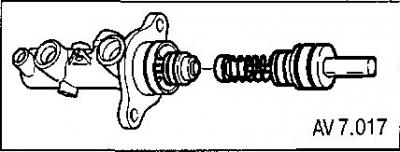
Assembly
Note: Do not use abrasives to clean the brake master cylinder.
Caution: Rubber parts and retaining rings must be replaced with new ones.
1. Using denatured alcohol or clean brake fluid, wash all parts. Then dry these parts with compressed air.
2. Inspect the master cylinder cavity for wear or corrosion. If wear or corrosion is detected, replace the master cylinder housing.
3. Lubricate the cavity of the master cylinder with clean brake fluid. (The illustration shows the master cylinder for brakes without anti-lock braking system.)
4. Carefully insert the secondary piston assembly into the cavity until the secondary piston touches the base of the cylinder body. If necessary, use a wooden or plastic rod.
5. Insert the primary piston.
6. Using a wooden or plastic punch, press the pistons into the cylinder cavity.
Note: When installing a new retaining ring, take care not to damage the cylinder cavity.
7. Insert the new retaining ring into the groove in the cylinder cavity. (The figure shows the housing of the master cylinder for a brake without anti-lock braking system.) Remove the rod.
8. After installation, move the piston back and forth to check for free movement.
9. Lubricate the sealing ring and install the seal on the shaft in the cylinder cavity. The open side should be facing outward until the seal is tightly installed on the piston.
10. Install the brake fluid reservoir onto the master cylinder.
11. Install the brake master cylinder.
12. Raise and secure the vehicle.
13. Bleed the brake system.
14. Lower the vehicle.