


Contents: Wheel alignment ↧ Longitudinal tilt of the wheel pivot… ↧ Wheel alignment ↧ Transverse tilt of the wheel pivot… ↧ Angle "kingpin-wheel" ↧ Shoulder (radius) of rolling ↧ Wheel offset ↧ Wheel turning angle ↧ Checking the camber and caster… ↧ Checking the rear wheel camber angle ↧ Checking the rear wheel alignment ↧
Correct wheel alignment is necessary to ensure the following vehicle properties:
- Self-return of the wheels when the car exits a turn and maintaining the direction of travel when the steering wheel is released and driving on a level road without tilt or crosswind (this is achieved by the presence of the so-called stabilizing moment).
- The lowest losses due to wheel rolling and friction against the road.
A complete wheel alignment check should include measurements of the rear wheel toe and camber angles. Alignment of all 4 wheels of the vehicle ensures that all 4 wheels roll in exactly the same direction. If the vehicle's wheel suspensions are adjusted geometrically correctly, fuel economy and tire life will be maximized, and handling will be most efficient and safe.
Wheel alignment
Wheel alignment - preliminary installation (when the vehicle is stationary) wheels located on the same axle, in which the distance between their front edges is less than between the rear ones. This position of the wheels is necessary to compensate for the elasticity of the wheel suspension units, as well as to compensate for the wear of these units.
When the toe-in is set correctly, the wheels are in the longitudinal plane during movement, that is, parallel to the direction of movement.
Incorrect toe-in or toe-out angles cause tire wear and increase fuel consumption. Always adjust the toe-in angle at the end.
Longitudinal tilt of the wheel pivot axis
Longitudinal tilt of the wheel pivot axis is the deviation from the vertical in the longitudinal plane of the axis around which the wheel turns. Backward tilt is positive, and forward tilt is negative. Longitudinal tilt of the wheel pivot axis affects the occurrence of a stabilizing force that tends to set the steered wheels in the direction of travel "straight ahead".
Weak springs or vehicle overload affect the longitudinal tilt of the wheel pivot axis. The higher the longitudinal tilt angle of the wheel pivot axis, the greater the force preventing the wheel from turning. The longitudinal tilt angle of the wheel pivot axis is measured in degrees and is non-adjustable. The optimal value of this angle allows for a small force to be achieved when turning the wheels and, at the same time, ensures stabilization of the direction of the vehicle on the road.
Wheel alignment
Camber is the tilt of the longitudinal plane of symmetry of the tire. Outward tilt is considered positive, inward tilt is negative. Camber angle is measured in degrees. Camber affects both directional control and tire wear.
If the car has too much positive camber, the tire edges on the outside of the car will wear. If the car has too much negative camber, the tire edges on the inside of the car will wear. Camber is not an adjustable parameter.
Transverse tilt of the wheel pivot axis
Caster - The tilt of the steering knuckle from the vertical at its top. Measure the caster angle between the vertical line and a line through the center of the strut and the lower ball joint when viewed from the front of the vehicle.
The transverse tilt of the wheel's pivot axis is necessary to form the correct shoulder (radius) of the rolling (see below).
The transverse inclination of the steering axis of the wheel on front-wheel drive vehicles should be such that the shoulder (rolling radius) was negative.
Angle "kingpin-wheel"
This is the angle formed by the axis of rotation of the wheel and the longitudinal plane of symmetry of the tire.
The kingpin-to-wheel angle is measured in degrees. In most cases, this angle is not measured directly. To determine it, subtract the negative or add the positive camber angle to the lateral tilt angle of the wheel's pivot axis.
Shoulder (radius) of rolling
The rolling radius is the distance measured along the road surface between the vertical plane of symmetry of the tire and the point at which an imaginary line, which is an extension of the wheel rotation axis, intersects the road surface. If the intersection points of the imaginary wheel rotation axes with the road surface are inside the track (limited by vertical planes of symmetry of tires), then the rolling shoulder is considered positive. In this case, the rolling resistance force of the wheel creates a moment tending to turn the controlled wheel outward.
If the intersection points of the imaginary axes of wheel rotation with the road surface extend beyond the planes of wheel symmetry, the rolling shoulder is considered negative. In this case, the wheel, resisting rolling, tends to turn inside the track.
The use of a negative rolling arm increases the stability of a front-wheel drive vehicle during acceleration and braking.
The size of the shoulder (radius) of the rolling is determined by the design of the car and is a non-adjustable value.
Wheel offset
Wheel offset is the distance one front hub and bearing assembly can be behind the other front hub and bearing assembly. Wheel offset is usually caused by the vehicle colliding with an obstacle.
Wheel turning angle
Steering angle is the angle at which each front wheel turns relative to the vertical when the vehicle is turning.
Loosen the locknuts of the threaded connection of the steering rods to the steering rod ends.
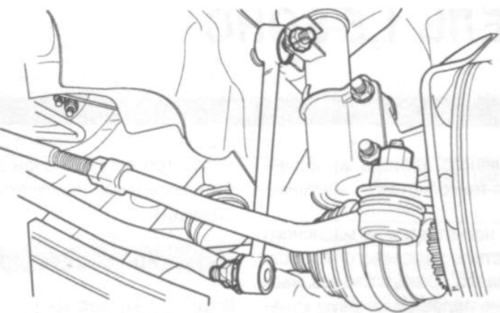
Turn the right and left steering rod adjuster to a toe-in value of 0°-10° to 0°+10. In this adjustment, the left and right steering rods should be the same length.
Tightening. Tighten the steering rod bolts to 64 Nm.
Wheel alignment angle values
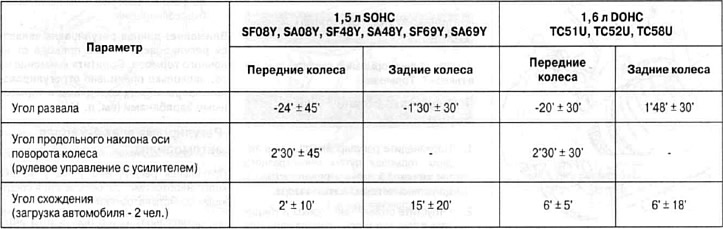
Checking the camber and caster angles of the front wheels
The camber and longitudinal tilt angles of the front wheel pivot axis are unregulated. Refer to the "Wheel Adjustment" table in this section. Before measuring the camber angle or the angle of the longitudinal tilt of the wheel axis of the wheels, raise and lower the vehicle three times by the bumper in order to avoid incorrect readings. If the measured camber angle or longitudinal tilt angle of the front wheel pivot differs from the specification values, identify and replace or repair any damaged, loose, bent, dented or worn suspension parts. If the cause is the car body, then repair the body.
Checking the rear wheel camber angle
The rear camber angle is not adjustable. Refer to the "Wheel Adjustment" table in this section. If the rear camber angle deviates from the specification values, determine the cause and correct it. If any damaged, loose, bent, dented or worn suspension parts are found, such parts must be repaired or replaced. If the vehicle body is the cause, the body must be repaired.
Checking the rear wheel alignment
The rear wheel toe-in is not adjustable. Refer to the "Wheel Adjustment" table in this section. If the rear wheel toe-in angle deviates from the specification values, inspect the rear axle housing and steering knuckle for possible damage on vehicles without an anti-lock braking system (ABS), and the rear axle housing and hub with bearing on vehicles with an anti-lock braking system.