
ChevyMan.ru
Mazda Mitsubishi Toyota Land Rover Honda Kia Nissan
English Русский
Български
Беларускі
Український
Српски
Hrvatski
Română
Polski
Slovenský
Magyar
|
Articles | Sitemap | Contacts |


Home   Aveo   Captiva   Cruze   Lacetti   Lanos   Niva   Tahoe   Others  
Aveo T300 (2012-2018) Aveo T250 (2006-2011) Aveo T200 (2003-2008)
  • Home
  • Aveo
  • T200 (2003-2008)
  • Chassis
  • Steering
  • Removal and installation the hydraulic fluid reservoir

Removal and installation the hydraulic fluid reservoir (Chevrolet Aveo T200)

            0

Contents: Removal ↧ Removal air from the system ↧ Checking the level and adding liquid ↧

Removal


1. Remove all liquid from the tank (for example, using a syringe).

2. Loosen the hose clamps and remove both hoses.

3. Unscrew the mounting nuts and remove the tank.
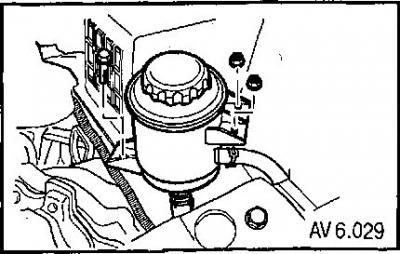
3. Unscrew the mounting nuts and remove the tank.


Note: To prevent foreign bodies from entering the hydraulic fluid, the hoses must be plugged immediately after they are disconnected from the reservoir pipes. Contamination of the fluid can lead to premature wear of steering gear components and loss of steering functions.


When installing, tighten the tank mounting nuts to a torque of 7 Nm.

Removal air from the system


To bleed air trapped in the steering system, follow these steps:.

1. Check the fluid level in the reservoir and the tension of the drive belt. If necessary, add fluid up to the MIN level mark.

2. Start the engine.

3. Bleeding the system is done by turning the steering wheel from side to side (but not to extreme positions) with the engine running.

Caution: Do not hold the steering wheel in extreme positions, as this may cause damage to the power steering pump.


Air will be removed from the system when normal steering operation is achieved.

Checking the level and adding liquid


The power steering fluid level is determined either by the mark on the reservoir or by the marks on the fluid level indicator on the reservoir cap.

During vehicle operation, the hydraulic fluid heats up to 60°C, which causes it to expand. Fluid level (in a warm state) must be between the MAX and MIN marks.

At normal ambient temperature (about 2°C) the fluid level should be at the MIN mark.
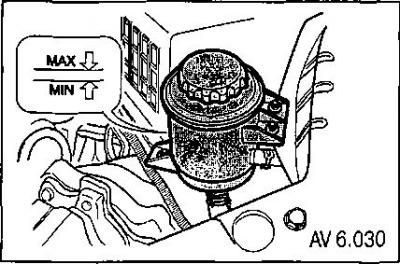
At normal ambient temperature (about 2°C) the fluid level should be at the MIN mark.


Note: Use only DEXRON II-D or DEXRON III power steering fluid for topping up and replacing. Using the wrong fluid may cause damage to hoses, seals and gaskets, resulting in fluid leakage. Monitor and maintain proper fluid level in the power steering reservoir.


The original material is located on the website «ChevyMan.ru»

The article was checked: Vladimir Romannikov
This article is available at russian, bulgarian, belarusian, ukrainian, serbian, croatian, romanian, polish, slovak, hungarian

Share information:

Previous articles
Aveo T200: Steering
Next articles

Removal and installation the power steering pump
Removal and installation the rack and pinion mechanism
Removal and installation the drive shaft-gear with the control valve
Replacing steering rods with internal ball joint
Replacing the tie rod end on a car
Removal and installation the steering column


See similar articles on the topic of Chevrolet cars:
Brake fluid reservoir Chevrolet Captiva 1 (2006-2018)
Checking the level and adding fluid to the brake master cylinder reservoir Chevrolet Cruze 1 (2008-2016)
Checking the fluid level in the brake and clutch hydraulic reservoir Chevrolet Lacetti 1 (2002-2009)
Checking the fluid level in the windshield washer reservoir Chevrolet Lanos T150 (2002-2009)
Clutch release hydraulic drive Chevrolet Niva 1 (2002-2016)
Checking and restoring the fluid level in the hydraulic power steering system Chevrolet Tahoe 1 (1992-2000)
Checking the hydraulic fluid level in the automatic transmission (every 3000 miles or 3 months) Chevrolet Lumina 1 (1989-1994)
Link in different formats to this page


Visitor comments

No comments yet


How much will 19 + 43 =


Aveo T300 (2012-2018) 
  • General information
  • Vehicle device
  • User manual
  • Main malfunctions
  • Maintenance
  • Power unit
  • Engine
  • Lubrication system
  • Cooling system
  • Supply system
  • Exhaust system
  • Transmission
  • Clutch
  • Manual gearbox
  • Automatic gearbox
  • Front wheel drives
  • Chassis
  • Front suspension
  • Rear suspension
  • Steering
  • Brake system
  • Body
  • Exterior
  • Interior
  • Doors and trunk
  • Security systems
  • Electrical equipment
  • Engine electrics
  • Equipment and devices
  • Heating and air conditioning
  • Electrical circuits


Aveo T250 (2006-2011) 
  • Manual
  • Driver's workplace
  • Salon equipment
  • Vehicle characteristics
  • Maintenance
  • Engine 1.5 SOHC
  • Engine repair
  • Fuel supply system
  • Control system
  • Cooling system
  • Engine 1.6 DOHC
  • Engine repair
  • Control system
  • Transmission
  • Clutch
  • Manual gearbox
  • Automatic gearbox
  • Wheel drive
  • Chassis
  • Wheel suspension
  • Steering
  • Brake system
  • Body
  • Exterior
  • Interior


Aveo T200 (2003-2008) 
  • General information
  • User manual
  • Power unit
  • Engine repair 1.5L SOHC
  • Fuel system
  • Control system
  • Cooling system
  • Transmission
  • Clutch
  • Manual gearbox
  • Automatic gearbox
  • Drive shafts
  • Chassis
  • Front suspension
  • Rear suspension
  • Steering
  • Brake system
  • Body
  • Exterior (external elements)
  • Interior (internal elements)
  • Electrical equipment
  • Equipment and devices
  • Electrical circuits


ChevyMan.ru © 2017-2026 · Mobile version · Feedback · Site search · Interesting to read · Sitemap: EN BG BY UA RS HR RO PL SK HU

Aveo 2003-2008 · Aveo 2006-2011 · Aveo 2012-2018 · Captiva 2006-2018 · Cruze 2008-2016 · Lacetti 2002-2009 · Lanos 2002-2009 · Niva 2002-2016 · Tahoe 1992-2000 · Tahoe 2000-2014 · Lumina 1 1989-1994 · Trailblazer 1 2001-2008 · Orlando 1 2010-2018 ·
🛡️ For your security and to improve our service, this site uses cookies. You can disable them in your browser.