


NOTE: Air conditioning is available on LT and LTZ trim levels only.
The system provides low-inertia regulation of air temperature, practically independent of the vehicle speed. The amount of air entering the cabin is mainly determined by the fan operating mode, so it should be turned on even when driving at high speed.
Outside air can enter the passenger compartment through the door windows when the windows are lowered and the air blower located in front of the windshield. Air from the air blower can enter the passenger compartment of the car through the windshield blower nozzles, side and central nozzles, as well as through the lower nozzles of the heater housing.
The volume, temperature, direction and intensity of air flows are regulated by switches installed in the control unit of the heating, air conditioning and ventilation system.
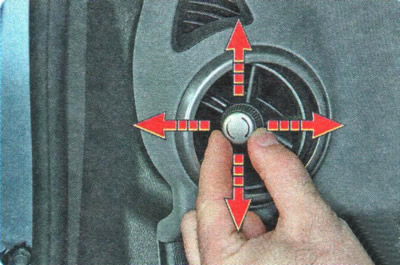
The direction of the air flow through the side nozzles is changed by turning the entire nozzle with a handle installed in the center of the nozzle.
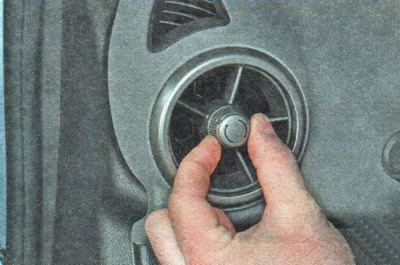
The amount of air supplied through the nozzles is regulated by the handles located in the center of each nozzle. When the handle is turned counterclockwise until it stops, the damper opens completely (maximum air flow). When turned fully clockwise, the damper closes completely, blocking the air flow.
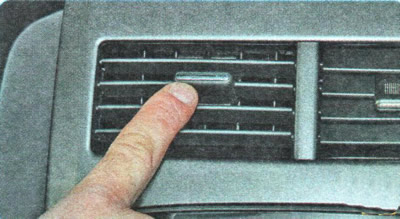
The direction of the air flow through the central nozzles is changed by turning the flaps upwards with a handle installed in the center of the nozzle...
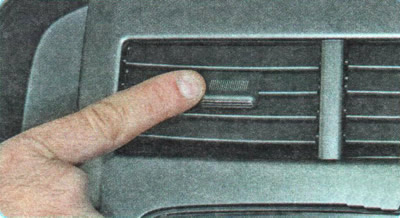
...or down...
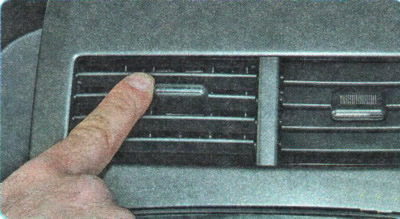
...or blinds to the right...
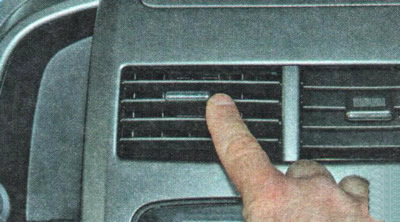
...or left.
The amount of air supplied through the nozzles is not regulated. The intensity of air supply depends only on the rotation frequency of the electric fan.
Depending on the configuration, the vehicle may be equipped with a manual air conditioner or only a heating and ventilation system. This subsection describes in detail the controls of the manual air conditioning system as more complex and having the most complete set of functions.
The control units of the air conditioning systems with manual control and heating are unified in terms of controls. The control algorithm and the location of the controls in both units are almost identical. The difference is the absence of an air conditioner switch in the heating and ventilation system unit (a decorative plug is installed instead).
USEFUL TIPS: For more efficient ventilation and heating at vehicle speeds below 50 km/h and when driving on particularly dusty road sections with the windows closed (to create excess air pressure in the cabin, preventing dust suction) we recommend turning on the heater fan switch at low or maximum speed.
To quickly eliminate fogging of the rear window and free it from ice and snow, turn on the heated glass switch.
If you do not use the air conditioner for a long time, it is necessary to turn it on briefly once a week with the engine running to restore the lubricant layer on the compressor parts and seals.
[The original article is on the website: «CHEVYMAN.ru»]