


Search for external leaks
1. Check the fluid level in the master cylinder reservoir. A slight decrease in the fluid level can be considered normal, which is explained by the wear of the brake linings. If the level drops noticeably, one can assume that there are leaks in the system.
2. If the fluid level is unacceptably low, adjust the fluid level.
3. Start the engine at idle speed.
4. Press the brake pedal with moderate force. Keep the pedal pressed without increasing the force. If the brake pedal gradually drops, there is a leak in the system.
5. Turn off the ignition.
6. Inspect:
- brake master cylinder fittings;
- all brake pipe and hose connection points;
- brake pipes and hoses by length;
- brake calipers.
Look for brake fluid leaks, excessive corrosion and/or damage. Pay particular attention to the connections of tubes and hoses.
7. While a thin film of fluid around the master cylinder reservoir is normal, it is unacceptable elsewhere in the system. Make any necessary repairs.
Search for internal leaks
1. Start the engine at idle speed.
2. Apply light, constant pressure to the brake pedal. Observe the pedal's behavior.
3. Release the brake pedal and turn off the ignition.
4. If the brake pedal is "soft" but the pedal travel is not too large, perform the following operations:
- a) Inspect the brake system for external leaks.
- b) Bleed the brake system.
5. If the brake pedal is "hard" but the brake pedal travel is large, perform the following operations:
- a) Loosen the nuts securing the master cylinder to the brake booster.
- b) Carefully separate the master cylinder from the booster just enough to allow inspection of the bearing surface of the master cylinder.
- c) Inspect the bearing surface. Look for signs of brake fluid leakage in the area of the primary piston (2).
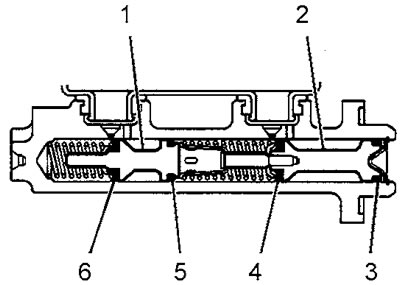
6. If there is a leak in the area of the primary piston (2), then the seals (3) and/or (4) of the primary piston may be damaged, carry out the necessary repairs or replace the master brake cylinder.
7. If there are no leaks in the area of the primary piston (2), bleed the brake system.
8. If the brake pedal is "hard" and the pedal travel is not excessive, but gradually and constantly increases, then the master brake cylinder needs to be repaired or the seals (5) and/or (6) of the secondary piston (1) need to be replaced.
9. If the brake pedal is "hard" and the pedal travel is not excessive, but gradually increases and then stabilizes at one level, then the pressure modulator valve may be leaky, replace the valve.
[The article is based on data from the website «ChevyMan.ru»]