
ChevyMan.ru
Mazda Mitsubishi Toyota Land Rover Honda Kia Nissan
English Русский
Български
Беларускі
Український
Српски
Hrvatski
Română
Polski
Slovenský
Magyar
|
Articles | Sitemap | Contacts |


Home   Aveo   Captiva   Cruze   Lacetti   Lanos   Niva   Tahoe   Others  
Tahoe 2 and 3 (2000-2014) Tahoe 1 (1992-2000)
  • Home
  • Tahoe
  • 2 (2000-2014)
  • General information
  • Maintenance
  • Checking the end of compression stroke pressure

Checking the end of compression stroke pressure (Chevrolet Tahoe 2)

            0

1. Before checking, check the level and condition of the engine oil, the condition of the starter and battery.

2. Before starting the verification procedure, check:
  • engine oil condition and level;
  • the condition of the battery and its charge level. The battery must be fully charged.

3. Disconnect the high-voltage wires from the spark plugs (see section "Spark plugs").
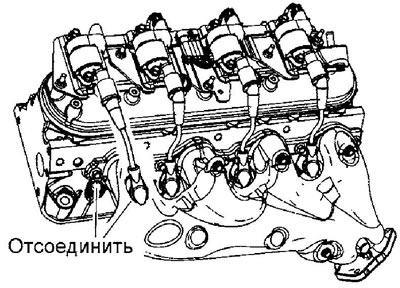
3. Disconnect the high-voltage wires from the spark plugs (see section «Spark plugs»).


4. Remove all spark plugs.

5. Perform the procedures necessary to prevent the engine control module from commanding fuel injection and ignition.

6. Cover the spark plug holes with a clean rag and, after turning the crankshaft with the starter, check that there are no foreign particles on the rag.

Attention:
  • Stay clear of the spark plug holes while cranking the engine with the starter.
  • If during the measurement of the pressure at the end of the compression stroke in the cylinder (as a result of cracks appearing) if coolant, oil, fuel, etc. gets in, these substances will heat up and fly out of the spark plug hole under pressure, which is a dangerous phenomenon.


7. Install the compression gauge into the spark plug hole.

8. Turn the engine crankshaft with the starter at fully open throttle and measure the pressure at the end of the compression stroke.


The difference between the minimum pressure value in one of the cylinders and the maximum value in one of the cylinders must not exceed 70% of the maximum value.

9. If the end-of-compression pressure in any cylinder is below the minimum permissible value or the difference in end-of-compression pressure between cylinders exceeds the maximum permissible value, then pour a little engine oil into the spark plug hole of that cylinder and repeat the measurements in step "8".

Attention:
  • If, after filling with oil, the pressure at the end of the compression stroke has increased, then the cause of the malfunction is wear or damage to the piston ring and/or cylinder bore.
  • If after filling with oil the pressure at the end of the compression stroke does not increase, the reasons are burnt or damaged valve seat, or gas (pressure) leakage through the cylinder head gasket.


10. Install the spark plugs.

11. Connect the high-voltage wires to the spark plugs.

The article was checked: Vladimir Romannikov
This article is available at russian, bulgarian, belarusian, ukrainian, serbian, croatian, romanian, polish, slovak, hungarian

Share information:

Previous articles
Tahoe 2 and 3: Maintenance
Next articles

Spark plugs
Removal and installation the battery
Checking the battery status
Fuel filter
Replacing the coolant
Attachment drive belt
Automatic transmission fluid
Transfer case oil
Front axle gearbox oil
Rear axle gearbox oil


See similar articles on the topic of Chevrolet cars:
Checking the compression in the cylinders Chevrolet Aveo T300 (2012-2018)
Checking the compression pressure Chevrolet Captiva 1 (2006-2018)
Checking the compression in the cylinders Chevrolet Cruze 1 (2008-2016)
Checking the condition of wheels and tires Chevrolet Lacetti 1 (2002-2009)
Checking the Manifold Absolute Pressure Sensor Chevrolet Lanos T150 (2002-2009)
Checking the performance of the pressure regulator Chevrolet Niva 1 (2002-2016)
Checking the compression in engine cylinders and diagnostics with vacuum measurement Chevrolet Trailblazer 1 (2001-2008, petrol)
Link in different formats to this page


Visitor comments

No comments yet


How much will 47 + 34 =


Tahoe 2 and 3 (2000-2014) 
  • General information
  • Vehicle characteristics
  • Vehicle device
  • Manual
  • Maintenance
  • Power unit
  • Engine repair
  • Engine overhaul
  • Cooling system
  • Injection and control system
  • Exhaust system
  • Engine electrical equipment
  • Transmission
  • Automatic gearbox 4L60, 4L65, 4L70
  • Automatic gearbox 6L50, 6L80, 6L90
  • Transfer case
  • Drive shafts and cardan
  • Front drive axle
  • Rear drive axle
  • Chassis
  • Car suspension
  • Steering
  • Brake system
  • Body (until 2007)
  • Exterior (external elements)
  • Interior (internal elements)
  • Doors, locks and windows
  • Heating and air conditioning
  • Security System (SRS)
  • Body (since 2007)
  • Exterior (external elements)
  • Doors, locks and windows
  • Interior (internal elements)
  • Electrical equipment
  • Electrical appliances (until 2007)
  • Lighting and lamps (until 2007)
  • Audio system (until 2007)
  • Electrical appliances (since 2007)
  • Lighting and lamps (since 2007)
  • Audio system (since 2007)
  • Wiring diagrams (2000-2005)
  • Wiring diagrams (2005-2007)
  • Wiring diagrams (since 2007)


Tahoe 1 (1992-2000) 
  • General information
  • User manual
  • Maintenance
  • Power unit
  • Engine in a car
  • Engine removed
  • Cooling system
  • Heating and air conditioning
  • Fuel and exhaust systems
  • Decreased toxicity
  • Transmission
  • Manual gearbox
  • Automatic gearbox
  • Transfer case
  • Clutch and drive shafts
  • Chassis
  • Brake system
  • Car suspension
  • Steering
  • Body
  • Repair of body elements
  • Electrical equipment
  • Engine electrics
  • Equipment and devices
  • Electrical circuits


ChevyMan.ru © 2017-2026 · Mobile version · Feedback · Site search · Interesting to read · Sitemap: EN BG BY UA RS HR RO PL SK HU

Aveo 2003-2008 · Aveo 2006-2011 · Aveo 2012-2018 · Captiva 2006-2018 · Cruze 2008-2016 · Lacetti 2002-2009 · Lanos 2002-2009 · Niva 2002-2016 · Tahoe 1992-2000 · Tahoe 2000-2014 · Lumina 1 1989-1994 · Trailblazer 1 2001-2008 · Orlando 1 2010-2018 ·
🛡️ For your security and to improve our service, this site uses cookies. You can disable them in your browser.