


Contents: Removal and installation ↧ Examination ↧
Removal and installation
1. Disconnect the high-voltage wire from the spark plug.
- a) Turn the spark plug wire tip half a turn.
- b) Pull the tip to disconnect the wire.
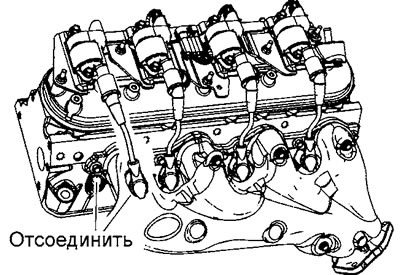
2. Clean the area around the spark plug. Blow with compressed air if necessary.
3. Remove the spark plug. If you remove several spark plugs, mark their installation locations.
Tightening torque:
- new spark plugs 20 Nm
- used 15 Nm
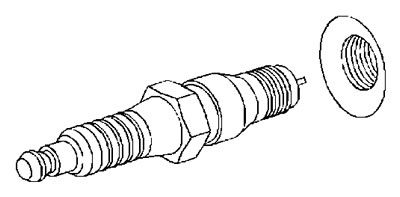
4. Installation is carried out in the reverse order of removal.
Examination
Note: the car manufacturer recommends replacing spark plugs with platinum or iridium electrodes every 100,000 km of the car's mileage, and regular spark plugs every 45,000 km. However, given the quality of gasoline in the CIS countries, it is recommended to replace spark plugs when they actually fail.
Caution: For spark plugs with platinum or iridium electrodes:
- Replace the spark plug if the gap limit is exceeded.
- Do not attempt to adjust the gap on these spark plugs.
- Cleaning these spark plugs may damage the electrode coating. Therefore, use a spark plug cleaner to remove carbon deposits and clean the spark plug completely for no more than 20 seconds to avoid damaging the electrode coating. Do not use a wire brush.
1. Inspect the spark plug wire terminal (1) for damage. Check that the terminal is securely screwed on (it shouldn't rotate).
Inspect the insulator (2), check for cracks or soot deposits. Cracks or soot cause breakdown between terminal (1) and ground instead of breakdown between electrodes (3) and (4).
Shake the spark plug: a rattling sound indicates internal damage to the spark plug (a loose fit of the central electrode (4) reduces the power of the spark discharge).
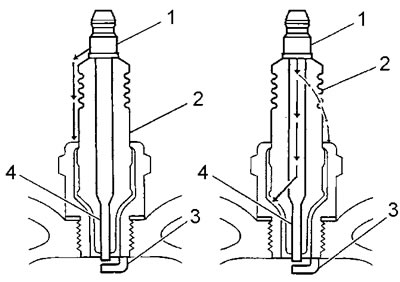
Inspect the area of the spark plug protruding from the cylinder head. Dirty or damaged threads indicate improper installation of the spark plug.
During normal spark plug operation, the color of the insulator changes from gray-yellow to brown with small inclusions of a powdery substance (combustion products of additives in fuel and oil).
Dry and fluffy carbon deposits can be caused by the following:
- a) Rich air-fuel mixture:
- leaking injectors;
- excessive fuel pressure;
- dirty air filter;
- incorrect combustion.
- b) Low output voltage:
- ignition coil defect;
- spark plug wire defect;
- incorrect gap between spark plug electrodes.
- c) Long-term operation at idle or low speeds.
2. Make sure the correct spark plugs are installed. Using the wrong type of spark plug will cause poor engine performance.
3. Measure the gap between the center electrode and the ground electrode. An excessively large gap may cause the spark plug to fire irregularly.
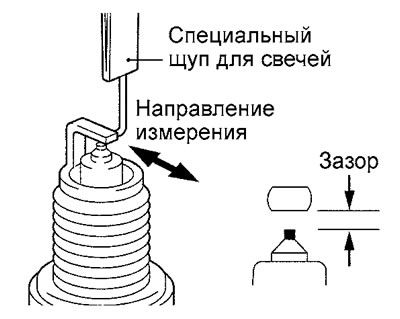
Recommended spark plugs:
- Models produced before 2007:
- NGK — Part # 12567759
- AC - Part # 25171803
- ACDelco - Part # 41-974
- Nominal clearance - 1.5 mm
- Models since 2007:
- GM - Part # 12571164
- ACDelco - Part # 41-985
- Nominal clearance - 1.0 mm
[The original text can be found on the website ChevyMan]