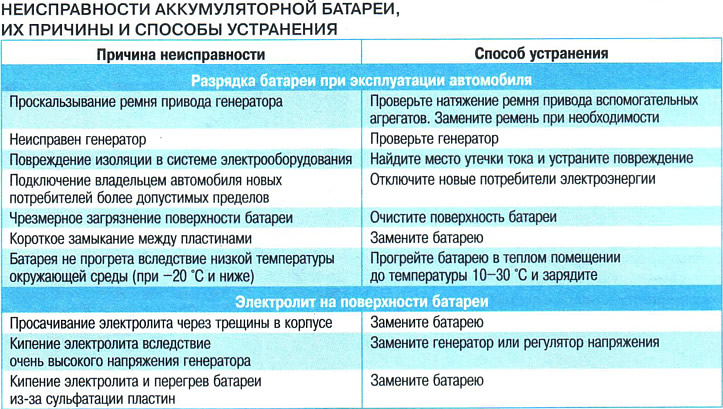


NOTE: The principle of operation of lead-acid batteries is based on the electrochemical reactions of lead and lead dioxide in a sulfuric acid environment. During discharge, lead dioxide is reduced at the cathode and lead is oxidized at the anode. During charging, reverse reactions occur, to which the reaction of water electrolysis is added at the end of charging, accompanied by the release of oxygen at the positive electrode and hydrogen at the negative.
A modern car is filled with various consumers of electricity, electronic devices, starting with the audio system and ending with electronic engine control units, gearbox, anti-lock braking system, airbags, etc. In the damp off-season, especially in winter, all car electrics and electronics, and first of all the car battery, pass the endurance test.
As practice shows, if problems with starting the engine in the cold season begin and to solve them you constantly have to recharge the battery, provided that the generator is in good working order and the tension of the auxiliary drive belt is normal, and the service life of the battery exceeds 3 years, it is quite reasonable to consider buying a new battery.
Modern batteries are usually of two types:
- maintenance-free throughout the entire service life;
- low-maintenance, requiring topping up with distilled water once or twice a year.
It is advisable to choose a maintenance-free battery for your car, taking into account the manufacturer's recommendations, from a wide range of car batteries from various manufacturers presented on the car parts market.
It is necessary to remember that at low temperatures, due to the increase in the viscosity of the engine oil and the deterioration of the conditions for ignition of the fuel, the power consumed by the starter when starting the engine increases two to three times. The start time of a cold engine in comparison with a warmed up one in some cases increases by 10-20 times. Thus, in winter at low air temperatures, increased requirements are imposed on the starter characteristics of the battery, i.e. on its ability for a short time (10 sec according to GOST) to produce the required current necessary for the starter to operate at the nominal speed of its anchor in the cold season (-18°C according to GOST).
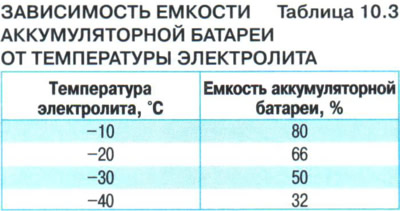
Table 10.3 shows the dependence of the battery capacity on the electrolyte temperature. The battery capacity is shown as a percentage of the capacity that the battery is capable of delivering at 25°C.
A lead-acid battery element consists of positive and negative electrodes, separators (dividing gratings) and electrolyte. The positive electrodes are a lead grid in which the active substance is lead peroxide (PbO₂). The negative electrodes are also a lead grid with spongy lead as the active substance. In practice, 1-2% antimony is added to the grid lead to increase mechanical strength. Currently, calcium salts are used as an alloying component in both plates or only in the positive ones (hybrid technology). The electrodes are immersed in an electrolyte consisting of an aqueous solution of sulfuric acid (H₂ SO ₄). The highest conductivity of this solution is at room temperature (which means the lowest internal resistance and the lowest internal losses) is achieved with its density of 1.26 g/cm³. However, in practice, in regions with cold climates, higher concentrations of sulfuric acid are used - up to 1.29-1.31 g/cm³. This is done because when a lead-acid battery is discharged, the density of the electrolyte drops and its freezing temperature becomes higher, a discharged battery may not withstand the cold.
NOTE: In new battery designs, lead plates (grids) are replaced with foamed carbon coated with a thin lead film, and the liquid electrolyte is gelled with silica gel to a paste-like state. Using less lead and distributing it over a larger area, the battery is made not only more compact and lighter, but also significantly more efficient: in addition to greater efficiency, it charges significantly faster than batteries of previous generations.
The battery elements are located in a polypropylene monoblock (housing) and are covered by a common lid, inseparably connected to the monoblock. Ventilation holes on the sides of the battery in the upper part provide an outlet for a small amount of gas formed in it.
WARNING: Batteries of the same model can be manufactured in two versions with different connection polarity (the positive and negative terminals of batteries of different versions are located oppositely). Purchase a battery of the same polarity as the one installed in the vehicle, since a battery of a different polarity cannot be connected to the on-board network due to insufficient length of wires and mismatch of the sizes of their tips. In addition, some manufacturers produce batteries with reduced terminal sizes (another standard), which also cannot be connected to your vehicle's on-board network.
When working with metal tools, avoid short-circuiting the battery.
When charging the battery, an explosive gas mixture is formed, so do not smoke near the battery or use open fire during charging or servicing. Charge the battery in a well-ventilated area.
If electrolyte accidentally splashes onto your skin or into your eyes, immediately rinse the affected areas with plenty of water and then with a 2% solution of baking soda until medical assistance is provided (0.5 teaspoon per glass of water).
After any work with the battery, be sure to wash your hands with soap.
NOTE: Instead of the standard maintenance-free battery, you can install any battery similar in voltage, capacity, mounting dimensions and connection polarity. In this case, use and maintain the battery in accordance with the instructions attached to it.